
With the continuous development of bilingual education policies in the United States, Chinese language education is facing new opportunities and challenges.
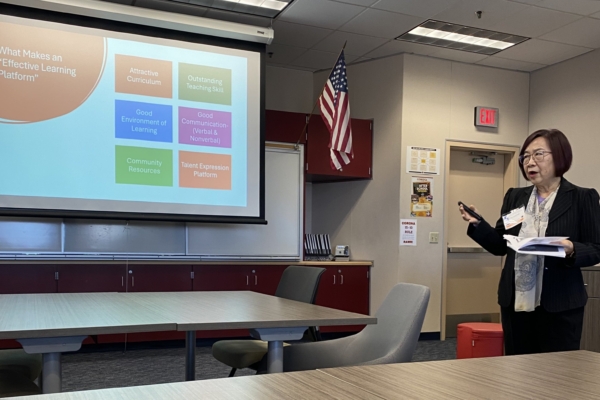
The Riverside branch of the California Association for Bilingual Education (CABE), with a history of 51 years, recently held its annual conference at Corona High School. At the conference, Ché Qīngyú, principal of Zhōngshān Chinese School and former president of the Southern California Chinese School Association, as the only Chinese representative, delivered a keynote speech on the development trends of Chinese language teaching under California’s bilingual policy, providing forward-looking perspectives on the localization and mainstreaming of Chinese language education.
The conference, held on January 31st (Saturday), brought together 18 education professionals, including teachers, principals, district administrators, and parent representatives, to collectively discuss the practicalities and policies of bilingual education.
Principal Ché Qīngyú delved into the topic of “Effective Bilingual Education Platform”, analyzing in depth how Chinese language teaching can collaborate with California’s promotion of “Dual Language Immersion” to establish a cooperative platform.
Facing the California government’s goal of having 1,600 schools offering dual language immersion programs by 2030, she emphasized that if “Chinese language heritage education” can effectively align with the public school system, it will significantly enhance teaching depth and students’ language proficiency, creating a mutually beneficial win-win model.
In terms of teaching methods, Principal Ché Qīngyú introduced the TPRS (Teaching Proficiency through Reading and Storytelling) approach. This method combines the concept of “Transformative Education”, utilizing storytelling and contextual teaching to allow students to naturally use language in real-life experiences, not only enhancing language proficiency but also fostering creativity and critical thinking skills.
Ché Qīngyú also detailed the specific platforms for “Chinese language heritage education”, covering K-12 and adult education. She specifically mentioned academic competitions, speech contests, and traditional festival cultural activities organized by the Southern California Chinese School Association, aimed at strengthening students’ dual abilities in language and culture.
Furthermore, regarding the promotion of “Expanded Learning” in various districts, Ché Qīngyú advocated for public school districts to collaborate with traditional Chinese schools to develop after-school diverse and experimental teaching programs, deepening bilingual literacy, cultural experiences, and professional skill cultivation, allowing Chinese language learning to extend beyond the classroom and integrate into the community.
On the community and international cooperation front, Ché Qīngyú pointed out that since the signing of the “US-Taiwan Education Initiative” in 2020, there has been increasingly close cooperation in Chinese language education. The “Taiwanese Chinese Language Learning Centers” (TCML) established in 2021 now number 68 nationwide, including 7 in California. As the initiative enters its second stage of development, TCML offers a more convenient Chinese language learning platform for adults.
Taking Zhōngshān Chinese School as an example, the school is currently cooperating with the municipal government to provide professional Chinese language courses for city officials, particularly focusing on language training for personnel in the medical and public service sectors to enhance communication accuracy and efficiency with the Chinese immigrant community, directly serving frontline public services through Chinese language education.
Through the exchanges at the CABE conference, Chinese language education, within the framework of California’s bilingual policies, is gradually integrating official, educational, and community resources. In California’s progress towards the 2030 bilingual education goals, drawing on the diverse learning platforms provided by Chinese schools will become an important force in promoting Chinese language education and deepening educational cooperation between Taiwan and the United States.