
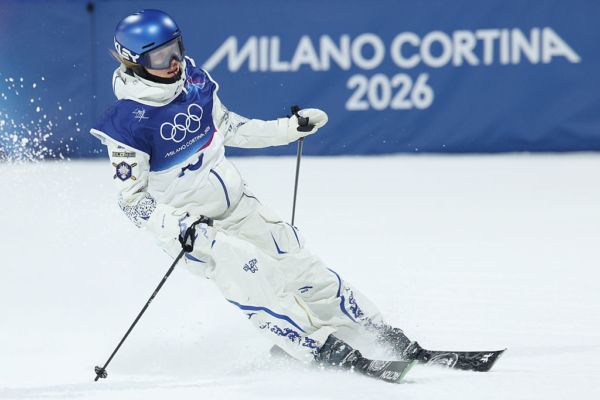
In 2025, details of the payment made by the Beijing Sports Bureau to freestyle skiing champion Gu Ailing were unexpectedly exposed, leading the authorities to quickly delete related information from documents and the internet.
At the beginning of 2025, it was revealed in the financial budget of the Beijing Sports Bureau that a total of 48.148 million yuan (approximately 6.6 million US dollars) was allocated for training guarantees for American skier Gu Ailing and figure skater Zhu Yi. It was also disclosed that in 2023 alone, Gu Ailing received over 47 million yuan in training fees.
Gu Ailing’s freestyle skiing career has been marked by significant commercial success from the start. This American-born star initially represented the United States in international competitions, winning a gold medal at the Freestyle Skiing World Cup in 2019. However, in June of the same year, she made the sudden decision to compete for China, achieving two gold and one silver medals at the 2022 Beijing Winter Olympics. At this year’s Milan Winter Olympics, the 22-year-old is once again representing China.
Gu Ailing is now one of the most popular sports stars in China and serves as the face of many international brand advertisements. Not only for her camera-friendly charm, but also for her ability to penetrate the Chinese market.
According to a report released by Forbes in December 2025 on the highest-earning female athletes globally, Gu Ailing ranked fourth, following tennis players Coco Gauff, Aryna Sabalenka, and Iga Światek.
The news of Beijing’s significant financial support for American athletes sparked widespread attention, leading the Sports Bureau to swiftly remove the athlete’s names from the budget, resulting in various media outlets, including Caixin, having their articles deleted across all platforms.
According to archived reports on Caixin, the Beijing government indicated that 2022 Beijing Winter Olympics gold medalist Gu Ailing, figure skater Zhu Yi, signed contracts with the Beijing Sports Bureau to continue representing Beijing and aim for success at the 2026 Milan Winter Olympics.
Given Beijing Sports Bureau’s total budget of 191 million yuan in 2025, the training fees provided for Gu Ailing and Zhu Yi exceeded 25% of the bureau’s total budget.
Amidst tight budgets for basic public services, these substantial allocations have sparked shock and criticism among the Chinese public. Related comments on social media have also been deleted.
Gu Ailing recently competed again and is considered a strong contender for gold at the Milan Winter Olympics, hoping to continue her success from the Beijing Winter Olympics. She has already won a silver medal in the Freestyle Skiing Slopestyle event and is set to participate in big air and halfpipe events.
Although Gu Ailing must acquire Chinese citizenship to represent China in competitions, her complete nationality remains a mystery. Due to the Chinese government’s prohibition of dual citizenship, she has consistently refused to disclose her nationality details.
“I am American when I’m in the US,” she said in 2020. “But when I’m in China, I am Chinese.”
In fact, Gu Ailing’s participation as part of the Beijing team in 2022 had previously sparked nationality controversies. However, this time, the victory of American-born Chinese figure skater Liu Mexian caused a renewed debate on values on the internet.
Liu Mexian became the youngest national champion in American figure skating at the age of 13 and won the team figure skating gold medal for Team USA at the 2026 Milan Winter Olympics following a brief retirement at 16.
Whether it’s her father Liu Jun’s escape experience during the Tiananmen Square protests or their refusal to be recruited by the Chinese communist regime, these stories have garnered widespread recognition among Americans, viewing Liu Mexian as a culmination of the “American Dream.” These narratives have ironically become a contrast for Gu Ailing.
Some Americans openly criticized Gu Ailing for her perceived double standards, aligning herself with Beijing, navigating the gray area of nationality, and reaping benefits from both China and the US.
Even her once-popular statement of being “Chinese when in China and American when in the US” has been reinterpreted by American netizens as “bearing the burden of trying to take advantage of two countries,” with sentiments stating, “she wins for China and loses to drag down America.”
Chinese citizens are also discontent with Beijing’s expenditure of nearly 100 million yuan in fiscal funds for these two foreign athletes.
On social media platforms, Chinese netizens have posted comments such as, “The inclusion of training expenses in the financial budget has raised concerns. The annual amount exceeds 47 million yuan. Behind the gold medals lies the hard-earned money of ordinary people. Would you support such gold medals?”
Another netizen mentioned, “Individual training expenses included in the Beijing municipal government’s financial budget amount to over 47 million yuan. If calculated based on the monthly allowance for rural low-income people at 500 yuan per person, her annual training expenses could support 80,000 people.”