
With the Chinese New Year approaching, the U.S. Consulate General in Shenyang recently posted a “Global New Year’s Greetings” video on its official Weibo account. Shortly after, the U.S. Embassy in China also shared it on their official WeChat account, causing it to go viral overnight across the internet.
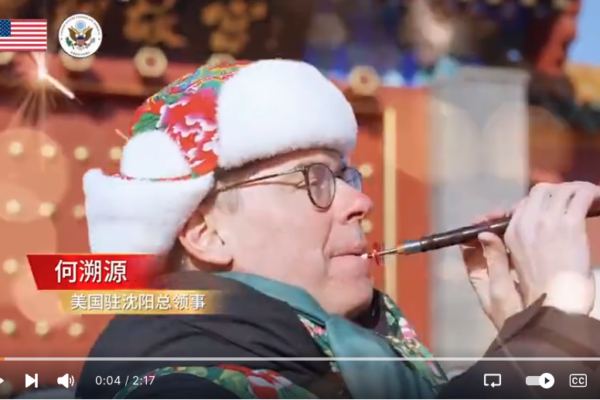
The video features William M. Coleman, IV, the U.S. Consul General in Shenyang, leading a group of diplomats in a lively performance wearing traditional embroidered jackets at the entrance of the Shenyang Imperial Palace, singing and dancing, creating a vibrant atmosphere.
Lyrics like “The black earth nurtures our parents,” “When brothers gather, we must have a feast,” “I love you so much, my hometown,” and “The yangge dance brings joy to people” are all authentically northeastern in flavor and were sung with passion and authenticity.
The U.S. Consulate in Shenyang revealed that most of these diplomats were learning to sing Chinese songs for the first time.
In their Weibo post, the U.S. Consulate in Shenyang exuded sincerity and humor.
The article mentioned how Consul General William M. Coleman, IV, has been busy this winter, not only learning the basic steps of the northeastern yangge dance but also leading his American colleagues to tackle the popular song “My Hometown in Northeast China.”
“In this instance, we greet the people of Northeast China through song: Wishing you great fortune in the Year of the Horse!”
“Fun fact: Most of the people in the video are singing a Chinese song for the first time. So here’s a question: Which lyric ‘knocked down’ all of our American colleagues?”
“Feel free to guess in the comments section! The first three netizens to guess correctly will receive a limited-edition Eagle Little Mei doll for the (Chinese New Year)!”
“Special thanks to #My Hometown in Northeast China# original singer, Teacher He Yu, for authorizing and supporting this video, allowing this enthusiasm and blessings from the United States to be seen by more people.”
Internet users were thrilled by the release of the New Year song by the U.S. Embassy in China, especially as American diplomats sang “My Hometown in Northeast China” in Chinese.
Responses in the comments section were lively and enthusiastic. Some exclaimed, “The moon is drunk, warming my heart.”
In contrast to not letting Chinese people celebrate Christmas, some lauded this display as true cultural confidence.
One individual remarked, “Long live China-U.S. friendship.”
Northeasterners were elated by the performance, with one stating, “Wow, the Americans sang so well!”
Others humorously suggested, “Uh-oh, are Northeasterners now behind Canada, Greenland, and Iceland (also joining the U.S.)?”
Another commenter praised the Americans for respecting intellectual property rights, even reaching out to the original creators for a non-profit short video.
William M. Coleman, IV, is known as a “China expert” and a “language prodigy” in diplomatic circles.
According to the U.S. Embassy in China’s website, William M. Coleman, IV, was born in North Carolina and holds a Ph.D. in Chinese and Tibetan History from Columbia University, as well as master’s degrees from the National Defense University and the University of Hawaii, and a bachelor’s degree from Furman University. He is fluent in Chinese, Japanese, Korean, Turkish, and Tibetan.
William M. Coleman, IV, is a senior American diplomat who assumed the position of Consul General at the U.S. Consulate in Shenyang on August 13, 2024. During his 21-year tenure at the U.S. State Department, he held leadership positions in public diplomacy in East Asia and the Pacific region, as well as Europe. His most recent position was spokesperson for the Bureau of East Asian and Pacific Affairs and from 2018 to 2021, he served as a spokesperson for the U.S. Embassy in South Korea. His other overseas assignments include Shenyang, China; Tokyo, Japan; Istanbul, Turkey; and Chengdu, China.
The history of the Shenyang Consulate General can be traced back to 1904, but it closed in 1949 upon the establishment of the People’s Republic of China and reopened in 1984 after the normalization of U.S.-China relations.