
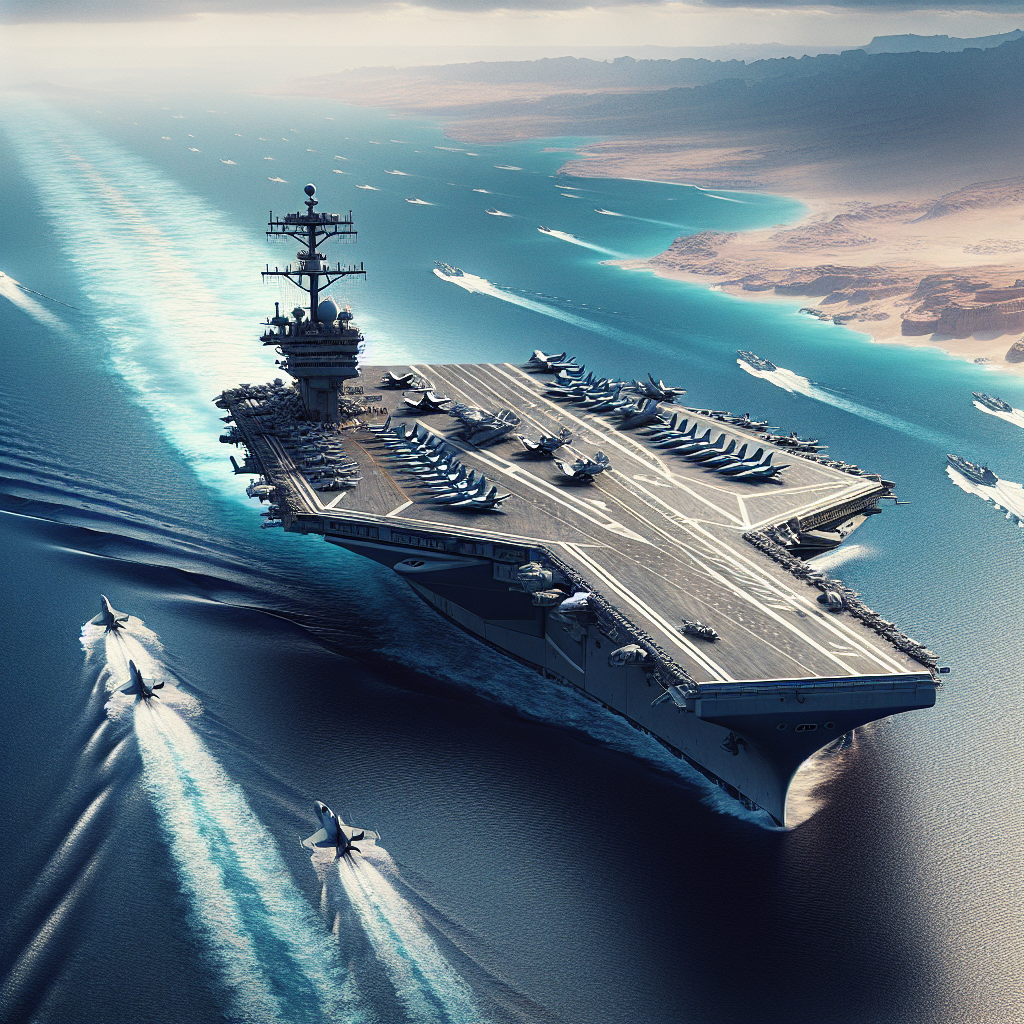
On February 13, multiple American media outlets reported that the world’s largest aircraft carrier, the USS Gerald R. Ford, is heading towards the Middle East. This move signals the imminent gathering of two U.S. aircraft carriers and their strike groups near Iran. President Trump’s decision to do so seems aimed at increasing military pressure on Iran and pushing them to make concessions in nuclear negotiations.
According to reports from the Associated Press, individuals familiar with the plan confirmed that the USS Gerald R. Ford and accompanying warships will be deployed to the Middle East. Previously, the USS Gerald R. Ford was repositioned from the Mediterranean to the Caribbean in October of last year. In early January of this year, during a U.S. military operation that targeted Venezuela and led to the arrest of the country’s president, “Ford” was part of the massive U.S. military presence gathered near that nation. Now, it is redirecting towards the Middle East.
At the end of January, another U.S. aircraft carrier, the USS Abraham Lincoln, and its strike group had already arrived in the Persian Gulf.
The presence of two American aircraft carriers and accompanying warships in the Middle East is a rare occurrence and further intensifies pressure on the Iranian regime.
President Trump’s decision to deploy the USS Gerald R. Ford aims to exert more significant pressure on Iran, prompting progress in nuclear negotiations.
On February 6, the U.S. and Iran held indirect talks in Oman. Iranian representatives met with the Omani Foreign Minister, who then met with U.S. representatives to convey Iran’s position. After the negotiations, both sides agreed to continue discussions.
Subsequently, President Trump hinted at the possibility of a new round of negotiations with Iran but substantive talks have yet to take place. This week, Iran sent a senior official to visit Oman and Qatar, using these countries as intermediaries to communicate with the U.S. rather than engaging in direct negotiations.
The negotiations between the U.S. and Iran face significant challenges, primarily due to the substantial differences in their positions.
Reports indicate that during the talks in Oman, Iran demanded that the U.S. first lift some economic sanctions before proceeding to the next round of negotiations, particularly those affecting the country’s oil exports and banking system.
However, the U.S. insisted on not granting economic benefits to Iran without nuclear restrictions and thus rejected this request.
The U.S.’s demands include Iran ceasing high-grade uranium enrichment, limiting its ballistic missile program, halting arms provision to proxies, and improving its treatment of domestic protesters.
Iran, on the other hand, explicitly stated it would only discuss uranium enrichment and excluded ballistic missiles from the current negotiation scope.
On Thursday, February 12, President Trump warned Iran that failing to reach an agreement with the U.S. would result in “very painful” consequences.
When asked about the timeline for reaching an agreement on Iran’s nuclear program, he said, “I think very soon, about next month, pretty much. It should happen quickly. They should reach an agreement soon.”
The day before, President Trump met with Israeli Prime Minister Netanyahu in the White House, holding lengthy discussions.
President Trump stated that negotiations with Iran need to continue, as Netanyahu urged the U.S. to pressure the Iranian regime to reduce its ballistic missile program and end support for Hamas and Hezbollah.
Ahead of this meeting, President Trump told the media that he was considering sending a second aircraft carrier strike group to the Middle East.
The USS Gerald R. Ford is the world’s largest and most advanced aircraft carrier, as well as the first of the Ford class in the U.S. Navy. It has a full load displacement of up to 100,000 tons, a length of 337 meters, a flight deck width of 78 meters, and can reach speeds exceeding 30 knots (approximately 56 kilometers per hour).
Being a nuclear-powered aircraft carrier, it has virtually unlimited endurance and can accommodate 2,600 crew members along with 2,480 carrier air wing personnel.
The aircraft complement is similar to the Nimitz class but more efficient, including F/A-18E/F Super Hornets, EA-18G Growler electronic warfare aircraft, E-2D Advanced Hawkeye early warning aircraft, and MH-60R/S Seahawk helicopters, with plans for F-35C and MQ-25 unmanned aerial refueling aircraft.
The simultaneous presence of two U.S. aircraft carriers in the Middle East is a rare occurrence. Apart from this instance, such deployments have only occurred four times in the past 20 years.
Around the time of the Iraq war in 2003, two to three aircraft carriers were deployed in the Gulf region simultaneously due to wartime mobilization.
During the peak of the Iran nuclear crisis in 2010-2011, two aircraft carriers were present due to carrier rotations. At that time, Iran’s nuclear program was rapidly advancing, leading to international suspicions of its pursuit of nuclear weapons, subsequently leading the U.S. and the EU to impose severe economic sanctions on Iran.
Amid the crisis in the Strait of Hormuz in 2019, both the USS Lincoln and the USS John C. Stennis briefly appeared. The year prior, during Trump’s first term in office, the U.S. withdrew from the Iran nuclear deal and began implementing “maximum pressure” on Iran. Iran attacked multiple oil tankers passing through the Strait of Hormuz.
In 2020, after the U.S. targeted and killed a key Iranian general, Qasem Soleimani, the USS Harry S. Truman and the USS Dwight D. Eisenhower were both briefly present in the Middle East.
(The article referenced reports from the Associated Press)