
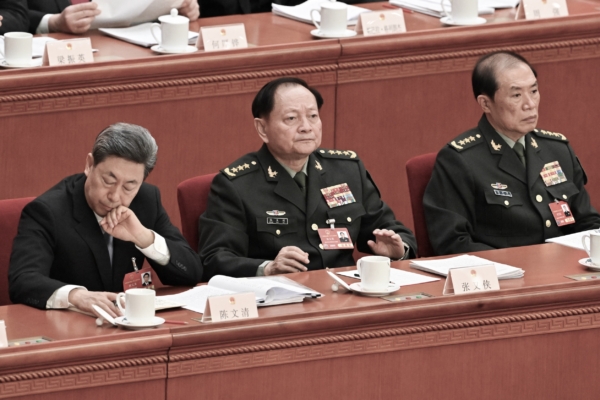
Since the fall of Zhang Youxia, Vice Chairman of the Central Military Commission of the Chinese Communist Party, and Liu Zhenli, a member of the Military Commission, on January 24th, rumors of internal power struggles within the CCP, especially the instability of military morale, have been ongoing. As the Chinese New Year approached, Xi Jinping’s regime released gestures to appease the military. Experts believe that the “purging” of Zhang Youxia has become Xi’s nightmare, turning Xi from controlling the military to “defending against the military,” and these appeasement actions may not be effective.
Leading up to the Chinese New Year, Xi Jinping visited the August 1st Building in Beijing on February 10th to inspect the military’s combat readiness via video call and express his regards to the troops. State media reported that Xi claimed the soldiers “follow the Party, are tough, and are trustworthy.”
It has been a traditional activity for the Chairman of the Central Military Commission to visit the troops before the Chinese New Year. From 2013 to 2022, Xi Jinping personally visited military camps to observe frontline duty positions. However, since 2023, he has switched to video format visits. In 2024 and 2025, Xi visited the Northern Theater Command headquarters via video call only; this year, like in 2023, Xi only interacted with troops via video at the August 1st Building in Beijing.
Shen Mingshi, a researcher at the Taiwan Institute for National Defense and Security Studies, told Epoch Times that due to the arrest of Zhang Youxia and Liu Zhenli, the morale of the military may be affected, prompting Xi Jinping to boost morale. However, by using video calls, he can only reach a portion of the soldiers, which may not yield a positive outcome in terms of comforting and reassuring them.
Chinese affairs expert Wang He stated that Xi Jinping using video calls to console the military is not unprecedented, citing a similar action in 2023. This shift may be closely related to Xi’s recent health condition. Additionally, due to the unrest among the military following the Zhang Youxia incident this year, Xi may proceed with caution, avoiding physical visits to military camps to prevent potential ambushes.
“Similar to his visit to Hong Kong, he did not stay overnight, which was perceived as absurd. He is highly suspicious, so he has adopted a cautious approach, trying to remain as static as possible,” Wang He explained.
Editor-in-Chief and founder of the NPO in Shenzhen, Ai Shicheng, indicated to Epoch Times that Xi’s decision to no longer personally visit military camps is not solely due to one reason. Nonetheless, whether due to health considerations or safety concerns, this decision increases the sense of distance between him and the military, weakening his direct control over the military, and potentially sparking unease among the troops.
Vice Chairman of the Central Military Commission of the CCP, Zhang Shengmin, visited troops stationed in Beijing on February 11th to inspect grassroots units. He emphasized the need to “implement the system of the Chairman of the Military Commission” and called for “maintaining a high level of unity and security and stability in the troops,” and more.
Regarding Zhang Shengmin addressing the troops, Shen Mingshi remarked that Zhang Shengmin comes from a political background, and the acting commanders of those troops may not necessarily heed his words. He believes that the CCP’s military may still be in an unstable state.
The Standing Committee of the National People’s Congress of the CCP will convene from February 25th to 26th to deliberate on the “qualifications of individual representatives.” Whether this meeting will involve the qualifications of Zhang Youxia, Vice Chairman of the Central Military Commission, and Liu Zhenli, a member of the Military Commission, has attracted attention.
Shen Mingshi stated that at the upcoming CCP “Two Sessions” in March, Xi Jinping may prevent these two individuals from attending the NPC meeting, potentially revoking their representative qualifications before the end of this month.
“If the NPC Standing Committee meeting at the end of the month revokes the positions of Zhang Youxia and Liu Zhenli as NPC delegates, it signifies the final decision on the whole incident,” he said.
Shen Mingshi also mentioned the possibility of whether Politburo member Ma Xingrui will have his NPC delegate qualifications revoked in this NPC Standing Committee meeting, hinting that some missing senior generals may have their NPC delegate qualifications revoked.
Chinese affairs expert Wang He believes that this NPC Standing Committee meeting is relevant to the upcoming “Two Sessions” in March, and finalizing the attendance list is routine work. This meeting may not necessarily be directed at Zhang Youxia. “It is very likely that various issues within the CCP have not been resolved, and there are variables in the final verdict on Zhang Youxia.”
On February 9th, the CCP’s military newspaper published an article using the example of early CCP leader Zhang Guotao, characterized as “creating a separate central authority,” claiming that “the remnants of corruption have not been completely eradicated” and advocated for “political rectification” to eliminate them. Speculation suggests that the military newspaper was targeting Zhang Youxia through Zhang Guotao as an analogy, signaling further cleansings within the military.
Ai Shicheng stated that considering the backdrop of the CCP’s upcoming 21st Congress next year and Xi’s potential re-election, he may continue internal purges within the military. However, due to the opaque nature of internal politics, external observers can only see the surface, with internal conflicts being discreet and unpredictable.
“Xi Jinping’s way of controlling the military has shifted from leading to defending against the military. With the 21st Congress approaching, the uncertainty of political purges within the military is escalating,” he noted.
Wang He believes that Zhang Youxia holds influence within the military, and Xi Jinping is concerned that mishandling the situation may incite mutiny within the military. Therefore, after controlling Zhang Youxia for the sake of the Party, Xi may exercise some restraint in further arrests. “Nevertheless, regardless of the approach, the cleansing of Zhang Youxia has sent massive shockwaves throughout the entire military. It is Xi Jinping’s nightmare.”
Shen Mingshi indicated that Xi Jinping’s arrest of even Zhang Youxia demonstrates his unwillingness to step down at the 21st Congress and his intention to eliminate all obstacles. However, despite being in power for so long, he has failed to address China’s economic issues. If he continues in office, with the economy stagnating, and the people struggling to survive, he will face even more severe crises.