
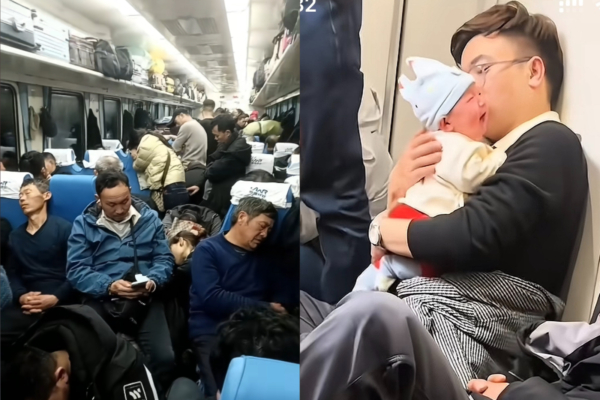
With the traditional Chinese New Year approaching, migrant workers who are away from home have started their journey back to their hometowns. However, in this era dominated by high-speed trains, a strange phenomenon has emerged during this year’s Spring Festival travel rush in mainland China. The once neglected “antique” green trains have now become the sought-after mode of transportation for millions of people returning home.
In recent days, videos showing overcrowded green trains have gone viral online. The videos depict the green trains, which were once deserted, now packed with passengers. Not only are the seats fully occupied, but the aisles are also crammed with people, some even carrying small infants.
According to reports from mainland China’s The Paper, at a time when everyone is accustomed to the speed of high-speed trains, the “antique” green trains have unexpectedly become the top choice for millions of travelers this Spring Festival. Tickets for these trains were quickly sold out as soon as they were available, with hard seat and hard berth tickets being snapped up instantly.
The reason behind this shift is not just nostalgia but also a consideration of living costs. Compared to high-speed trains, green train tickets are often only a quarter of the price or even less. For the middle and lower-income groups, migrant workers, and students working away from home, choosing the green train means substantial savings, as it is a more affordable option. While the green trains may seem outdated in terms of railway development, they have become a necessity for many travelers.
An article by a NetEase author, “History always rhymes,” pointed out that the ticket price for a green train from Beijing to Handan is just over 60 yuan. Once the tickets are released, they are immediately sold out, while high-speed train tickets are still available.
The author emphasized that the main reason for the popularity of green trains is the affordability, despite their longer travel time and less comfortable experience. Saving a few hundred yuan by taking a green train is equivalent to a day or two of wages. Being squeezed inside the train carriage may even be more bearable than going to work. As long as they arrive home safely, the saved money can be used to buy clothes for their children or prepare for the upcoming Lunar New Year. Therefore, the green trains, almost obsolete in the modern era, have become a highly sought-after option for everyone.
Not only green trains but also low-cost buses have reportedly become popular again. For example, a bus ticket from Zhuhai to Shenzhen costs only 19.8 yuan, while a high-speed train ticket is priced at over 140 yuan.
The author concluded by stating that when everyone’s time is not valuable, saving money can be seen as earning more. They expressed a wish for every hardworking individual to afford a ticket that can take them home without burdening their finances.
These discussions have sparked heated debates online. Many netizens expressed sentiments like, “Who wouldn’t want to take the high-speed train, but our pockets won’t allow it.” Others shared their experiences of opting for green train seats over high-speed trains due to the significant savings.
Ultimately, the shift towards more affordable modes of transportation reflects the economic realities faced by the general population, highlighting the challenges of livelihood. The conversation around the resurgence of green trains and low-cost buses indicates a decrease in consumer spending ability, showcasing the true state of the economy.