
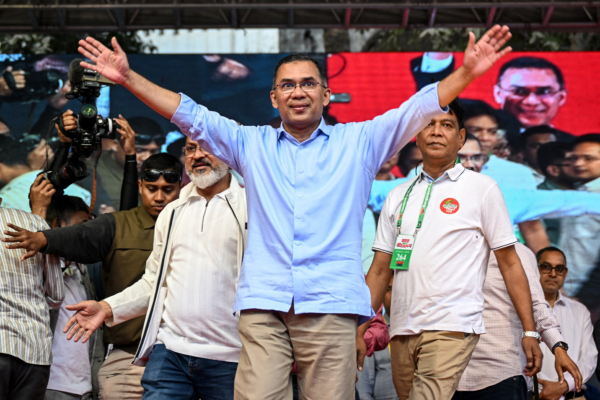
The Bangladesh Nationalist Party (BNP) declared a major victory on Friday, February 13, as they prepare to form a new government. This signifies a significant reshuffling of the political landscape in Bangladesh, with the party’s leader Tarique Rahman, who has been in exile overseas for 17 years, expected to become the new Prime Minister.
The BNP media department announced on social media platform X that the party has secured enough parliamentary seats to independently form a government. Although the final official results have not been announced by the election commission, preliminary tallies from various local media outlets indicate that the BNP has significantly crossed the threshold of 150 seats needed for governance, expected to win over two-thirds (approximately 212 seats) of the total.
BNP core committee member Salahuddin Ahmed told Agence France-Presse: “This victory was expected. The people of Bangladesh trust a party that can realize the dreams envisioned by young people during the protests, so it’s not surprising.”
At the age of 60, Tarique Rahman returned to Bangladesh last December after 17 years in exile in London. His mother, former Prime Minister Khaleda Zia, passed away in December last year.
Previously, Rahman faced multiple corruption charges during the tenure of the Hasina government. However, following the downfall of the Hasina regime in 2024, the charges were dropped, paving the way for his return to politics.
U.S. Ambassador to Bangladesh Brent T. Christensen quickly congratulated Rahman and the BNP, acknowledging their “historic victory.” He stated: “The United States looks forward to working hand in hand with your country to achieve the mutual goals of prosperity and security.”
The coalition led by the Jamaat-e-Islami party is expected to secure 70 seats, showing significant growth compared to previous elections but falling short of their governance target.
In addition to the parliamentary elections, voters also participated in a referendum on the “Reform Charter.” Known as the July Charter, the reform proposal includes limiting the Prime Minister’s term to 10 years, establishing an upper house of parliament, enhancing the President’s powers to balance the executive branch, and significantly increasing judicial independence. The Charter also proposes ensuring the participation of the opposition party in parliament and personnel appointments to prevent one-party rule in the future.
According to local media predictions, voters widely support this institutional reform aimed at preventing one-party rule in the future.
Interim government leader Muhammad Yunus expressed after the vote that Bangladesh has “ended a nightmare and opened up new dreams.”
He urged all parties to remain calm, stressing, “While we may have differences of opinion, we must remain united for the greater national interest.”
In contrast, former Prime Minister Hasina, in exile in India, issued a statement criticizing the vote as “illegal and unconstitutional.”
Despite the decisive victory, BNP senior leader Ruhul Kabir Rizvi called on supporters in a statement to offer prayers at mosques instead of celebrating on the streets to maintain the nation’s fragile order.
Ahmed also emphasized to Agence France-Presse: “Now is not the time for celebration, as we face significant challenges in building a country without discrimination.”
The election was held under tight security, with a large deployment of security forces across the country prior to the voting.
Police records showed that political conflicts during the campaign period resulted in 5 deaths and over 600 injuries. However, the election commission stated that the voting day was generally peaceful, with only “minor disruptions.”