
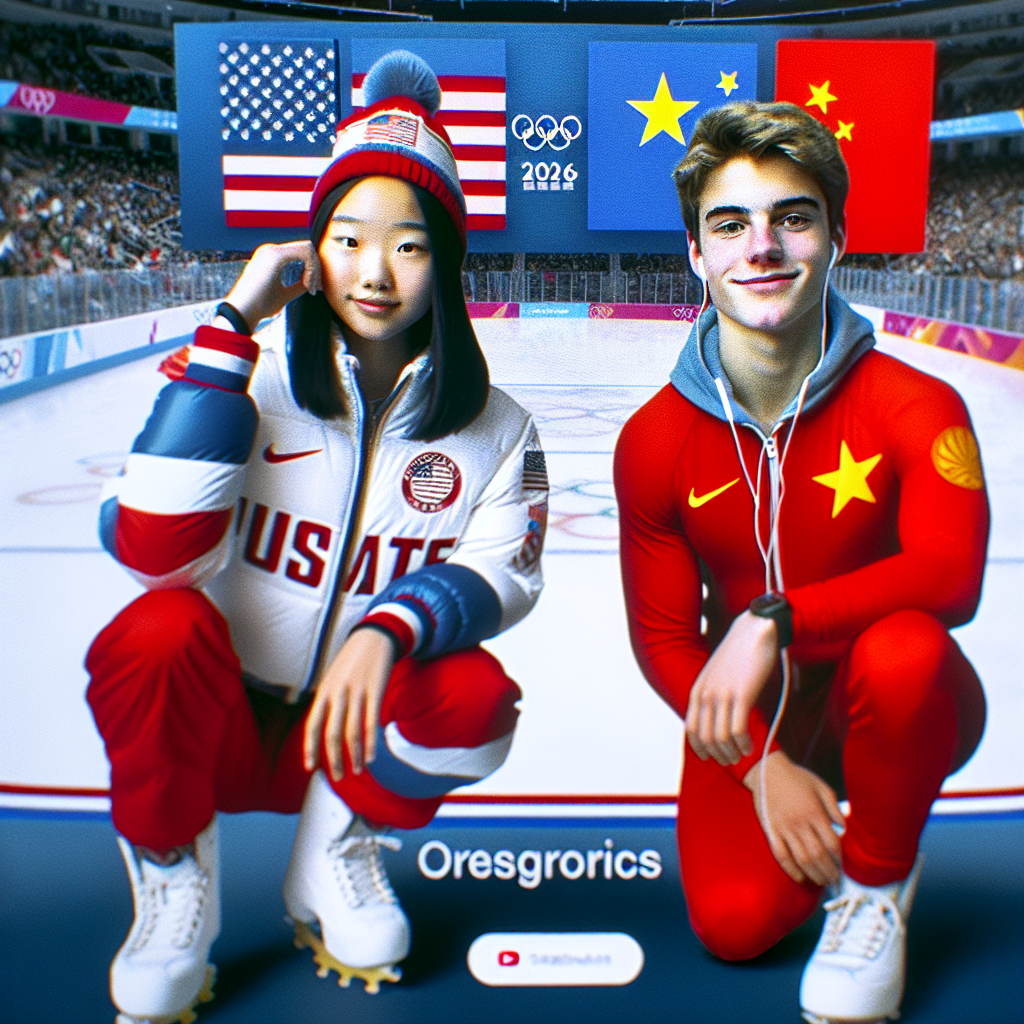
In the 2026 Milan Winter Olympics, Chinese-American athletes Liu Meixian and Gu Ailing have become the two most talked-about athletes. One represents the US, while the other dons the red uniform of Beijing.
On social media platform X, a video of the two teenagers in California has gone viral, showing a shy 12-year-old Liu Meixian and a tall 14-year-old Gu Ailing, seemingly not much different.
Both grew up in single-parent households, with Liu Meixian raised by her father and Gu Ailing by her mother. They are both mixed-race Chinese, with their parents coming to the US for different reasons. Eight years later, these two world-class athletes have taken different paths in life. In fact, four years ago, they and their families made choices that set their paths.
Although Liu Meixian and Gu Ailing have never competed in the same sports event, they have unexpectedly diverged into different value systems, especially against the backdrop of the complex structural opposition between the US and China. Their different paths are not only seen as reflections of different value systems but also interpreted as choices of allegiance to different values.
Some Chinese on platform X express that Liu Meixian and Gu Ailing have taken completely different paths – one staunchly chooses the US, loyal to the country and upholding universal values, while the other leans towards Beijing, maneuvering through the grey area of nationality and reaping benefits on both sides of the US-China divide.
Former Republican congressional candidate Lily Tang Williams, a Chinese-American living in the US, stated in an interview with English-language NTD Television that there are two groups of Chinese-Americans – those who love America and embrace American values, and those who are pro-Communist China.
She added, “Liu Meixian is a patriot of the United States. We need to judge a person based on their character, not their race.”
Despite Gu Ailing’s participation in the 2022 Beijing Winter Olympics with the Chinese team sparking nationality controversies, the presence of “Liu Meixian” this time serves as a stark contrast.
The controversy stemmed from American skier Hunter Hess openly voicing conflicting emotions about representing the US at the Winter Olympics due to his dislike of the current political atmosphere and disagreement with the immigration policies of the Trump administration.
President Trump strongly criticized Hess’s remarks, calling him a “real loser.” Subsequently, some American athletes voiced support for Hess.
After the competition, Gu Ailing expressed her support for Hess during a media interview, criticizing the US President’s political comments as against the spirit of the Olympics. She also expressed sympathy for American athletes under attack and claimed to empathize with them.
Gu’s comments were hard for American netizens to accept. The most widely shared and liked post on platform X was written by Theo Wold, stating, “In Gu Ailing’s world – selling out the country for money, we need to be like Liu Meixian.” The post garnered around 48,000 likes, about 4,944 retweets, and had millions of views.
Gu Ailing had previously represented the US in international competitions, winning a gold medal in freestyle skiing at the 2019 Freestyle Skiing World Cup. However, starting in June of that year, she opted to represent China and has been a Chinese national athlete since. In the 2022 Beijing Winter Olympics, she achieved two gold medals and one silver across three events. And at the Milan Winter Olympics, at the age of 22, she once again chose to represent China.
American netizens began to unearth more stories about Liu Meixian and Gu Ailing.
Liu Meixian became the youngest national figure skating champion in American history at 13 and briefly retired at 16, only to come back strong for the 2026 Milan Winter Olympics, winning a gold medal for the US team in figure skating team event with an outstanding performance.
Both her father, Arthur Liu, and her refusal to be recruited by the Chinese Communist Party received widespread recognition from Americans, who see Liu Meixian as a symbol of the American Dream. These circumstances provided a perfect juxtaposition with Gu Ailing.
Americans also publicly accused Gu Ailing of being hypocritical, alleging that she never dared to speak out about human rights issues in China, but now, as a Chinese athlete, she criticizes the US President loudly.
Having a dual identity as a “Chinese in China and American in America,” Gu Ailing straddles the line between China and the US. After missing out on a gold medal at the Milan Winter Olympics, she mentioned in a media interview, “Bearing the weight of two countries is not easy.”
Amid the structural conflicts between the US and China, Gu Ailing’s statements were reinterpreted by American netizens on platform X as “shouldering the burdens of trying to exploit both countries” – “winning for China when she wins, dragging the US down when she loses.”
Former NBA player Enes Kanter Freedom, who previously played for the Celtics, criticized Gu Ailing, saying, “Gu Ailing built her name in a free country but chose to represent an authoritarian regime, and profited from endorsements associated with forced labor camps. She disappears whenever human rights issues are mentioned. This is not neutrality; this is a choice.”
Michael Sobolik, a researcher at the Hudson Institute specializing in US-China relations, questioned whether Gu Ailing’s behavior – not criticizing the CCP’s persecution of Uighurs or discussing imprisoned political dissidents – also “goes against the spirit of the Olympics.”
“If you only criticize America and say nothing about the CCP, it says a lot,” he wrote.
Gu Ailing has consistently avoided discussing human rights issues, including the incident involving former Chinese Communist Party official Zhang Gaoli’s alleged sexual assault of Chinese tennis star Peng Shuai.
Starting from the Beijing Winter Olympics, criticizing “Princess Frog” Gu Ailing on Chinese social media has become taboo. By the time of the Milan Winter Olympics, the censorship had become more severe. Any comments questioning Gu Ailing’s nationality on Weibo would swiftly be deleted by the Chinese authorities or internet companies.
This indicates that Gu Ailing has become a sensitive term for the authorities. Officials may fear public resentment arising from her actions, possibly leading to collective expressions of dissatisfaction with the CCP.
In contrast, Liu Meixian was born in California in 2005. Her father, Liu Jun, had participated in the 1989 Tiananmen Square protests and sought political asylum in the US in the 1990s.
On the mainland Chinese search engine “Baidu Baike,” references to Liu Jun’s involvement in the 1989 Tiananmen Square protests have been removed, highlighting his story of having five children through in vitro fertilization.
Liu Jun revealed that the CCP had tried to recruit Liu Meixian with high training fees and endorsement payments, but both father and daughter vehemently refused. “We chose America because it represents freedom and opportunity,” Liu Jun stated in a media interview, emphasizing that this experience transformed Liu Meixian into a sports star symbolizing “resisting temptation and loyalty to values.”
Some American Chinese admit that Liu Meixian’s actions are the best way to “give back” to the US for providing asylum.
Fox News reported that before heading to Beijing for the 2022 Winter Olympics, Liu Meixian learned that she and her family were under surveillance by the Chinese government, but she still chose to compete in China, receiving full protection from accompanying US personnel. She placed sixth in the competition at the time, without much attention.
Although communist China claims not to allow dual nationality, in recent years, an increasing number of foreign athletes with Chinese heritage have been recruited with high salaries to represent the Chinese team in international competitions. When winning a gold medal, they may instantly be hailed as “heroes” by the CCP; yet, if they miss out on a gold medal, they face cyberbullying and irrational attacks in China, all part of the so-called “patriotic fever.”
According to Article 41 of the Olympic Charter on eligibility to participate, athletes must be nationals of the country they represent. Currently, there is no indication that 22-year-old Gu Ailing has given up her American citizenship. The Chinese government does not recognize dual nationality.
Gu Ailing is now a popular star in China and also endorses many international brand advertisements.
In a report released by Forbes magazine in December 2025 on the highest-earning female athletes globally, Gu Ailing ranked fourth, following tennis players Coco Gauff, Aryna Sabalenka, and Iga Światek.
Due to her father’s involvement in the Tiananmen protests, the CCP is unlikely to allow Liu Meixian to inherit his values, preventing her from gaining the same level of fame as Gu Ailing.
In the tug-of-war between the US and China, people value not just champions but also the winners of values. The diverging paths of Liu Meixian and Gu Ailing seem to remind us that nationality is not just a label but also a test of loyalty and integrity.
An overseas journalist based in Beijing commented on platform X, “After all, outside the ice and snow arena, the real winners are those who choose conscience over money.”