
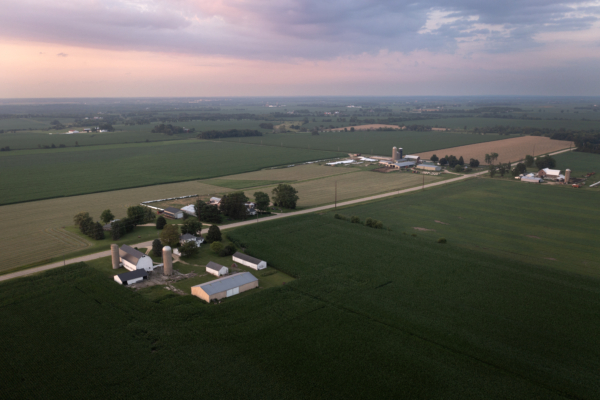
The United States Department of Defense and the Department of Agriculture (USDA) officially signed a memorandum of understanding (MOU) on Wednesday, February 11, declaring their joint commitment to protecting American farmlands and agricultural resources from foreign threats.
This interagency collaboration is a key pillar of the National Farm Security Action Plan, aimed at preventing potential national security risks, particularly with a focus on monitoring land ownership surrounding military bases and critical infrastructure.
Under the agreement, the Defense Advanced Research Projects Agency (DARPA) under the Pentagon will closely coordinate with the USDA’s Chief Scientist to develop new technologies for detecting and addressing agricultural threats. Additionally, Agriculture Secretary Brooke Rollins announced the establishment of a dedicated new office within the USDA to oversee and safeguard sensitive agricultural research outcomes, preventing technology leaks.
Defense Secretary Pete Hegseth emphasized during a press conference that this collaboration will enhance military readiness. He stated, “We are not dealing with hypothetical issues. The threats are real and must be thoroughly eradicated.”
The USDA pointed out that the trend of foreign entities acquiring American farmlands has raised significant government concerns, particularly regarding land acquisitions near sensitive military facilities.
Secretary Rollins revealed staggering comparative data, stating, “Currently, China alone owns over 265,000 acres of American farmland, whereas in 1983, this number was only 2,000 acres.”
She stressed that this contrast exposes the strategic vulnerability of the U.S. food and agricultural supply chain.
Secretary Hegseth further noted that security concerns are not baseless conjectures. He mentioned that in training manuals discovered in Afghanistan by the U.S. military after the 9/11 attacks, hostile forces explicitly identified American agriculture as a potential target, underscoring the interconnectedness of agricultural security and national security.
To address the current risks, the USDA has embarked on substantive investigations.
Rollins stated that officials have already terminated seven agreements involving entities funded by “concerning countries” and have dismissed approximately 70 foreign contracted researchers. She also mentioned that officials are in the process of removing an additional 550 entities for similar reasons, aiming to thoroughly block security vulnerabilities within the agricultural sector.
This administrative action has garnered support from members of Congress. Chairman of the House Committee on China, Republican Congressman John Moolenaar, stated that farm security is national security and highlighted that this collaboration will strengthen the federal government’s ability to protect the homeland.
In the future, the USDA will enhance coordination with the Committee on Foreign Investment in the United States (CFIUS) to conduct more rigorous reviews of foreign investments in agricultural land, businesses, and technologies.
Meanwhile, legislators at both state and federal levels across the United States have introduced dozens of bills in an attempt to restrict individuals or entities affiliated with “concerning countries” such as China, Russia, Iran, and North Korea from purchasing land. Several states have successfully passed related legislation.