
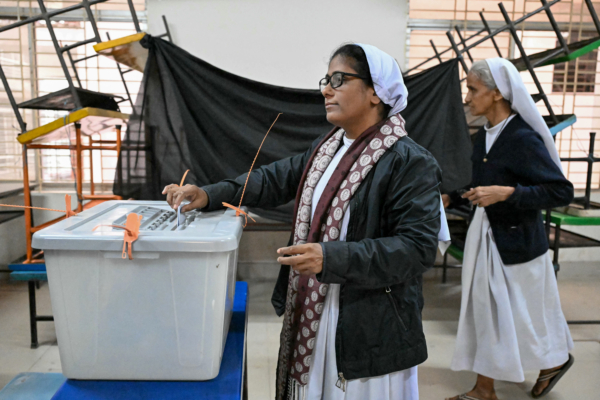
On Thursday, February 12th, Bangladesh held a milestone parliamentary election voting. This election marks a crucial test for the country to return to stability after the “Z Generation” youth protests in 2024 led to the overthrow of long-term Prime Minister Sheikh Hasina’s rule.
The election was held concurrently with a constitutional reform referendum, where 128 million registered voters will decide whether the country can truly break free from years of authoritarian rule.
Voting stations opened at 7:30 am local time, and long queues formed in various locations in the capital city of Dhaka. To maintain order and prevent violence, the government deployed around 958,000 security personnel.
39-year-old voter Mohammed Jobair Hossain, while waiting in line, excitedly told Reuters, “I feel very excited because this is the first time in 17 years that we can freely vote. Our votes will have an impact and meaning.”
This election signifies a dramatic shift in the political landscape of Bangladesh. It is the first time in decades that the country is holding elections without the participation of the two prominent female political figures – Hasina and Khaleda Zia.
Hasina is currently in exile in India and has been sentenced to death by a special court in Bangladesh for crimes against humanity related to the crackdown on protesters in 2024 that resulted in about 1,400 deaths; her party, the Awami League, has also been barred from participating in politics.
The current focus of the election campaign has shifted to a showdown between two major alliances led by the Bangladesh Nationalist Party (BNP) and the Bangladesh Jamaat-e-Islami party.
In addition to electing 300 members of parliament, voters also had to cast their ballots on a series of constitutional reforms known as the “July Charter.” These reforms include limiting the prime minister’s term to a maximum of 10 years, establishing a bicameral parliament, increasing the role of the opposition party in the parliament and appointment mechanisms, and strengthening the independence of the judiciary and the election commission.
Nobel laureate and interim government leader Muhammad Yunus commented on the election, saying, “This election is not just another routine vote. We have witnessed a public awakening to long-standing anger, inequality, poverty, and injustice, and this awakening is now reflected at the constitutional level in this election.”
Unlike previous elections, this time there were over 2,000 candidates (including many independents) vying for the 300 seats in the National Parliament. At least 50 political parties participated in the election, setting a national record, and for the first time, overseas voters were allowed to cast postal votes.
A fair and decisive election result is crucial for the stability of Bangladesh. The country is striving to recover from months of turmoil and is facing economic challenges such as inflation, corruption, and setbacks in the crucial garment industry.
Voting is expected to end at 4:30 pm local time, followed by the counting of votes. Initial trends are expected to emerge by midnight, with the final results likely to be clear by Friday morning.