
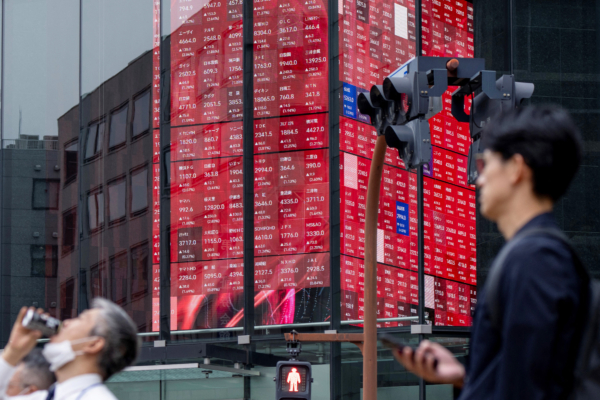
On Thursday, February 12, the Japanese stock market reached a new high as the Nikkei 225 index surpassed the 58,000-point mark for the first time during trading hours. This surge has been attributed to the market’s expectations of expanding economic stimulus measures following the overwhelming victory of Prime Minister Takaichi Sougei and the Liberal Democratic Party in the recent election, a trend now referred to as the “Takaichi trade”.
In early trading today, the Nikkei index peaked at 58,015.08 points, marking a significant 15% increase since the beginning of 2026.
Wataru Akiyama, a strategist at Nomura Securities, commented, “With the recent strong financial performance and the decisive victory of the Liberal Democratic Party under the leadership of Takaichi, the market has been on a notable upward trend.”
However, he also expressed caution, stating, “The market seems to be overheating, so profit-taking selling pressure may begin to emerge.”
Global investment institution GMO highlighted that the election victory has granted Takaichi Sougei a strong and multi-year mandate to drive policies, which provides long-term support for both the Japanese market and corporate sector.
Nevertheless, the institution also warned that if the Japanese yen approaches the psychological barrier of 160 against the US dollar, the risk of government intervention in the foreign exchange market will increase.
In terms of individual company performance, with Japan’s earnings season in full swing, results have been mixed. Cosmetic giant Shiseido saw its stock price surge by 14%, while AI industry key supplier Mitsui Kinzoku also rose by 11%. On the other hand, Honda fell by 3% due to a 61% drop in third-quarter profits, and Sharp plummeted by 11%.
It is noteworthy that the performance of Asian markets has diverged from that of the US stock market. Despite the US non-farm payroll employment increasing by 130,000 in January, far exceeding the market’s expectation of 55,000, leading to a cooling of rate cut expectations by the Federal Reserve and a weakening of the US stock market, Asian investors remained unaffected.
In addition to the record-breaking performance of the Japanese stocks, the South Korean KOSPI index quickly surged by over 2.7% after opening, breaking through the 5,500-point mark and setting a new historical record at 5,515.18 points during trading. The index has seen a gain of over 28% so far this year.
The rise in the South Korean stock market has been primarily driven by blue-chip stocks, with Samsung Electronics showing strong performance in early trading with a significant increase of over 6%, and SK Hynix also rising by 3.6%.
The benchmark index in Singapore also crossed the 5,000-point threshold for the first time.