
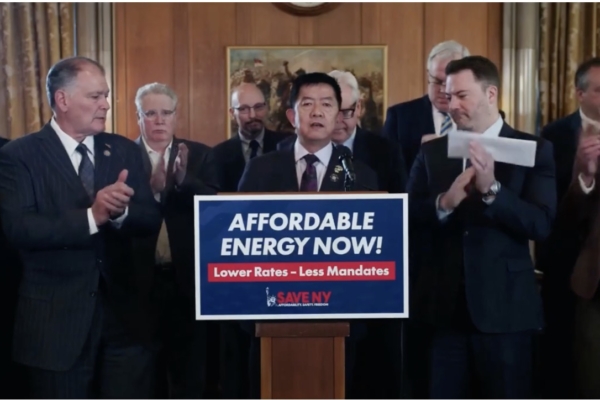
New York State Senate Republicans have introduced the “Affordable Energy” legislative proposal as a key component of their “Save New York” 2026 legislative agenda amid continuing soaring energy prices. The proposal aims to immediately ease the burden on users and review the impacts of current climate and energy policies on the public.
Senate Republican Leader Rob Ortt, along with Senators Mario Mattera, Tom O’Mara, Stephen Chan, and other members, jointly announced the reform plan on Monday, emphasizing that the current energy costs have made it difficult for New York households and small businesses to afford.
The core of the Republican proposal includes two immediate relief measures: first, returning the unused $2 billion in green energy funds held in the New York State Climate Investment Account to taxpayers. The Senate bill S8461A, proposed by Tom O’Mara, suggests that the approximately $2 billion idle green energy program funds currently held by the New York State Energy Research and Development Authority (NYSERDA) be directly refunded to users through utility bill offsets.
Secondly, a utility bill tax holiday. The S8463 bill proposed by Rob Rolison and co-sponsored by Stephen Chan suggests a one-year suspension of water and gas surcharges and related taxes, similar to the fuel tax holiday implemented in 2022. Republicans point out that about 40% to 50% of various surcharges and taxes are included in the water and gas bills.
O’Mara stated that this would provide “real and immediate relief,” especially amidst the backdrop of inflation and a housing crisis.
Republicans cited data indicating that New Yorkers are currently facing one of the highest energy rates in the country. New York’s residential electricity prices are 50% higher than the national average, with a 7.6% increase in the past year, surpassing the national average growth rate. Since the implementation of New York’s most radical Climate Leadership and Community Protection Act (CLCPA) by the Democratic Party in 2019, electricity prices in New York have risen by 45%, causing New Yorkers to pay 30-40% more than neighboring Pennsylvania.
Ortt criticized the green energy policies promoted by the Democratic Party as “a disconnected green new scam, attempting to force a zero-emission economy that has no impact on the climate.” He pointed out recent media reports indicating that over 400,000 users have been cut off from electricity or natural gas due to inability to pay, a situation “even worse than during the Great Depression.”
“The legislative body should serve all voters, not cater to radical environmentalists while causing suffering to other residents across the state,” he said.
State Senator Stephen Chan from Brooklyn pointed out that energy policies have inflicted substantial harm on residents in his district.
He mentioned the impact of the closure of the Indian Point nuclear power plant and highlighted that approximately 1,500 households in Brooklyn were without power for more than two days during a cold spell. With water heaters and heating systems requiring electricity to operate even when using natural gas (such as thermostats or multiple safety sensors inside water heaters that need power), residents were left without water or hot water in sub-zero temperatures, forcing them to temporarily stay in hotels.
Chan noted that many families in his district run restaurants, grocery stores, barber shops, self-service laundromats, as well as union workers and teachers. Confronted with high property taxes, rent, and insurance costs, they now have to bear the burden of soaring energy bills.
He recalled asking voters about their electricity bills at a private dinner with around 60 attendees: “Who paid over $500 last month?”. About 25 people raised their hands. “What about over $1000?” Some also raised their hands.
Chan stated that the Public Service Commission recently approved a 10.4% increase in electricity rates by Con Edison, and a 15%-16% increase in gas rates. He mentioned that the gas bill for his ordinary semi-detached residence is around $1400 per month.
In addition to price issues, Chan also criticized the state government for forcefully pushing the “lithium battery energy storage” project for maintaining green electricity, disregarding community opposition.
He mentioned concerns raised by residents near battery storage projects near 17th Avenue and 86th Street, close to daycare centers and P.S. 128 elementary school, as well as the one near 64 Street at 924 (rear of Dragon Supermarket), just one block away from P.S. 69 and P.S. 310.
He referred to numerous national incidents of fires at storage facilities and pointed out the requirement for substantial water usage to extinguish lithium battery fires, questioning the safety of setting up such facilities near schools.
His Senate bill S7710 proposes to prohibit the construction of certain storage systems within 500 feet of residential homes or schools. “Are we truly willing to sacrifice public safety for radical energy goals?” he asked.
Over 30 state legislators have urged Governor Hochul to declare an “energy emergency” to temporarily suspend certain taxes and provide interim relief.
Republicans also questioned whether the state government’s push towards full electrification may exceed the grid’s capacity. Ortt stated, “We are moving in a direction where we are asking people to pay more, but we may not be able to provide enough electricity because we have set an unattainable timetable.”
Governor Hochul’s senior energy and environmental communication adviser Ken Lovett responded by stating that the governor has proposed a “Taxpayer Protection Plan,” including measures to prevent unreasonable utility price hikes, eliminate hidden fees, limit executive compensations, and continue to promote energy supply expansion.
The statement also countered the Republicans, stating that if they wish to lower energy costs, they should urge Washington Republicans to stop hindering approved energy projects and cancel federal tariffs that increase supply costs.