
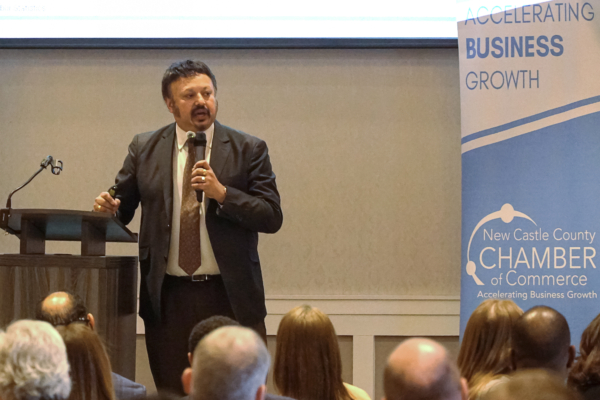
On February 10th, the New Castle County Chamber of Commerce in Delaware held the 2026 Economic Forecast Luncheon at Riverfront Events in Wilmington, inviting Dr. Anirban Basu, Chairman and CEO of Sage Policy Group, one of the most renowned economists in the mid-Atlantic region, to speak. Over 200 local business leaders gathered to discuss the potential economic outlook for Delaware and the United States in the upcoming year. Dr. Basu expressed a cautious view despite the strong current economic growth in the United States. While states like Texas, Florida, and the Carolinas are experiencing robust economic development, Delaware and Maryland may face some softening in their economies. He praised the main advantage contributing to the economic growth in the U.S. as attracting investments.
Dr. Basu founded Sage Policy Group in Maryland in 2004 and is known for his witty and humorous approach to discussing serious economic topics. One of the themes of his speech was the prevailing fear among the mainstream American society. Although many on Wall Street and in Silicon Valley are satisfied with the economic situation, the economic conditions for ordinary people, including in parts of Delaware, are quite dire.
In 2025, the U.S. economy grew by 3.8% in the second quarter, 4.4% in the third quarter, and an estimated 4.2% in the fourth quarter. Dr. Basu commented on the strong performance in the last three quarters of 2025, leading the economy into 2026 with a robust growth momentum.
He pointed out that the current strong economic growth in the U.S. is being largely driven by factors such as artificial intelligence, stock market prosperity, corporate profits, and spending by affluent households, which have led to an overheating of economic development, playing a significant role.
Dr. Basu highlighted investments in artificial intelligence infrastructure, particularly in computer chips and data centers to accommodate these chips, as significant. Starting from November 2022, following the release of ChatGPT, numerous companies including Alphabet, Amazon, Meta, Microsoft, and others with large-scale data centers began investing heavily to dominate the global artificial intelligence field. Microsoft invested nearly $90 billion in AI infrastructure last year and is expected to invest more this year. These investments have injected substantial capital into the economy, creating vast opportunities for many companies, resulting in historically high profit prospects for U.S. businesses.
Regarding stock market prosperity driven by artificial intelligence, companies like Tesla, Google’s parent company Alphabet, Apple, Amazon, Meta, Nvidia, and Microsoft have shown outstanding performance, along with other components of the S&P 500 index. However, approximately 40% of Americans do not own any stocks, leading to a lack of relatability when companies like Nvidia reach a market value of $5 trillion.
Despite record highs in the stock market and robust growth in GDP and national output, consumer confidence reflects pessimism, mainly stemming from the weakness in the U.S. labor market. Dr. Basu noted a significant softness in some areas of the economy, particularly evident in the U.S. labor market, especially in monthly job additions. Over the past eight months, the U.S. has averaged about 10,000 new job additions per month, which is almost negligible in a country with over 330 million people. From a statistical perspective, this is equivalent to zero. The industries most affected by job losses are leisure and hospitality services, such as hotels and restaurants, as well as manufacturing. The majority of new job additions come from the healthcare services sector.
Dr. Basu attributed the growing pessimism about economic prospects among many Americans to inflation, specifically the pressure brought about by rising prices.
The rising cost of food is a major concern for ordinary residents. Dr. Basu mentioned that over the past five and a half years, inflation in the U.S. has reached 27.5%, with the core inflation rate, excluding food and energy prices, at 25%. Energy prices have increased by nearly 60%, transportation services cost up by 53.2%, housing costs like apartment rents have risen by about 30%, and food prices by 29%. However, the soaring prices have not been balanced by wage growth. He highlighted certain occupations where salary growth has been significant, including truck drivers.
Concerning the Federal Reserve’s monetary policy, Dr. Basu disagreed with economists at JPMorgan, stating that the Fed would lower interest rates later this year following a decline in prices.
In answering audience questions, Dr. Basu praised the U.S.’s main advantage in attracting capital investment. The country continues to attract significant investment capital from around the world, channeling it into our companies, corporate sectors, eventually creating job opportunities, and more.
Though the U.S. makes up less than 5% of the world’s total population, it leads in life sciences, artificial intelligence, and aerospace. Dr. Basu mentioned that the U.S.’s leading position is not surprising as Americans excel in scaling up good ideas. He emphasized that Americans are unparalleled in investing vast seed funds, venture capital, and private equity in good ideas, rapidly expanding their scale.
Dr. Basu believed that the U.S.’s entrepreneurial spirit sets it apart, as it supports good ideas, even when they involve risk-taking. While China took the lead in artificial intelligence, the U.S. has surpassed them by providing more investment capital to entrepreneurs and being more willing to do so.
Before Dr. Basu’s speech, Scott Malfitano, Chairman of the Delaware Workforce Development Board (DWDB) and Vice President of CSC, a global enterprise management and compliance solutions provider headquartered in Wilmington, introduced Delaware’s future development direction. This includes prioritizing investments to train workers in high-growth, high-demand industries, and increasing the educational attainment of the working-age population by 60%, including acquiring apprenticeships, certifications, and degrees among higher education credentials.
Malfitano highlighted Delaware’s collaborations with institutions such as the University of Delaware, Delaware State University, Wilmington College, Goldey-Beacom College, and Delaware Technical Community College to create business cooperative education programs to retain residents within the state.
He mentioned that within a nine-mile radius of Wilmington, there are 17,000 students, actively seeking companies and businesses to engage in the “learn while earning” approach for college students. Malfitano stated that Delaware has the potential to become the first state in the U.S. with a statewide cooperative education program.