
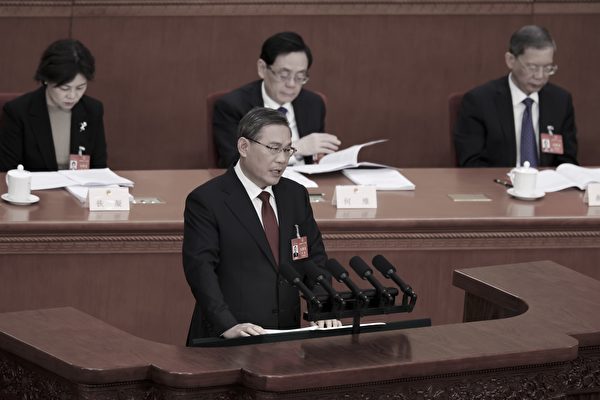
On May 27th, the Central Political Bureau of the Chinese Communist Party convened a meeting to discuss regulations on financial risk accountability, emphasizing the need for financial regulation to be more stringent. Despite being the director of the financial committee, Chinese Premier Li Keqiang, who has been marginalized in economic affairs, was absent from the meeting due to his overseas visit. Experts believe that whether Li attends or not, the lack of effectiveness within the CCP’s professional team has led to serious economic issues.
The official Chinese state media Xinhua reported on May 27th that Xi Jinping presided over the Political Bureau meeting, reviewing “several policy measures to accelerate the rise of the central region in the new era” and “accountability regulations for preventing and resolving financial risks.”
The meeting emphasized the need to strengthen the Party’s “centralized and unified leadership” over finance and reiterated the importance of financial regulation being “long-toothed and sharp.”
Since the beginning of the year, the Xi Jinping administration has repeatedly emphasized the need for financial regulation to be “long-toothed and sharp” and has intensified efforts to crack down on corrupt officials within the financial system. Nearly a hundred senior financial executives within the CCP have faced corruption allegations since the 20th Party Congress.
On April 16th, the CCP dispatched inspection teams to 34 financial institutions, including the central bank, emphasizing that it was a “political inspection” aimed at upholding Xi’s “core position in the Party and centralized leadership.” Ahead of the upcoming Third Plenary Session of the CCP in July, the authorities have sent a strong signal regarding “financial risk accountability,” raising concerns about possible investigations into high-ranking officials.
Taiwanese financial expert Huang Shicong stated on May 28th that Xi Jinping may attribute many of China’s economic problems to lax regulation or corruption, hence his call for regulatory officials to “show their claws.” However, Huang believes that excessive regulation could have negative effects on the economy and that the deeply rooted corruption within financial institutions cannot be easily altered by a few regulatory personnel.
Huang pointed out that many foreign assets are privately owned, and countries protect assets through legal and commercial mechanisms. In contrast, under CCP rule, everything is state-owned, leading individuals to pocket assets acquired through state channels. The lack of a comprehensive protection mechanism and operational framework under the CCP’s rule raises doubts about its effectiveness in preventing abuse.
Professor Zheng Zhengbing from Yunlin University of Science and Technology in Taiwan analyzed that the CCP’s emphasis on adopting a tough stance in financial regulation and accountability indicates significant financial problems across regions, necessitating such punitive measures and warnings.
In the past, provincial leaders in China wielded extensive power and could act with impunity. With vast financial leverage driving economic growth, the central authority paid little attention to monitoring regional financial activities. However, given the current vulnerabilities exposed in the financial system, failure to manage fiscal and financial crises could result in punitive measures and stricter control from the central government.
It is noteworthy that Premier Li Keqiang, a member of the CCP’s Political Bureau and the State Council, was absent from the Political Bureau meeting on May 27th as he was attending the ninth trilateral meeting of the leaders from China, Japan, and South Korea in South Korea.
Zheng pointed out that whether Li Keqiang participates in domestic economic meetings does not significantly impact decision-making, as Li’s economic acumen is limited. Li primarily consults and executes Xi Jinping’s directives, indicating that he functions more as Xi’s chief executor rather than an independent decision-maker.
Regarding China’s economic development, Zheng highlighted the lack of effectiveness in the CCP’s professional team, attributing it to the emphasis on loyalty over expertise in leadership selection. Unlike previous high-ranking officials such as Zhu Rongji, Wen Jiabao, Li Keqiang, or Liu He, who had renowned economists as advisors, the current leadership lacks significant financial expertise. The current cadre of officials must align with Xi Jinping’s preferences and are cautious about expressing dissenting opinions, raising concerns about potential economic ramifications.
Xi Jinping hosted a symposium with enterprises and experts in Jinan, Shandong Province, on the 23rd of this month, discussing “further comprehensive deepening of reforms.” Notably, two deputy directors of the Deepening Reform Commission—Wang Huning and Cai Qi—attended, while the top-ranked deputy director, Li Keqiang, was absent as he was conducting research in Henan.
Last March, the central government reorganized the Central Financial Committee and established the Central Financial Work Committee to enhance the CCP’s control over the financial sector. Li Keqiang was appointed as the director of the Central Financial Committee, but the actual power wielder in the State Council is believed to be He Lifeng, Xi’s close ally, serving as the director of the Central Financial Office and the secretary of the Central Financial Work Committee, as noted by The Economist.
During a financial thematic seminar for provincial and ministerial-level cadres held on January 16th, Li Keqiang was absent due to his visit to Europe. On January 19th, the seminar concluded with a speech by the member of the Politburo, Cai Qi, responsible for ideology, as Li had returned but did not attend the closing ceremony.
Huang Shicong noted that traditionally, the Chinese Premier would be responsible for economic matters, but Li Keqiang has not played a significant role in economic decision-making so far. Many critical decisions are made in his absence, or by others on his behalf, indicating he operates more as Xi Jinping’s chief enforcer.
Zheng emphasized that Xi Jinping now holds extensive power and appoints senior officials based on loyalty rather than expertise, unlike previous eras where prominent economists held key positions. With a lack of financial backgrounds among the new leadership, China’s economic decision-making may become vulnerable, particularly as dissenting opinions are discouraged and centralized control reinforces Xi’s preferences.
Xi Jinping himself, while not extensively knowledgeable, exudes confidence and suspicion towards others, creating an environment where economic officials are hesitant to take decisive actions, potentially leading to significant economic challenges for China.