
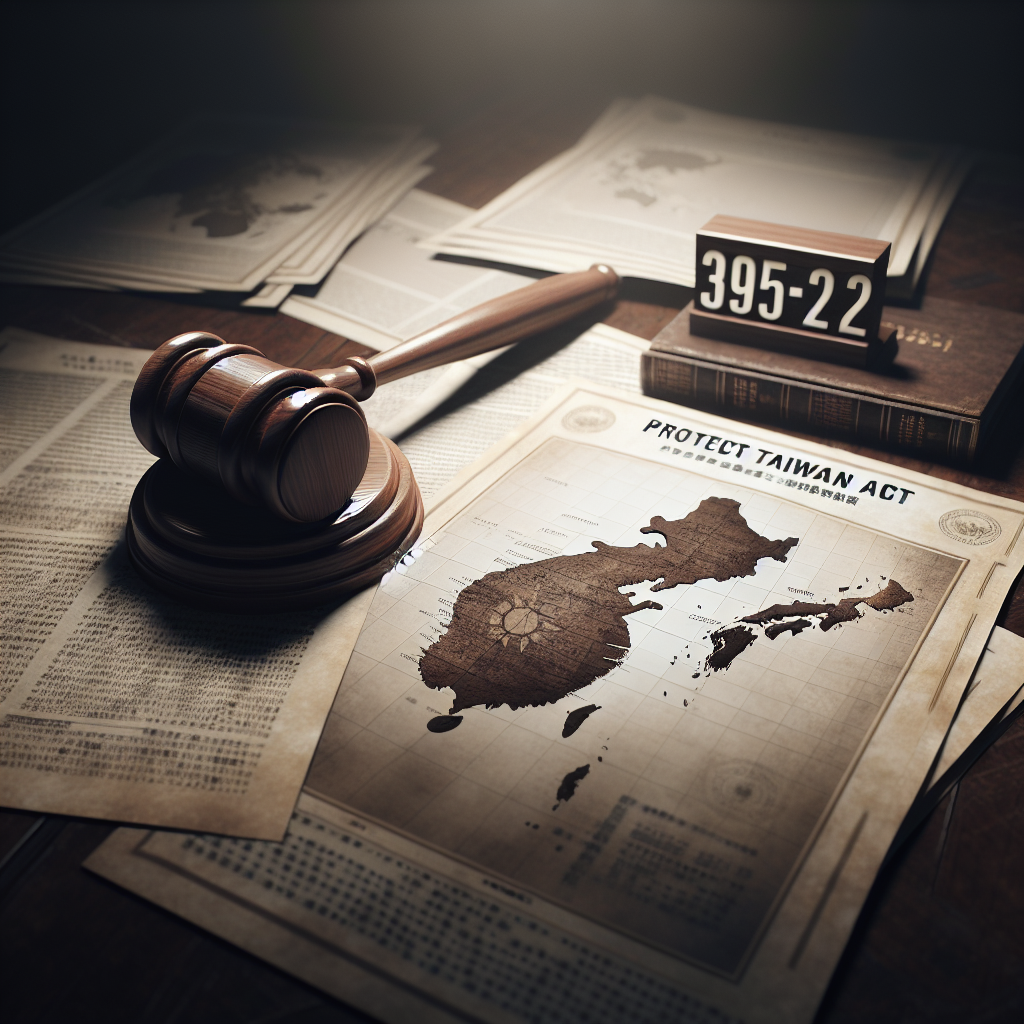
On February 9, the U.S. House of Representatives overwhelmingly passed the “Protect Taiwan Act” with a vote of 395 in favor and 2 against. This legislation calls for the exclusion of China from international financial institutions and organizations in case Taiwan’s security is threatened by Chinese actions. It marks the latest effort by the United States to increase its support for Taiwan. Several experts have analyzed the strategic game between the U.S. and China in the Taiwan Strait issue, as well as China’s strategies towards Taiwan, noting that China’s tactics may not be effective.
The bill, introduced by Republican Congressman Frank Lucas, is part of a series of bipartisan legislative measures aimed at enhancing Taiwan’s security in recent years.
According to the legislation, if Taiwan’s security, society, or economic system is threatened by Chinese actions, the U.S. should exclude Chinese representatives from international financial mechanisms and organizations such as the G20, Bank for International Settlements (BIS), and Financial Stability Board (FSB) to the fullest extent possible.
Congressman Lucas stated that this bill conveys a clear message that if China intends to engage in conflict with Taiwan, it must be prepared to face the consequences.
Taiwanese legislator Chen Guanting commented that the “Protect Taiwan Act” represents the international community’s use of financial and institutional means to deter China, turning political statements into institutional consequences and concrete costs.
The next step for the “Protect Taiwan Act” is to be submitted to the Senate for review, and if passed, it will be signed into law by President Trump. In addition to the recent passage of the legislation, the U.S. has been actively promoting arms sales to Taiwan to bolster its defense capabilities.
In December of last year, the U.S. Department of Defense announced a record-breaking $11 billion arms sale to Taiwan, including equipment such as Harpoon missile systems and M109A7 self-propelled howitzers. China’s Ministry of Foreign Affairs subsequently lodged a protest.
On February 4, Trump had a phone call with Chinese leader Xi Jinping, where they discussed various issues, including Taiwan. China requested the U.S. to “handle arms sales to Taiwan carefully” following the call.
China has long viewed U.S. arms sales to Taiwan as a pressure tactic and has tied arms sales to Trump’s visits to China.
Director of the Strategic Studies and Resources Division at the Taiwan Institute for National Defense and Security Studies, Su Ziyun, stated to Epoch Times that the U.S. will not adjust its arms sales policy due to pressure from Beijing, as it is not only a matter of institutional commitment but also fits into a larger strategic framework where Taiwan is included.
He believes that the U.S. State Department and relevant officials have reiterated their unwavering commitment to Taiwan’s security, demonstrating Washington’s strategic foresight.
Military analyst Mark expressed to Epoch Times that the Taiwan Strait issue is primarily a matter of strategic and security concerns and will not become the primary bargaining chip for the U.S. “Trump has always been open to arms sales to Taiwan since his first term, and as long as Taiwan has needs, the U.S. will generally agree.”
He noted that China’s linkage of arms sales to Taiwan with Trump’s visits reflects Xi Jinping’s anxious mindset under internal and external pressures. Beijing urgently needs positive signals internationally to showcase diplomatic achievements domestically.
He stated, “If China can compel the U.S. to delay announcing a large-scale arms sale to Taiwan, Xi Jinping could spin it internally as a diplomatic victory, thereby easing political pressure.”
With the recent increase in U.S. support for Taiwan and adjustments in China’s Taiwan strategy, former Beijing lawyer and independent scholar Lai Jianping assessed that China may shift its focus towards “soft tactics,” aiming to sow divisions within Taiwan through political and media means.
On the day the “Protect Taiwan Act” was passed, Chinese authorities held a two-day meeting in Beijing on it. According to Xinhua News Agency, Wang Huning, a member of the Politburo Standing Committee, Chairman of the National Committee of the Chinese People’s Political Consultative Conference, attended and delivered a speech. Wang is in charge of China’s United Front work towards Taiwan.
At the meeting, Wang stressed the need to “firmly grasp the initiative and control in cross-strait relations, support patriotic unification forces in Taiwan, and combat pro-independence separatist forces.”
Researcher at the Taiwan Institute for National Defense and Security Studies, Shen Mingshi, explained during an interview with Epoch Times that the comments made at the meeting represent typical united front rhetoric, focusing on “unifying the majority and combating the minority.” China has long labeled the “Taiwan independence forces” as a minority and seeks to influence Taiwan politics by supporting pro-China or pro-unification forces on the island.
Lai Jianping told Epoch Times that “China may hope that by supporting certain political forces on the island, it can hinder the ruling party’s governance through political confrontation and policy obstruction, leading to political infighting in Taiwan.”
However, Shen Mingshi believes that “even if China openly supports certain political forces on the island, it might backfire, causing these political figures to lose support from the Taiwanese public.”
According to long-term polls conducted by Taiwan’s Mainland Affairs Council and the Election Study Center of National Chengchi University, the proportion of support for “immediate unification” has consistently been below 2.5%, while support for “maintaining the status quo before unification” is around 10%, together still forming a minority. In contrast, the combined percentage for “maintain the status quo permanently” and “maintain the status quo with a path to independence” ranges from 70% to 80%.
“If China continues to base its policies on the assumption that ‘Taiwan independence is a minority,’ there will be a significant gap between its policies and Taiwan’s social structure,” Shen Mingshi remarked.
Lai Jianping stated that “China’s consistent hardline and coercive strategies often have a counterproductive effect, causing countries under pressure to unite politically.” He continued, “The changes in Japan’s political scene are a typical case of this counteractive effect, and this effect could also transfer to Taiwan.” He added, “If China publicly expresses similar intentions, it may undermine the social legitimacy of these political forces, making Taiwanese society more alert.”
Recently, Japanese Prime Minister Sanae Takamichi scored a landslide victory in the House of Representatives election, leading her Liberal Democratic Party to not only a decisive win but also securing the highest number of seats of a single party in post-war elections. During the election, China criticized Takamichi and imposed economic sanctions, travel bans, aiming to undermine her and the ruling coalition she leads.
China’s recent countermeasures have relatively tapered down. Shen Mingshi attributed this to three main reasons: the tumult in the country’s senior military leadership, the looming 2026 Taiwan local elections where excessive military intimidation could alienate voters and benefit the opposition camp, and the tense U.S.-China relations, where a public display of hardline stance might attract higher-level attention and countermeasures from the U.S.
Su Ziyun stressed that Taiwan should maintain a “normal mindset,” highlighting that while international assistance is important, Taiwan’s fundamental path to security lies in enhancing its own defense capabilities.
Lai Jianping believed that after decades of democratic practice in Taiwan, the overall political quality of society is higher, with the majority of voters able to discern political stances and external influences. He speculated that as relevant issues continue to ferment, Taiwanese public opinion may undergo self-correction, further reinforcing support for the current political path.