
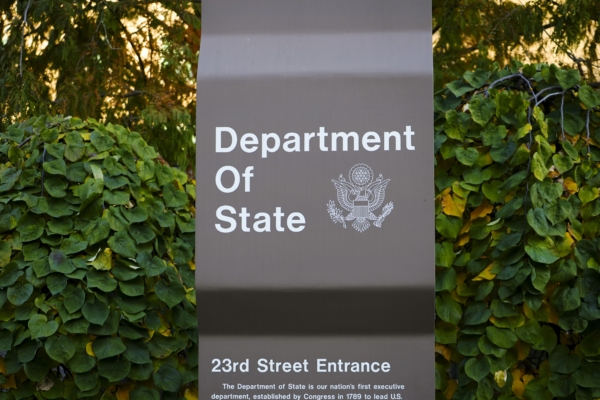
On Tuesday, February 10, the US government announced a ban on Palau Senate President Hokkons Baules and his family from entering the country, accusing him of involvement in corrupt activities related to the Chinese Communist Party. This move aims to contain Beijing’s infiltration in the Pacific region.
According to US State Department spokesperson Tommy Pigott, Baules has been added to the sanctions list for representing the interests of the CCP in significant corrupt activities. “Baules abused his power, accepted bribes, and provided propaganda and support for the Chinese government, companies, and criminal groups,” he said.
Pigott noted, “His actions constitute serious corruption and harm US interests in Palau.”
Furthermore, the State Department also sanctioned former Mayor of the Marshall Islands, Anderson Jibas. The State Department stated that Jibas was involved in the “embezzlement, abuse, and diversion” of funds from the trust fund provided by the US for the Bikini Atoll resettlement. The fund aimed to address issues left over from US nuclear tests in the 1940s and 1950s.
The State Department’s statement emphasized that embezzlement, abuse, and diversion of funds provided by the US not only waste American taxpayers’ money but also lead to local unemployment, food shortages, immigration to the US, and inadequate power supply. Jibas’ corrupt behavior without accountability undermines public trust in the Marshall Islands government and provides opportunities for malicious influence from China (CCP) and other countries.
These sanctions will result in Baules, Jibas, and their immediate family members losing the right to enter the US.
Palau and the Marshall Islands are two strategically important Pacific island nations allied with the US, which have become focal points for geopolitical competition between the US and China in recent years.
Both Pacific island nations receive economic support from the US through the Compact of Free Association. In return, the US is responsible for the defense of both countries and enjoys exclusive military access to strategic positions in the Pacific.
However, China has been infiltrating the region, seeking economic opportunities to sway these financially constrained Pacific island nations.
Baules admitted to drug trafficking in 1989 and has been one of the most active pro-CCP figures on the island. Under his leadership, the Palau Senate passed resolutions criticizing US military activities in Palau, while he himself has been pushing for expanding relations with China.
Company records reviewed by Reuters show that the Baules family operates a local business called “Fuji Restaurant,” which local authorities have linked to Chinese criminal activities.
“Citizens United for Democracy Foundation” think tank expert on the Compact of Free Association, Cleo Paskal, told Reuters, “Corruption opens the door for China (CCP) to advance its agenda, especially in countries that recognize Taiwan and have significant US military bases.”
“The US will continue to hold those accountable who abuse public office for personal gain, stealing citizens’ property for personal enrichment. These sanctions reaffirm the US commitment to combat global corruption that affects American interests,” the State Department statement read.
Moreover, Palau and the Marshall Islands are among the few countries that maintain formal diplomatic relations with Taiwan.
In recent years, Palau officials have been seeking increased US patrols in their waters after Chinese vessels encroached into their exclusive economic zone. Palau also has a US-controlled airfield where the US military is constructing an advanced radar station.
The Kwajalein Atoll in the Marshall Islands is the site of an important testing ground for the US missile defense system.