
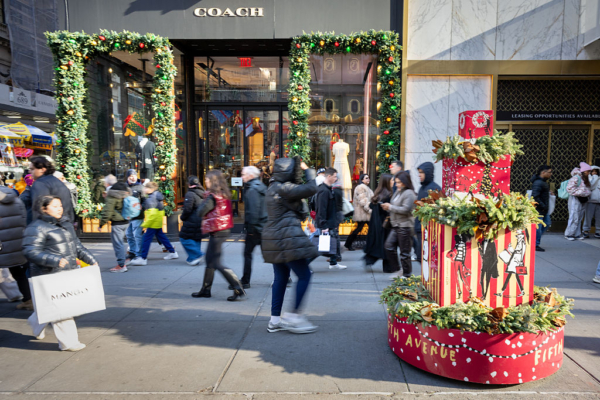
The U.S. Department of Commerce reported on Tuesday (February 10th) that due to severe weather conditions and factors such as tariffs, consumer activity in the United States slowed significantly during the holiday shopping season in December of last year.
The newly released data on Tuesday showed that retail sales in the U.S. in December remained flat compared to the previous month, while retail sales had increased by 0.6% in November.
The unexpected decline in retail sales in December surprised economists surveyed by Dow Jones & Company and the financial data and software company FactSet, who had predicted a 0.4% growth.
Retail sales data is adjusted for seasonal factors but not adjusted for inflation.
Excluding auto sales, retail sales in December also remained flat compared to the previous month, falling below economists’ expected increase of 0.3%.
On an annualized basis, retail sales in December increased by 2.4%, a significant decline from the 3.3% increase in November. Excluding auto sales, retail sales increased by 3.3% year-on-year.
The report from the Department of Commerce put a negative end to what had been a strong year of shopping activity. While affluent consumers had maintained their spending momentum for most of 2025, lower-income groups were more cautious with their money.
Sales for various product categories in December declined, with only a few retail categories seeing significant growth.
Sales at grocery retailers and furniture stores decreased by 0.9%, while sales at clothing and accessory stores dropped by 0.7%, and sales of electronics and household appliances decreased by 0.4%.
In contrast, online retailers saw a slight increase in sales, but the growth was only 0.1%; meanwhile, building materials and gardening centers performed the strongest with a sales increase of 1.2%.
Heather Long, chief economist at Navy Federal Credit Union, said, “This is a K-shaped economy, with spending strong among high-income earners and much more cautious spending among middle and low-income consumers. Retail sales were flat in December, dragged down by weak spending on cars, home goods, appliances, and clothing. These goods were heavily impacted by tariffs in 2025, leading consumers to shift spending to other areas.”
The growth rate of retail sales in December failed to keep pace with the inflation rate, as the Consumer Price Index (CPI) for December rose by 2.7%.
Meanwhile, another report released on Tuesday by the U.S. Bureau of Labor Statistics (BLS) showed that wage growth for Americans in the fourth quarter of last year slowed to its lowest level in over four years.
BLS data indicated that the Employment Cost Index (ECI), which measures changes in wages and benefits, only increased by 0.7% in the last three months of 2025, marking the lowest growth rate since the second quarter of 2021.
(Reference: CNBC)