
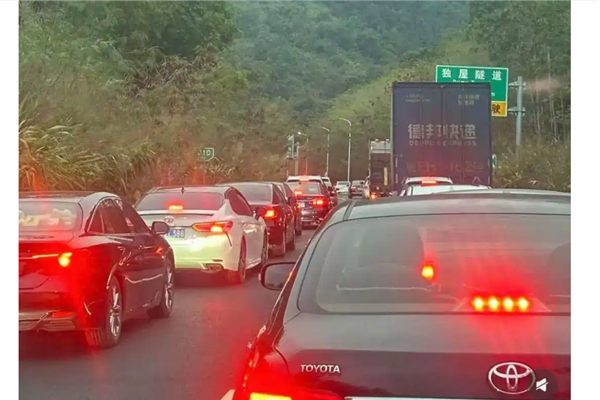
With a week to go until the traditional Chinese New Year, people who have been busy outside their hometowns for the past year are hoping to rush back home to reunite with their families before the Chinese New Year’s Eve on February 16th.
Recent reports show that multiple highways in mainland China have entered a “traffic congestion mode” as the first wave of people returning home for the Lunar New Year are stuck on the roads. Videos captured by netizens depict heavy traffic on the highways, slow-moving vehicles, and long lines of congested cars, sparking discussions online and becoming a hot topic.
According to various Chinese media outlets including “Guangzhou Daily,” on the first day of the 2026 “Spring Festival Travel Rush,” highways in many regions experienced a peak flow of vehicles heading back to hometowns, leading to extended periods of congestion on certain sections of the roads.
Some drivers returning home have reported longer travel times, with one driver mentioning that the journey from Zhejiang to Hunan took longer than usual, especially due to congested service areas along the way.
Frustrated drivers stuck on the highways have resorted to turning off their engines and sleeping inside their vehicles.
On social media platforms, many self-driving travelers have shared their experiences of being stuck on the highways. One netizen, known as “Da Xiao Wang,” shared their journey departing from Shenzhen on February 8th to return to Sichuan for the New Year, but after 8 hours of driving, they hadn’t even crossed the Guangdong province border. They revealed, “We left at 9 in the morning yesterday, took over 8 hours from Shenzhen to Zhaoqing, and rested in Guigang at night.”
Another netizen described a chaotic scene on February 7th, with long lines of vehicles on multiple highways in Guangdong heading out of the province, with some travelers expressing their frustration at being stuck for hours without making much progress.
There were accounts of travelers encountering road closures due to heavy snow while on their journey home, leading to overnight standstills and the impossibility of moving forward.
A Weibo user shared that their friend spent two hours stuck on the Jinggang’ao Expressway while returning from Shenzhen to Shaoguan on February 8th.
Reports from Guangdong indicate that the 2026 “Spring Festival Travel Rush” began on February 2nd and is scheduled to end on March 13th, lasting a total of 40 days. It is estimated that the inter-regional population movement in Guangdong will reach around 1.159 billion trips, accounting for approximately 12.2% of the national total and showing a 4.24% year-on-year increase.
Projections suggest that the inter-regional population movement in Guangdong will reach approximately 1.159 billion trips, with around 1.087 billion trips by road, showing a 4.05% increase compared to the previous year. Out of these, non-commercial small passenger car trips on highways and national and provincial roads are estimated at 1.02 billion trips, representing a 4.18% increase; while commercial passenger trips on roads are expected to reach 67 million trips, a 2.14% increase. Additionally, railway passenger traffic is projected to be 54.43 million trips, a 7.5% rise; waterway passenger traffic at 5.8 million trips, a 6.17% increase; and air passenger traffic at 114.516 million trips, a 6.76% growth.
The total traffic volume on highways in the province is estimated to be around 307 million trips, showing a 3.09% increase year-on-year, with the peak traffic expected before the New Year’s Eve on February 7th, reaching approximately 8.83 million trips in a single day, and after the New Year on February 23rd, peaking at around 8.61 million trips in a day.