
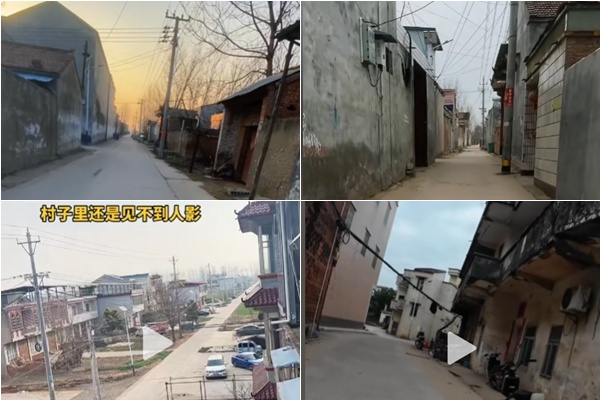
On February 10th, which is traditionally known as “Little New Year” in China, the day is usually filled with activities such as offering sacrifices to the kitchen god, cleaning the house, hanging up couplets for the Spring Festival, and welcoming the Lunar New Year. However, with the continuous economic downturn in China, rising unemployment rates, heavy burdens like housing loans, and various other financial pressures, people are feeling increasingly stressed in their daily lives. Especially in rural areas, with a decrease in income for migrant workers, the festive atmosphere of the New Year has noticeably diminished, as many villagers report a significant decline in consumer spending this year, with some unable to even afford meat.
According to reports from villagers in various regions, there are several noticeable changes this year compared to previous Lunar New Year celebrations. One, there is a clear decrease in population. Two, migrant workers have been unable to earn money, leading to financial difficulties for many families. Three, there is a significant decrease in overall purchasing power.
At the same time, social media platforms have been flooded with videos reflecting similar situations. In some villages in the northern regions, populations are sparse, resembling ghost towns.
A netizen from Heilongjiang province uploaded a video, saying, “As the New Year approaches, there are hardly any people on the streets. In previous years, it used to be lively and everyone would come back for the New Year. Where have all the people gone? It’s too desolate.”
A villager from a village in the northern region named Qiancheng described the current situation of the village, stating that in the past, every household would visit each other to exchange New Year greetings on the streets, but now, hardly anyone can be seen.
Qiancheng expressed to the media, “It’s so empty and desolate outside, where have all the people gone? Some remote villages have no one left, the entire village is deserted.”
Another villager from the central region, Wang Shun, also mentioned that the atmosphere this Lunar New Year is unusually quiet, with significantly fewer people in the village and market. He said, “In the past, the streets would be packed with people by this time. This year it’s very deserted, very few people, vegetables are not selling, neither is the meat. Nothing is selling this year.”
Wang Shun explained that due to the economic downturn, they struggled to find stable work as migrant workers over the past year, having to travel all over the country for odd jobs, yet still unable to earn money by the end of the year.
Wang Shun lamented, “We haven’t earned any money this year, we are all poor, I can’t even afford to buy a pound of meat now.” He mentioned that in previous years, they could buy fifty to sixty pounds of meat, with plenty of vegetables to last for a long time, but this year, even buying a small amount is a struggle to last a few days, “We can’t afford meat anymore.”
Xiaowei, another migrant worker who has not returned home yet, stated that his employer still owes him three months’ worth of wages, and he is still waiting to receive it. He shared, “Last year was really tough, I need to get my money before I can go home for the New Year.”
Qiancheng recalled that in the past, during the days leading up to the Lunar New Year, every household would be busy making traditional New Year dishes, steaming and frying multiple pots of food. However, due to the economic pressure, they have lost the enthusiasm to celebrate the New Year.
He further mentioned that in the past, by the end of the year, both companies and individuals would receive some money, but now, not only are they lacking funds, but they don’t even have the basic living security, making it difficult to get into the festive spirit for the New Year. Many elderly people in rural areas have passed away due to the lack of funds for medical treatment, “The pressure is too much.”
Qiancheng’s daughter works in another city and has started her own family, but due to unemployment last year and struggling with mortgage and car loans, it has been challenging. To cut costs, she decided not to return home for the New Year this year, leaving Qiancheng alone in their old house.
“Young people have mortgage loans, car loans, parents to take care of, where can they find a way out? How can we celebrate the New Year? In mainland China, there are many people who can’t afford to eat or drink,” Qiancheng remarked.