
As the Chinese New Year approaches, wage disputes have resurfaced in many places across China. Videos and information related to these incidents have been posted by an overseas social media platform account, involving regions such as Guangdong, Shaanxi, Shanxi, Sichuan, and Shanghai. Some details have not yet been released in official reports by local governments.
Several videos show that on February 4, in Shenzhen, Guangdong Province, Yarley Exploration Shenzhen Co., Ltd. was accused of owing wages to its employees. In the video footage, several workers gathered outside the company’s entrance demanding their overdue wages, with security guards holding riot shields blocking the entrance. A worker said, “Our wages have been delayed for months, we just want to get back what we’ve earned.”
On February 8, in Bagong Town, Jincheng City, Shanxi Province, several workers surrounded the town government office due to unpaid wages from a project, seeking government intervention. On the same day, at the entrance of Shaanxi Construction Engineering New Infrastructure Construction Co., Ltd., workers also protested for their unpaid wages. In Yuexi Wanda Plaza Marketing Center in Yudu New District, Maoming City, Guangdong Province, workers gathered demanding the settlement of their wages.
Also on the same day, wage protest actions were reported in Shanghai, Shaanxi, and Chengdu. In Jinshan North Station, Jinshan District of Shanghai, workers from a project related to Beijing Tonghao were protesting wage arrears; at the entrance of Shaanxi Shanjiao Chemical Industry Co., Ltd., workers were blocking the entrance; in Hanzhong, Shaanxi, several workers went to the Hanzhong Petition Office to report wage arrears and request government intervention. In Chengdu, Sichuan Province, workers climbed to a high place to demand their wages at the China Gezhouba Group Second Engineering Co., Ltd. project.
Mr. Wang, a former volunteer at Shenzhen Chunfeng Labor Service Society who has long been concerned about labor rights, told reporters on February 10, “The period before the Chinese New Year is a peak time for wage disputes. Recently, there have been wage disputes in Guangdong, and we just received a report from a factory in Huizhou where workers are unable to receive compensation.”
Regarding whether foreign-funded companies are facing similar issues, Mr. Wang mentioned, “So far, I haven’t heard of foreign-funded factories, such as Japanese or American companies, encountering such problems. Most Hong Kong and Taiwan-funded enterprises have already withdrawn.”
Aside from wage arrears, some regions have also experienced situations where businesses have shut down or business owners have gone missing. In recent years, delayed payments in construction and commercial projects have led some companies into bankruptcy or liquidation processes. In some cases, the company owners have disappeared, making it difficult for workers to claim their wages.
Mr. Liu, a Beijing scholar who focuses on migrant worker issues, told reporters, “When the economy declines, investment slows down, and the repayment period extends, small and medium-sized enterprises inevitably struggle to pay wages. In the past few years, over 90% of companies that were invested in have been losing money recently, they don’t have the funds to pay their workers.”
Publicly available information online shows that authorities across China have launched investigations into wage arrears before the Chinese New Year, mandating timely payment of wages to migrant workers. However, interviewees have indicated that in practice, local governments tend to favor enterprises, disregarding the interests of migrant workers.
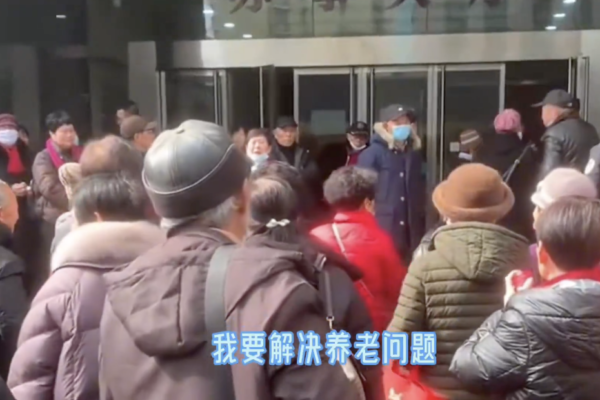
According to information released by the rights-oriented social media account “Yesterday” on February 3, hundreds of private substitute early childhood educators gathered in front of the Zhejiang Provincial Department of Education, chanting slogans demanding the resolution of the issue of “elderly lack of support” by the Chinese government. In the video, several activists gathered at the department, shouting slogans like “Give back our teaching years” and “No money to eat.”
One activist at the scene stated that since they have decades of teaching experience, they should be compensated with several decades of pension social security contributions, unified under the social security system. A person present at the scene said, “Not only us, but all elderly people who have worked should unconditionally be included in the social security system, including farmers who work the land.”
Since January, there have been continuous collective incidents in various parts of the mainland. However, no protective measures focusing on safeguarding people’s rights have been emphasized in the various regulations officially implemented this year. Legal professionals have pointed out that unlike Western democratic countries, the legal system in China is more often used to protect the interests of the authorities and prevent social protest actions.