
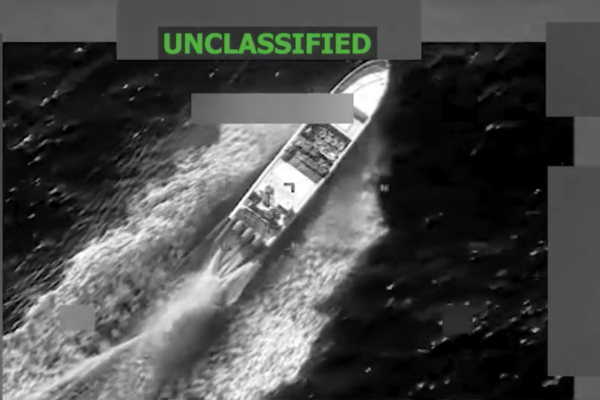
The United States military has confirmed that a deadly military strike was carried out on a drug-related vessel operating in the East Pacific on Monday (February 9th). In this operation, two suspected drug terrorists were killed while one survived.
The U.S. Southern Command announced through social media that the operation was conducted under the direction of General Francis L. Donovan by the Joint Special Operations Task Force known as “Operation Southern Spear.”
According to U.S. intelligence agencies, the vessel was sailing along a known drug smuggling route in the East Pacific and was directly involved in drug trafficking activities. The U.S. military deemed it to be part of the “narco-terrorism” network, constituting a transnational organized crime and security threat.
The military stated that the operation resulted in the deaths of two drug-related terrorists, with one surviving individual. Following the engagement, the command immediately informed the U.S. Coast Guard and initiated search and rescue procedures for the survivor.
Reportedly, the U.S. Coast Guard stated that the rescue operation was coordinated by the Ecuadorian Maritime Search and Rescue Coordination Center, with technical support provided by the U.S. side.
The Southern Command emphasized that this operation is part of “Operation Southern Spear,” aimed at combating transnational drug smuggling networks and the terrorist organizations behind them, in order to weaken their ability to engage in illegal activities through maritime channels.
This marks the third “lethal kinetic strike” operation acknowledged by the U.S. this year under “Operation Southern Spear,” following those in January and earlier this month.
In recent years, the U.S. government has consistently focused on the East Pacific and the Caribbean as key regions for combating transnational drug crimes, often highlighting close connections between some drug smuggling groups and terrorist organizations as recognized by the U.S.
The U.S. believes that these activities not only pose a serious drug threat but also present potential challenges to regional security and international maritime order. Therefore, such maritime interception operations aim to simultaneously address anti-drug and anti-terrorism objectives, with the goal of weakening the operational and financing capabilities of related criminal networks.