
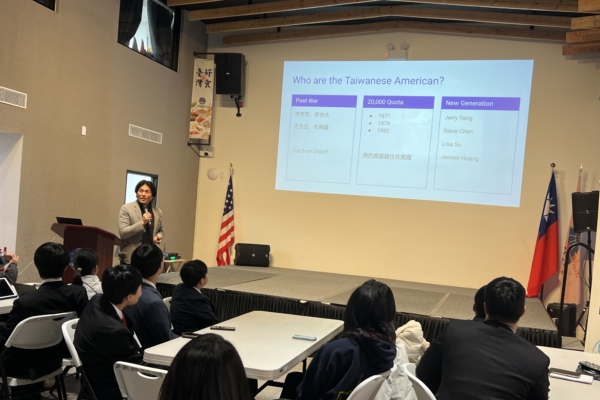
Over the decades following World War II, numerous talented youth from Taiwan crossed the Pacific Ocean to study, develop, and establish themselves in the United States. Among them are world-renowned corporate leaders, top scientists, and scholars. Taiwan and its descendants have produced many well-known Taiwanese Americans, such as Jerry Yang, co-founder of Yahoo; Steve Chen, co-founder of YouTube; Lisa Su, Chairperson and CEO of AMD; and Jensen Huang, co-founder and CEO of NVIDIA. These individuals have not only held crucial positions in the global technology industry but have also become role models for Taiwanese individuals striving to achieve the “American Dream.”
Early on, Taiwan’s students who were able to study in the U.S. were often the cream of the crop, excelling in rigorous competitions. During the 1960s to the 1980s, a well-known saying circulated in Taiwanese society: “Come to National Taiwan University (NTU); Go to the United States.” This phrase reflected the typical life path of Taiwan’s elite at that time: entering Taiwan’s top institution, NTU, before pursuing further education in the U.S., immersing themselves in the world’s most advanced research and industry systems.
The history of Taiwanese immigration to the United States is closely tied to Taiwan’s domestic social development and international political environment. After the Republic of China relocated to Taiwan in 1949, Taiwan became a crucial ally for the United States in East Asia amidst the Cold War. Through educational exchanges and scholarship programs, the U.S. admitted a large number of Taiwanese students to cultivate scientific, engineering, and management talent. Meanwhile, as Taiwan’s economy was still in its early stages of development, with limited higher education resources, many outstanding students aspired to study abroad for broader opportunities.
In the 1950s, Taiwanese students studying in the U.S. were still a minority. Early on, emigration controls were stringent, leading some individuals to take extreme measures, such as stowing away on ships or planes, to seek better developmental opportunities overseas. Simultaneously, government officials established pathways for studying abroad to nurture talent. For example, in 1954, then-Vice President of the Republic of China Chen Cheng initiated the “High School Graduate Study Abroad Program,” allowing exceptional high school graduates to directly study in the U.S., exempting them from military service. His eldest son, Chen Lu-an, was one of the early study-abroad students in the U.S. and later became a prominent political figure and scholar in Taiwan.
Starting in the 1960s, as Taiwan’s education system gradually improved and American universities actively attracted international talent, the number of Taiwanese students studying in the U.S. rapidly increased, leading to the first wave of overseas studies. These students mainly focused on fields like science, engineering, medicine, and law, and after completing their studies, many opted to remain in the U.S., becoming a significant force in American research and industry.
For instance, international law scholar Chen Lung-chih graduated as the valedictorian from Tainan First High School, gained direct admission to the law department at National Taiwan University, graduated at the top of his class in 1958, pursued further studies in the U.S., and earned a Juris Doctor from Yale University in 1964. He later became a renowned international law professor at New York Law School, earning high acclaim in the field of international law. Another example is Su Chin-huai, father of Lisa Su, who graduated from Tainan First High School, received a full scholarship to study mathematics and statistics for his Ph.D. at Columbia University, and later served as a senior policy and economic researcher in the New York City government. Lisa Su, born in Taiwan and immigrated to the U.S. at the age of 3, graduated from the Massachusetts Institute of Technology (MIT) with a Ph.D. in electrical engineering, currently serving as Chairperson and CEO of AMD, successfully leading the company out of a long period of deficit to reclaim its position as a leading enterprise in the global semiconductor industry.
The history of Taiwanese immigration to the U.S. entered a new phase after the 1970s. In 1971, the Republic of China withdrew from the United Nations, and in 1979, the U.S. severed diplomatic ties with Taiwan, establishing relations with the People’s Republic of China. These significant diplomatic changes heightened uncertainties for some Taiwanese people about their future, prompting more individuals to choose to study and immigrate to the U.S.
Xu Bocheng particularly emphasized that Taiwanese students who came to the U.S. years ago, though residing overseas, remained deeply connected to Taiwan’s fate. They not only focused on their studies but also cared about Taiwan’s position in the international community. “In 1971, when news broke that the Republic of China was forced to withdraw from the United Nations, some Taiwanese students gathered in front of the UN headquarters in New York, chaining themselves to the UN gate in protest. The New York Post even published a photo of this event,” Xu Bocheng stated. “My uncle was among those Taiwanese individuals. These were scholars who came to the U.S. on scholarships and used various methods to advocate for Taiwan.”
The concern for their homeland did not diminish over time. For decades after, during the United Nations General Assembly sessions, overseas Taiwanese residents would hold marches and gatherings outside the United Nations headquarters in New York, urging for Taiwan’s return to the UN and seeking international participation. Xu Bocheng mentioned, “This is not just a temporary action but a shared desire and historical memory passed down through generations of Taiwanese people.”
In 1981, the U.S. Congress passed the Taiwan Relations Act, which included relevant immigration provisions that officially took effect in 1982, establishing Taiwan’s independent quota in the U.S. immigration system. Under this policy, Taiwan is allocated approximately 20,000 immigrant visas annually, separate from mainland China. This measure significantly increased the opportunities for legal Taiwanese immigration to the U.S., leading to the second wave of Taiwanese immigration in the 1980s and 1990s.
As time passed, the next generation of these early students and immigrants received education in the U.S. and grew up, further entering the core of technology, finance, and academia, exerting a profound influence on global industries. From semiconductors and artificial intelligence to the internet revolution, individuals born in Taiwan or from Taiwanese immigrant families play critical roles in the advancement of global technology.
Xu Bocheng emphasized that the history of Taiwanese students and immigrants is not just a tale of individual struggle but a collective history transcending borders. Armed with Taiwan’s educational and cultural background, these individuals shine on the world stage, serving as both Taiwan’s pride and essential bridges connecting Taiwan with the world.