
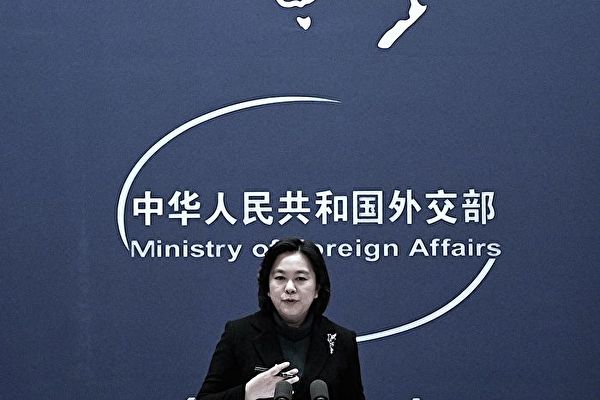
The Chinese Communist Party has officially appointed Hua Chunying as the Deputy Minister of Foreign Affairs. During her tenure as the spokesperson of the Ministry of Foreign Affairs, her “wolf warrior” rhetoric has occasionally sparked controversy. What does Hua Chunying’s promotion signify? Experts believe that this is merely a face-saving move for the party leader Xi Jinping, as since the downfall of Qin Gang, there have been no trustworthy individuals in the Ministry of Foreign Affairs.
On May 27th, the Chinese Communist Party officially announced the appointment of Hua Chunying as the Deputy Minister of Foreign Affairs, with her ranking as the last among the five deputy ministers.
Public records show that Hua Chunying was born in 1970 (54 years old) and graduated from Nanjing University. She has been working at the Ministry of Foreign Affairs since 1992, serving in various capacities including the Departments of Western Europe, Europe, News, the Embassy of China in Singapore, and the Mission to the European Union. Unlike other deputy ministers who have served as ambassadors, the highest position she held abroad was as a counselor.
Hua Chunying became the Deputy Director of the Department of News in 2012 and became the fifth female spokesperson of the Chinese Foreign Ministry. In 2019, she was promoted to Director of the Department of News. Since October 2021, she has been serving as an assistant minister while retaining her role as the spokesperson, having held the position for 11 years.
Among the five deputy ministers in the Ministry of Foreign Affairs, Hua Chunying is the only female deputy minister and the third female Deputy Foreign Minister since Wang Hairong and Fu Ying. She is also the first deputy minister in the Ministry of Foreign Affairs from the “Post-70s” generation.
Like former Chinese Foreign Ministry spokespersons Zhao Lijian and Ambassador to France Lu Shaye, Hua Chunying has been seen as a representative of China’s “wolf warrior diplomacy” in international public opinion. She has declared, “What’s wrong with being a wolf warrior?”
In February 2021, during a press conference, Hua Chunying questioned why foreigners are allowed to use Chinese social media platforms while Chinese people are not allowed to use Twitter and Facebook, leading to ridicule from Chinese netizens.
On March 25, 2021, Hua Chunying claimed at a press conference that there was no forced labor in Xinjiang, displaying a black and white photo of American “slaves” picking cotton alongside a color photo of mechanized cotton picking in China. However, later reports from American media revealed that the “slave” photo shown by Hua Chunying was actually a picture of prisoners working in American prisons in the 1960s.
Hua Chunying herself is an active user of the banned platform Twitter, frequently posting English messages praising the Chinese Communist Party and criticizing the United States.
Responses to the news of Hua Chunying’s promotion on the mainland are predominantly congratulatory and flattering; however, on platforms inaccessible to Chinese netizens, comments are filled with mockery.
In a commentary on Sino-Japanese political and economic relations, it is noted that Hua Chunying’s trajectory represents a typical “Chinese Dream” and “Communist Party member’s dream.” Starting as the daughter of a county discipline secretary, she excelled academically to enter Nanjing University, eventually joining the Ministry of Foreign Affairs. Gradually rising through the ranks, she assimilated into the Party’s machinery, relinquishing her individual consciousness and conscience to become a cog in the Communist regime.
Regarding the appointment of hawkish officials within the Chinese government, the National Committee Chair of the China Democratic Party and political scholar living in the United States, Wang Juntao, stated to Epoch Times on May 28th that Xi Jinping’s encouragement of “wolf warriors” through Hua Chunying’s promotion reflects a desire to boost this faction within the foreign policy establishment. Despite Hua Chunying’s elevation, Wang Juntao believes that if anyone were to be promoted among the hawks, it should be Ambassador to France Lu Shaye rather than Hua Chunying, as she lacks substantive hawkish policy arguments and displays ignorance.
Wang Juntao expressed that Xi Jinping’s personnel decisions, such as the rise of Hua Chunying, prioritize allegiance to him, where active compliance and proactive response to his policies take precedence over individual qualifications. By championing a strong diplomatic stance, Xi Jinping seeks to cultivate a team with superficial attributes such as gender and youth for appearances’ sake, enhancing the Communist Party’s image.
Honor Professor at the School of International Affairs at National Chengchi University in Taiwan, Ding Shufan, shared his views with Epoch Times on May 28, stating that within the Chinese Communist Party’s promotion system, Hua Chunying’s elevation does not defy convention. While not having served as ambassadors to major nations like Fu Ying, there seems to be a desire within the Ministry of Foreign Affairs to have a female deputy minister, with Hua Chunying seemingly positioned as a role model.
Chinese issues expert Wang He further elaborated to Epoch Times, stating that Hua Chunying’s promotion reflects Xi Jinping’s leadership style, prioritizing political loyalty over competence – individuals are expected to embody the “wolf warrior” persona in line with Xi’s grandiose diplomatic ambitions. Hua Chunying has accompanied Xi Jinping on various international visits, including the 2023 US-China Summit in San Francisco. Her presence during Xi’s recent visit to Europe highlights her central role in diplomatic engagements.
Many former directors of the Department of News at the Ministry of Foreign Affairs have been reassigned to significant roles, including the current Minister of the International Liaison Department Liu Jianchao and Deputy Minister of Foreign Affairs Ma Chaoxu, along with the dismissed former Foreign Minister Qin Gang.
Commenting on Xi Jinping’s unpredictable foreign policy decisions, Wang Juntao astutely remarked that Xi Jinping’s precarious standing within the diplomatic system is underscored by the lack of trustworthy individuals. Xi Jinping recognizes the untrustworthiness even within figures like Wang Yi, who possess cunning and calculative traits.
The Foreign Affairs system remains an Achilles’ heel for Xi Jinping, having lacked experience in national and international governance in his prior regional posts. As per Wang Juntao’s analysis, the realm of foreign affairs presents unique challenges, necessitating compliance with international norms and standards, areas in which Xi struggles. Thus, the individuals he promotes, such as Hua Chunying, share his paradigms, enabling their rise within the Ministry of Foreign Affairs.
Last November, the Central Commission for Discipline Inspection pinpointed political risks, integrity issues, and managerial failings within the Ministry of Foreign Affairs and Foreign Affairs system. The highlighted issues included inadequate execution of Xi Jinping’s directives, risks of leaks, infiltration, or subversion, private agendas, mismanagement of cadres, nepotism, and intolerance for dissent.
Wang He emphasized the deep-rooted corruption and fierce internal power struggles plaguing the Chinese Foreign Affairs system, illustrating Xi Jinping’s failure to establish a loyal cadre to consolidate his influence, unlike in the public security sector with Wang Xiaohong. Noting the age and enduring tenure of Wang Yi as Foreign Minister, Wang He highlighted Xi Jinping’s minimal trust in the diplomatic system.
Wang Juntao suggested that Hua Chunying’s promotion and Qin Gang’s departure reflect Xi Jinping’s vacillating foreign policy stance; Xi’s aggressive posturing towards the West has led to deteriorating relations on multiple fronts, culminating in a marked retreat in 2023 and 2024.
The hardline diplomatic approach by the Chinese Communist Party may necessitate adjustments, as inferred from Xi Jinping’s recent statements. Despite a tough exterior in conversations with the United States and certain European countries, there seems to be a requisite for internal posturing, implying a need to ameliorate relations with international counterparts to avert isolation from Western nations.
The so-called “wolf warrior diplomacy” attributed to Xi Jinping has permeated throughout the bureaucratic apparatus of the Chinese government, encapsulating officials like Hua Chunying. In the event of Xi Jinping initiating subtle shifts in policy, figures like Hua Chunying are expected to recalibrate their approaches accordingly.