
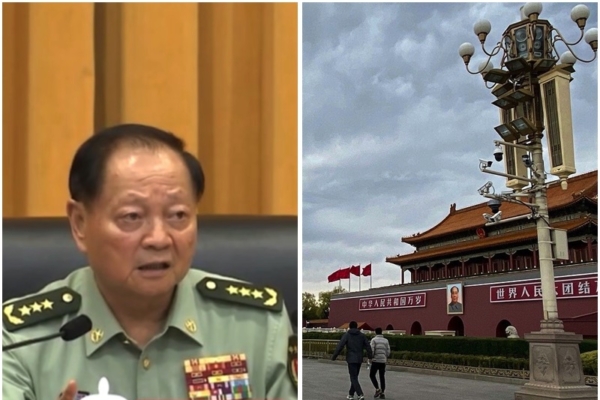
After the announcement of the downfall of Zhang Youxia, the second-in-command of the Chinese military, it not only shocked the international community but also caused a huge stir in Beijing. Recently, a post-80s Beijing resident shared his insights with Epoch Times.
On January 24, the Chinese military announced the downfall of Zhang Youxia and Liu Zhenli, the chief of staff of the Joint Staff Department of the Central Military Commission. The accusations were not about corruption but rather highly politicized “six serious issues,” including serious disruptions/negations of the Chairman’s responsibility system of the Military Commission; wrong positions on important principles; undermining and passively implementing Central Military Commission decisions; causing substantial harm to the absolute leadership of the Party and the military, and more. Subsequently, in two commentaries in the military reports, Zhang Youxia’s charges were linked to corruption.
A Beijing post-80s named Li Wei (pseudonym), who owns several properties in Beijing and leads a comfortable life, shared that after Zhang Youxia’s incident, everyone was shocked and confused about the next steps and direction. Li Wei mentioned, “People are saying, what’s going to happen next? Where are we heading? Even the common folks are baffled and unsure.”
Growing up with several active-duty military officers among his childhood friends, Li Wei expressed that senior military officers in the army think the situation is extremely bad and are concerned about potential repercussions on themselves. He stressed that many are fearful and anxious about their future.
Li Wei further analyzed that the top generals of the Chinese People’s Liberation Army have almost all been removed from their positions, causing a considerable weakening of the PLA’s combat capabilities. He questioned, “Can the army still fight? Will these officials, besides eating, drinking, engage in combat? Do the military men in the compound where I live know how to fight, at least a dozen of them?” He emphasized the lack of preparedness for combat and the situation being laughable, as they have not seen a battlefield in years.
In the aftermath of Zhang Youxia’s incident, various rumors were circulating, with at least ten different versions of his downfall. On February 4, the Chinese Communist Party convened the 20th session of the Standing Committee of the National People’s Congress. As the meeting was not held within the regular two-month cycle and ended within a day, it was considered an ad hoc or emergency meeting related to Zhang Youxia and Liu Zhenshi. However, the official announcement afterward did not mention the two, but rather disclosed the removal of three technical bureaucrats from the military system as National People’s Congress delegates.
Li Wei shared insights from his official friends that the leader may be struggling to control some of the wolves and dogs beneath him. He emphasized that the current situation regarding Zhang Youxia is particularly unstable, affecting people’s understanding and causing everyone to be in a state of observation.
He further described the tension in Beijing, where even taking children to places like the subway requires thorough identity and background checks. Li Wei noted increased surveillance and security measures in prominent areas like the Forbidden City, with soldiers carrying rifles and police diligently checking people and vehicles.
He highlighted the discontent among Beijing residents, who express reluctance to cooperate with authorities, saying, “What? Am I a fugitive? I have my ID number.” He explained that the 110 identity card, unique to Beijing, symbolizes the growing frustration and dissatisfaction among the locals.
Li Wei pointed out that discussions among Beijing residents revolve around the mismanagement of the economy, the military, and initiatives like the Belt and Road, especially the troubled Xiong’an New Area in the northern region. According to him, it is a massive failure in progress.
Regarding the Xiong’an New Area in Beijing, Li Wei mentioned that the government’s plan to relocate state-owned enterprises and central enterprises has failed, with all of them eventually withdrawing. He expressed concern about completing construction in the area and avoiding leaving it unfinished.
He emphasized the chaos in the current leadership and the adverse effects on the general population. Li Wei highlighted the growing trend of residents investing in gold and antiques as a way to secure their assets in uncertain times.
Li Wei believed that the people of Beijing are aware of the deep-rooted problems within the country and the ruling party. He noted a lack of willingness to openly discuss these issues due to fear and restrictions on freedom of expression.
Regarding state-owned enterprises, Li Wei mentioned that employees are often unproductive, with one task being handled by several individuals. He described a work culture where employees clock out immediately at the end of their shift, avoiding responsibilities and pretending not to see tasks that need attention.
The situation in Beijing reflects a growing sense of unease, with the public being more cautious and critical of the government’s actions. The uncertainty surrounding key figures in the military and governmental systems has led to a sense of instability and distrust among the citizens.
责任编辑:高静#