
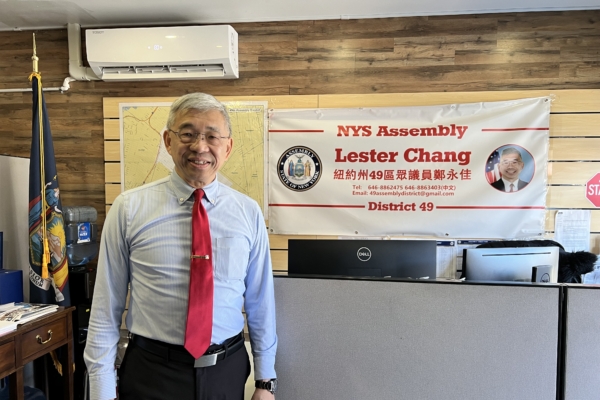
Brooklyn Bensonhurst Assemblyman Lester Chang is running for re-election this year and recently met with Chinese media reporters on the 8th to explain his policy proposals. He addressed issues such as immigration policy, affordable housing, state budget allocations, and the unequal distribution of resources between the Democratic and Republican parties. Additionally, he clarified some community rumors and emphasized his role in the state council as “independent and pragmatic.”
Looking ahead to his re-election campaign this year, Chang stated that he will continue to focus on community safety, housing policies, and the affordability of housing for young families. This includes exploring options like extending mortgage terms and shortening the timeline for housing court proceedings. He stressed that increasing homeownership rates contribute to community stability and safety, which aligns with his long-term policy focus.
Regarding immigration and public safety issues, Chang reiterated his opposition to “sanctuary city” policies, believing they do not enhance public safety and may protect criminals. He emphasized that law enforcement resources should prioritize serious crimes rather than undocumented immigrants who lead low-key lives and abide by the law.
In addressing the latter group, Chang advocated for finding legal pathways for them to stay in the United States. He revealed a conceptual immigration reform proposal called “America’s First Visa” that he has presented to the Republican Party, hoping to provide legal stay options for DACA recipients and overstayed visa holders.
According to his proposal, applicants would need to pay approximately $100,000 for the visa fee, with an initial validity of six years extendable to twelve years before being eligible to apply for a green card. Applicants would not be able to sponsor relatives, and they must undergo rigorous background and social media checks. Chang emphasized that staying in the U.S. is an economic choice that individuals should bear the cost of themselves, rather than taxpayers. The proposal is currently under discussion within the Republican Party leadership and has not been formally adopted.
On the housing issue, Chang mentioned that tax burdens, energy costs, and housing systems are crucial factors affecting affordability. He opposed any tax increases and pointed out that New York City may face a financial deficit of around $12 billion next year.
He also proposed expanding the New York State of New York Mortgage Agency’s (SONYMA) first-time homebuyer program by suggesting research into introducing 40-year, 50-year, or even longer-term housing loans to reduce monthly repayment amounts, making homeownership costs competitive with renting and helping young families enter the housing market sooner.
Chang believed that assisting residents in homeownership is more effective than ongoing government building projects, aligning better with the core spirit of the “American Dream.” His assistant, Zhao Jing’an, added that based on international experiences from countries like Japan and Singapore, higher homeownership rates lead to increased community overall safety.
In terms of state council resource allocation issues, Chang admitted that minority party (Republican Party) members are at a significant disadvantage concerning employee salaries, operating expenses, and discretionary funds due to the majority party (Democratic Party) controlling budget allocations. He proposed that true institutional balance must be achieved through gubernatorial veto power or legislative reform to ensure that members from different parties receive relatively fair resources to address voter demands.
Regarding recent community rumors alleging that he has a “staff budget of $400,000,” Chang immediately denied these claims and clarified the actual situation. He highlighted that his annual salary as a state assemblyman is approximately $142,000, and his office’s total annual staff salary budget is only around $145,000, almost the same as his individual salary. Due to limited resources, his office only employs one full-time staff member, with the rest being part-time. In comparison, neighboring Democratic Party state assembly offices have a staff budget at least $180,000 higher.
He explained that the perception that all state assembly members are “treated equally” in resource allocation is a misconception. Besides the basic salary being the same, the discrepancy in manpower and administrative budgets available to each member is substantial, showing no “uniform standard.”
Concerning fund distribution, Chang emphasized that he does not have the authority to issue discretionary checks and cannot arbitrarily allocate funds to community groups. The funds he can nominate are mostly for capital use subsidies, requiring strict planning and document review. Over the past few years, he has assisted and nominated several community organizations, including the Avenue Community Center, Bensonhurst Business Association, United Chinese Association, and Homecrest, with related funds being evenly distributed, each unit receiving approximately $50,000 to $60,000.
To address issues where Chinese and small community organizations have long complained about “lack of resources,” Chang candidly stated that the current fund distribution mechanism shows a phenomenon of “big fish eating small fish,” lacking transparency in the process. He advocated for a system where large organizations can compete for significant grants but must preserve space so that medium and small-scale organizations can also have opportunities for survival and development.
In terms of policy stance, Chang repeatedly emphasized his “independent voice” in the state council. He mentioned that he can publicly oppose congestion pricing policies and support charter schools and school voucher programs without being confined to the Democratic Party’s position. He pointed out that many politicians, despite internally agreeing with certain doctrines, cannot openly express them due to party pressures, but he can directly address what is detrimental to his community and what is beneficial.
Reflecting on the election battle three years ago, Chang highlighted his victory over a 30-year incumbent in a Democratic Party-dominant district. At that time, his opponent had a campaign budget of nearly $2 million while he spent only around $25,000. He believed that the key to his victory lay in voters’ dissatisfaction with the existing political system and their recognition of his commitment to “speaking the truth and doing real work.”
In terms of constituent service, Chang mentioned that his office has assisted thousands of cases over the past three years, without regard to party lines or districts, providing basic assistance wherever needed. He also revealed that the office is enhancing data management for cases, serving as crucial evidence for advocating for budgets and human resources from the state government.
Chang expressed his hope that voters would once again trust him to continue advocating for more equal resources and institutional balances for the community in an independent and pragmatic manner. He emphasized that the balance between the two parties is crucial for the democratic system to prevent excessive power concentration within a single party, aiding in ensuring that policy discussions and public resource allocations are more transparent and accountable.