
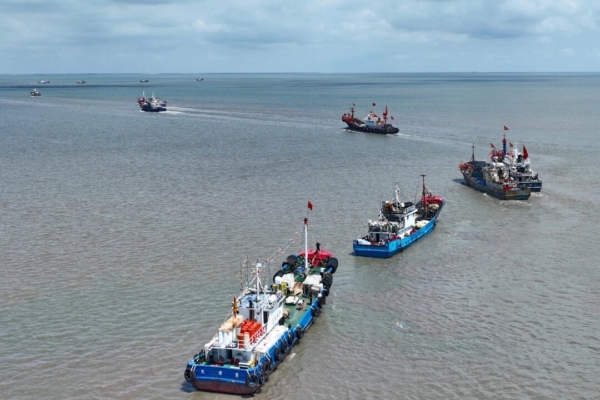
On a clear morning in the expansive Yellow Sea, Korean ship captains are cautiously navigating around something that didn’t exist a few years ago. A massive structure resembling an oil drilling platform has sprung up, flanked by bright yellow steel cages the size of apartment buildings.
This facility is not located near China’s coast but within the Provisional Measures Zone (PMZ), a maritime area jointly managed by the governments of China and South Korea, as agreed upon for shared fisheries. The “Beyond Parallel” project by the Center for Strategic and International Studies (CSIS) based in Washington, D.C., has tracked three Chinese steel structures through satellite images and Automatic Identification System (AIS) data – a modified platform and two “Shenlan” deep-sea cages.
Beijing claims the facility to be a deep-sea fish farm, showcasing octagonal cages to demonstrate China’s capability in industrializing nearshore aquaculture. South Korean sailors and officials see a steel fortress obstructing their navigation route, equipped with a prominent helicopter landing pad, three connecting bridges, and multiple decks, resembling more of a logistics hub than a maritime prison. According to a detailed report by the English version of the Korean newspaper, The Chosun Ilbo, the main platform is approximately 100 meters by 80 meters, capable of housing dozens of navy and intelligence personnel.
In early 2025, when the Korean research vessel “Onnuri” approached these structures for inspection, Chinese coast guard ships intervened, leading to a tense standoff that forced “Onnuri” to retreat. The “Beyond Parallel” project recreated this event using AIS trajectory data, elevating an initially fisheries-related incident to a national security concern in Seoul.
At the core lies a legal compromise not meant for permanent maintenance. Under a 2001 Sino-Korean fisheries agreement, both countries designated the PMZ in the central Yellow Sea, setting aside their overlapping Exclusive Economic Zones (EEZs) to negotiate final maritime boundaries. While allowing fishing activities for both sides, the agreement restricts any party from altering the status quo through establishing new permanent mechanisms or enforcing stringent measures.
Over the past decade, this agreement has gradually eroded. The Chinese authorities first laid buoys, then deployed the deep-sea cage “Shenlan-1” in 2018 and “Shenlan-2” in 2024. Additionally, a large modified platform emerged in 2022, now serving as the operational center of the facility. Reports from the Financial Times and local Korean media traced these installations appearing within a Pakistani military restricted zone despite multiple protests from South Korea.
Analysts from the Asia Maritime Transparency Initiative (AMTI) under CSIS described the main structure as a decommissioned oil platform with six operational floors, possessing “the potential for expanding beyond aquaculture.” A supporting report by Stanford University’s SeaLight project titled “Fish Farms or Footholds? China, South Korea and an OSINT Success Story” highlighted this event as a rare “OSINT success story,” where commercial imagery compelled China to acknowledge what was unfolding quietly in a corner of the Yellow Sea.
In a recent commentary from CSIS, anonymous South Korean officials labeled these platforms as part of Beijing’s “incremental sovereignty” strategy – gradual, ostensibly civil actions that alter the maritime status quo, shaping negotiating positions for future boundary talks.
South Korea’s foremost concern is basic maritime safety. The South Korean Ministry of Foreign Affairs warned that the Chinese platform physically obstructs the navigation of Korean fishing vessels and navy ships in the PMZ, a crucial fishing ground for South Korea. Mariners could previously navigate in a straight line but now must navigate around fixed barriers patrolled by Chinese coast guard ships.
Moreover, there are precedents. South Korean ruling party and opposition lawmakers conducted bipartisan hearings on the Yellow Sea facilities, passing a parliamentary resolution condemning the threat posed by these structures to maritime security and the spirit of the 2001 agreement.
Lawmakers questioned, if China can construct semi-permanent platforms in the shared management zone today, what would prevent them from building larger, better-equipped facilities tomorrow? Especially in areas that Seoul considers within its future EEZ?
This move comes as South Korea faces broader challenges in its relations with China. Over the years, the two countries have ongoing tensions over missile defense and economic coercion, and Seoul is attempting to once again stabilize ties with Beijing. Simultaneously, South Korea is strengthening security ties with Washington and Tokyo to counter North Korea and manage Taiwan-related crises. A previous report by the South China Morning Post warned that the fish farm dispute could undermine efforts to improve Sino-Korean relations.
In this backdrop, the Yellow Sea platforms evoke a sense of familiar unease. The Times reported that South Korean political figures have already begun using terms like “gangster tactics” – reminiscent of China’s militarization of artificial islands in the South China Sea.
Seoul perceives a recurring pattern: a seemingly civilian project emerges in disputed waters, gradually escalates over time, then becomes a new benchmark for Beijing to manipulate borders.
Meanwhile, Beijing attempts to construct a narrative around fish farming issues. Chinese officials insist these facilities are commercial aquaculture operations jointly run by state-owned enterprises like the Wanzefeng Group and Shandong Marine Group, asserting compliance with international law. China even invited South Korean officials to inspect the facilities while rejecting any proposals to relocate them from the PMZ.
The message from Beijing is clear: the platform will remain, and Seoul’s choice is either silent acceptance or vocal opposition.
Yet, as the technology debate intensifies between the two countries, South Korean officials and Western analysts lean towards describing the Yellow Sea platform as a case of gray-zone coercion. This term, common in alliance theory, refers to the use of civilian or quasi-military means – such as coast guards, fishing fleets, survey ships, “private” infrastructures – to alter the status quo in maritime areas while staying below the threshold for triggering a military response.
The Chinese regime excels in deploying this strategy in the South China Sea, presenting ostensibly civilian dredgers and construction teams while transforming contested reefs into military bases with runways, radar, and missile launch sites. It also employs its maritime militia – fishing vessels following local military commands, conducting activities near disputed reefs – utilizing similar tactics. Investigations by The Guardian and regional think tanks documented how these forces assist Beijing in pressuring the Philippines and Vietnam over the island dispute.
While the situation in the Yellow Sea varies slightly, the tactics remain the same. The platforms and cages serve commercial purposes under fisheries companies and provincial state-owned enterprises. They strategically sit in an undefined boundary but critical region for South Korea’s food security and naval posture.
They likely function as dual-use vessels, equipped with sufficient power, deck space, and communication equipment to carry sensors or serve as logistics nodes for law enforcement and militia ships. They come with an “enforcement bubble”: Chinese coast guard ships swiftly monitor and intercept any Korean vessels that come too close.
To outsiders, this might seem like a technical dispute in the crowded aquaculture sector of Northeast Asia. But that would be a misjudgment. The PMZ platform guards important fishing grounds and potential maritime routes, requiring any future South Korean administration to defend the safety of this maritime area amidst increasing climate and food pressure, faced with an assertive Chinese regime.
As Washington becomes aware of the scale of Beijing’s maritime ambitions, these reports follow suit. A new joint report by the House Select Committee on the Chinese Communist Party and the Maritime Subcommittee of the Homeland Security Committee titled “China’s Global Fishing Offensive” concludes that Beijing currently controls the world’s largest DWF fleet – approximately 2,000 to 16,000 vessels, contributing to about 44% of global fishing between 2022 and 2024 – using it as “a weapon” of the CCP.
This report extends beyond the Yellow Sea, documenting various human rights violations and coercion from West Africa to Latin America. It should provide a clearer understanding for the United States and its allies of the steel contours appearing on the western horizon of the Korean Peninsula. These platforms undoubtedly represent a distinct maritime governance concept – where so-called civilian facilities and fleets could be deployed in disputed waters, established as fait accompli, then leveraged in the next political crisis for gains.
For those concerned about China’s maritime rise, the Sino-Korean Yellow Sea dispute is not a peripheral issue but a prelude to future developments. The CCP regime still poses a security threat to many nations within its sphere of influence.