
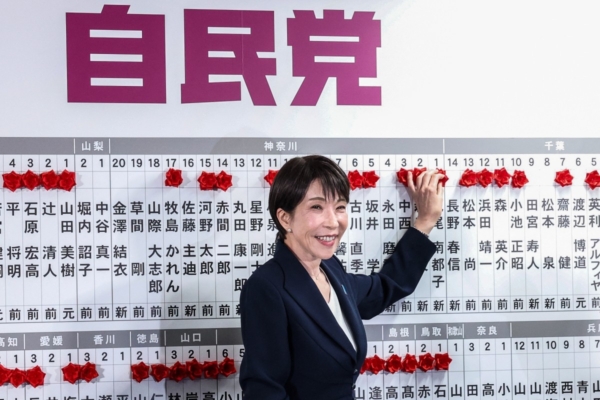
Japan held parliamentary elections on Sunday, February 8th, with Prime Minister Sanae Takai’s ruling coalition achieving a resounding victory, giving Takai a strong mandate to advance her political agenda. Experts say that the Chinese Communist Party (CCP) is forced to acknowledge the reality that its tactics to isolate Takai have completely failed.
Takai draws inspiration from the “Iron Lady” Margaret Thatcher of the United Kingdom. She has amassed a large following on social media, with voters drawn to her candid and hardworking image.
Following the election results, Takai stated in a televised interview, “This election involves significant policy shifts, especially in economic and fiscal policies as well as enhancing security policies.”
Reuters reported that Takai’s strong performance in the election could accelerate her plans to bolster Japan’s defense, further angering the CCP.
As election results are announced, Japanese Defense Minister Taro Kono said in a television interview that Japan hopes to accelerate policies to strengthen its defense while engaging in dialogue with Beijing.
David Boling, the head of Asia Group providing geopolitical risk information for businesses, stated, “Beijing will not welcome Takai’s victory.”
“China (CCP) now faces the reality that Takai’s position is secure—its efforts to isolate her have utterly failed,” Reuters quoted Boling as saying.
According to the Japanese news agency Kyodo News, political science professor Masahiro Iwasaki of a Japanese university had stated before the election, “If the Liberal Democratic Party (LDP) achieves a resounding victory in the election, Prime Minister Takai may take a more assertive stance on security issues.”
At a press conference on January 19th, Takai explained her decision to call for early elections, stating that she seeks public authorization and political stability to boldly advance policies and reforms that may provoke domestic divisions.
Japan currently faces its most severe security environment since World War II, with the CCP military intensifying maritime and aerial activities in the Indo-Pacific region and North Korea conducting multiple ballistic missile launches into the Sea of Japan, including two short-range missiles on January 27. The LDP’s campaign promises include amending the post-war peace Constitution for the first time and enhancing intelligence operations.
Robert Eldridge, the North Asia regional director of the Global Risk Mitigation Foundation, commented, “Given the growth in the quality and quantity of weapons systems and the military, it is understandable and expected that Japan would increase defense spending.”
Takai, known for her hawkish stance towards China, became Prime Minister in October last year. Shortly after taking office, she publicly discussed how Japan might respond to a CCP attack on Taiwan, stating that a conflict in the Taiwan Strait could be seen as a “threat to Japan’s survival.” This stance effectively provides legal basis for Japan’s military intervention in the event of a Taiwan Strait conflict.
This sparked the biggest dispute with Beijing in more than a decade. The CCP then took a series of economic retaliatory measures against Japan and repeatedly demanded Takai retract her statements. The CCP also launched a propaganda campaign, manipulating state media to report negative comments about Takai. CCTV’s “Xinwen Lianbo” aired at least one segment criticizing Takai every day for a period of time.
The CCP’s economic retaliation and propaganda campaign aimed to discredit Takai domestically, but unexpectedly, these actions have boosted Takai’s high approval ratings in Japan. The highly anticipated results of the parliamentary elections on Sunday serve as evidence of this.
As the CCP becomes increasingly assertive, Takai is accelerating the process of increasing defense spending. In December last year, the Japanese parliament approved a supplementary budget for the 2025 fiscal year, raising defense spending to 2% of the gross domestic product (GDP), two years ahead of the initial plan.