
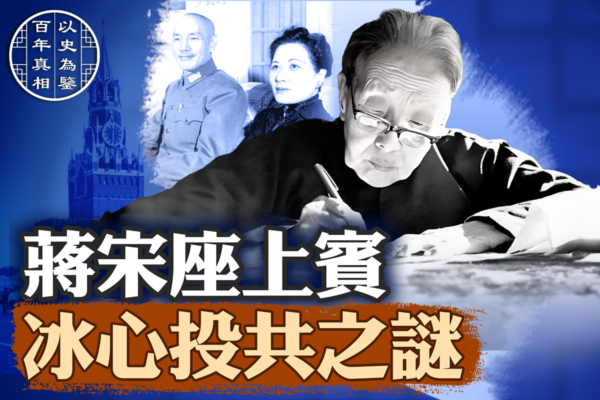
Audience members, hello everyone! Welcome to watch “The Hundred-Year Truth”.
Bing Xin, a famous female poet, novelist, and essayist in modern China.
This talented woman had close ties with both the Kuomintang and the Communist Party, was classmates with Soong Ching-ling, received courtesy from Chiang Kai-shek, but ultimately defected to the Communist Party. However, during the madness of the Cultural Revolution, she was insulted by the Red Guards as a “vampire” and “imperialist lackey”, plunging three generations of her family into turmoil!
Today, let us delve into the twists and turns behind this story.
Bing Xin, born Xie Wanying in 1900 into a wealthy Christian family in Fuzhou. Her father, Xie Baozhang, later became a high-ranking official in the Republic of China Navy and moved the family to Beijing.
At a young age, Bing Xin attended the American missionary-founded Beiming School and the preparatory department of Concordia Women’s College, dreaming of becoming a doctor to save the dying and injured, thus choosing a science major.
In 1919, the fervor of the May Fourth Movement swept the nation, igniting her passion for literature! She boldly switched to a literature major, engaged in student movements, and began writing under the pen name “Bing Xin”.
Why the name Bing Xin? She said it came from a Tang poem, “A piece of ice in a jade pot,” which not only had simple strokes but also echoed the character “ying” in her name, symbolizing purity and flawlessness.
Her cousin was the editor of one of the four major newspapers at the time, “Morning News”, and encouraged her writing, leading Bing Xin to quickly gain prominence. In 1921, she joined the literary research society founded by Zhou Zuoren and Jiang Baili, the first pure literary group in the history of modern Chinese literature!
After graduating from the preparatory department of Concordia Women’s College, Bing Xin entered Yenching University. Founded by the American John Leighton Stuart, this institution became the cradle of her literary career. In 1923, she received a scholarship from Wellesley College in the United States, went abroad to study English literature, and returned three years later with a Master’s degree to teach at Yenching University and Tsinghua University’s women’s college of arts and sciences.
In 1929, Bing Xin married Wu Wenzao, whom she met in the United States. Wu Wenzao was a Columbia University Ph.D., social anthropologist, and ethnologist, who was also a renowned scholar at the time.
Their wedding ceremony was officiated by John Leighton Stuart, the president of Yenching University, at his residence, Linhu Xuan. This couple was a prominent figure in the elite circle of Chinese society at the time, attracting much attention!
In 1937, the Japanese invaded China, and the flames of war spread. Bing Xin and Wu Wenzao resigned from their positions at Yenching University and went to the southwestern rear with ideals and beliefs.
At the end of 1940, Chiang Kai-shek’s wife, Soong Ching-ling, personally invited them to Chongqing. Soong Ching-ling and Bing Xin were alumnae of Wellesley College, and in the capacity of alumnae, she invited Bing Xin to be a member of the National Political Council, with a monthly salary of precious white rice in wartime! Wu Wenzao served as a counselor at the National Defense Commission in Chongqing, specializing in ethnic, religious, and educational issues on the border.
Bing Xin visited Soong Ching-ling three times, each time at Chiang Kai-shek’s residence on the outskirts of Chongqing, including one occasion when Chiang Kai-shek and his wife dined together with Bing Xin and Wu Wenzao.
Bing Xin vividly recorded these meetings in her works, praising Soong Ching-ling as “among all the women I have met, never have I seen anyone as sharp and astute as Madam. She is slim, vigorous, especially with those clear beautiful eyes.”
The support of the Chiang-Soong couple greatly improved the living standards and social status of Bing Xin’s family, making them VIPs in the political arena at that time. Their lives seemed like a glamorous painting, enviable to many.
In 1945, after the victory of the war, Wu Wenzao was sent to Japan as the political group leader of the Chinese Embassy in Japan, also serving as a Chinese consultant in the Allied Commission for Japan. As a result, Bing Xin’s family lived in Japan for five years.
From 1949 to 1951, Bing Xin taught new Chinese literature at the University of Tokyo, gaining great fame. However, during this time, the Communist Party’s united front reached out quietly to this prominent couple.
Wu Wenzao’s deputy, Xie Nanguang, was a member of the underground Communist Party. Through him, Bing Xin and her husband came into contact with Mao Zedong’s writings, attracted by the Communist Party’s “beautiful promises”. They began to secretly plan to defect to the Communist Party.
In 1951, Yale University in the United States invited Wu Wenzao to teach, and they applied to travel to the United States through the Nationalist government in Taiwan. Given their past trust, the application was approved within a week.
However, instead of heading to the United States, they followed Zhou Enlai’s secret arrangements, taking their three children to Hong Kong first, returning to the mainland, and residing in a courtyard in Beijing’s Dongdan prepared by Zhou Enlai.
In fact, Bing Xin had early ties with the Communist Party. In 1941, she met Zhou Enlai for the first time at a welcoming ceremony of the Literary and Art Resistance Against the Enemy Association in Chongqing. At that time, Zhou Enlai was in charge of the Southern Bureau of the Communist Party, specializing in cultural united front work.
Afterward, Bing Xin gradually became close with Zhou Enlai and his wife, especially establishing a close relationship with Deng Yingchao, whom she called her “first confidante in her life”.
This friendship became a significant factor in her later choices.
During the initial years back on the mainland, Bing Xin’s family was esteemed. Bing Xin became the honorary chairperson of the China Democratic Promotion Committee and the vice chairman of the Writers’ Association, enjoying a prominent status. However, in 1957, the storm of the Anti-Rightist Campaign arrived, and everything changed.
Wu Wenzao was labeled a rightist, had his position as head of the department revoked, and was stripped of his teaching rights. He suffered greatly, often murmuring to himself, “They accuse me of being anti-Party and anti-socialist, digging into my roots, how can I dig, what should I dig? If I were against the Party and socialism, I would have stayed abroad to oppose, why would I come back to oppose?”
Their son Wu Ping was sent off to labor reform in Tianjin as a rightist for his words. Their daughter Wu Bing, studying at Peking University, was exiled to Lanzhou for her “right-leaning” tendencies, shattering her dream of staying in school.
If during the Anti-Rightist Campaign, Bing Xin and Wu Wenzao’s family endured spiritual torment, during the Cultural Revolution, they faced not only spiritual but also physical torture.
Because Wu Wenzao was a “hat-grabbed rightist,” he became a target of the revolution from the onset of the “Cultural Revolution” and was required to engage in four hours of labor every morning.
One day in August 1966, the Red Guards burst into Bing Xin and Wu Wenzao’s home, demanding that they kneel on the stone road, kneeling for three hours. Even the nanny carrying their two-month-old grandchild was not spared, and the child was not allowed to drink milk!
To avoid further denunciation, Bing Xin requested to stop receiving her salary, then donated all her fixed deposits, the clothes she wore abroad, and the gifts she received. Yet, even this did not prevent further troubles.
A month later, the Red Guards ransacked their home, taking away photos, memorabilia, clothes, watches, calligraphy, and paintings, without issuing any receipts. The items they deemed useless were thrown onto the ground and destroyed.
A few days later, the Red Guards held an “Exhibition of Bing Xin’s Bourgeois Lifestyle”, labeling Bing Xin and Wu Wenzao as “vampires”.
The nearly seventy-year-old Bing Xin stood with a large sign around her neck that read “bourgeois wife, revisionist gang writer”, standing under the scorching sun at the exhibition entrance for hours on end.
Wu Wenzao was sent away for denunciation, labeled as “remnants of the Kuomintang,” an exposed-rightist, and a reactionary academic authority of the bourgeoisie.
Bing Xin was imprisoned in the “cowshed” for three years, departing at six in the morning from the western suburbs, rushing to the Writers’ Association building to clean the four floors of restrooms, then engaging in endless self-criticism, studying Mao Zedong’s works and quotes, and enduring constant denunciation.
In 1970, the 70-year-old Bing Xin was sent to the Xianning 57th High School in Hubei to plant cotton, harvest wheat, and repair roads alongside Wu Wenzao. These physically demanding tasks she had never done before were now placed on her frail shoulders. Born into a wealthy family, she never imagined that at the age of 70, she would be forced to do agricultural work.
Their daughter Wu Qing was teaching at Beijing Foreign Studies University at the time, constantly pulled into denunciation by students. Their grandson was only two years old, frightened by nursery teachers who warned him, “Your grandmother, grandfather, and mother are ‘black,’ scaring the child into nightmares, cowering in bed and crying.
Reflecting on the post of the Cultural Revolution, Bing Xin lamented, “At that time, there was no humanity; it turned into animalistic behavior.”
In 1971, Mao Zedong decided to establish diplomatic relations with Western countries. In July of that year, the then-US President’s National Security Adviser, Henry Kissinger, made a secret visit to China. In order to receive Nixon, engage with the United States, and understand Nixon, the Communist Party needed insights into the West.
The Communist Party decided to translate some Western books, especially history books. Translating such books was challenging, the abilities of the rebels were insufficient, and all universities had suspended classes at that time, with intellectuals undergoing labor reform in rural schools.
Out of necessity, the Communist Party decided to gather the scholars who had previously studied in Europe and the United States to translate these books. Bing Xin, Wu Wenzao, Fei Xiaotong, and other “stinking old nine” were now deemed useful people, thus spared from the physically demanding labor at the rural schools.
Conclusion
Reflecting on her experiences during the Cultural Revolution, Bing Xin wrote, “To be honest, after the tumultuous waves of the Anti-Rightist Campaign, into the ten years of the catastrophe, even the President and founding fathers of the country could not escape, if we ‘stinking old nine’ did not face family ruin, that was already lucky enough.”
This reflected her true inner feelings. Many intellectuals believed in the lies of communism, risked aiding the Communist Party in seizing power but ultimately ended up with the tragic outcome of family ruin.
Alright, that’s the end of today’s show, thank you for watching. If you enjoyed our program, don’t forget to like, share, and subscribe. See you next time.