
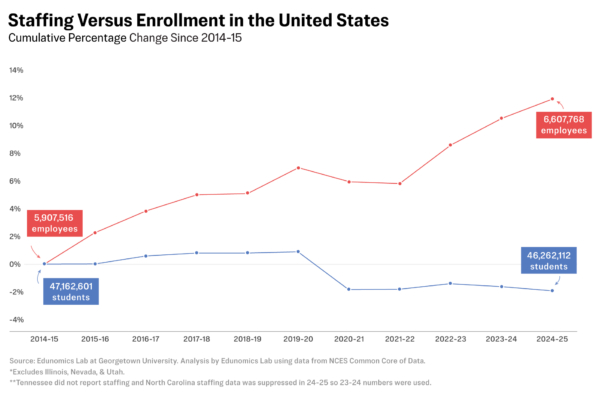
Latest data shows that in most public school districts in the United States, the number of staff continues to increase while student enrollment remains stagnant or even decreases.
As districts begin to develop budget plans for the 2026-2027 school year, the situation is approaching a critical juncture. Policy experts warn that federal relief funds allocated to address the COVID-19 pandemic have been exhausted, and state aid based on enrollment numbers has also decreased, forcing education boards across the country to make tough choices between layoffs and raising local property taxes.
The Edunomics Lab at Georgetown University in Washington, D.C. analyzed data released by the National Center for Education Statistics and found that over the decade from 2015 to 2025, public K-12 school enrollment across the U.S. decreased by nearly 900,500 people, a 1.9% decline. Meanwhile, during the same period, the number of staff (including teachers and support personnel) increased by over 700,000, a growth of 11.8%.
Virginia saw the largest changes in the past decade, with staff numbers increasing by 18.6% while enrollment dropped by 2%.
The National Center for Education Statistics has begun releasing data for the 2024-2025 school year over the past two months, but the latest information for each state is not yet available.
Data from the National Center for Education Statistics indicates that over the past ten years, more than 80% of states saw a decrease in student enrollment while the number of teachers grew.
However, the growth in teacher numbers is relatively modest compared to the significant increase in administrative and non-teaching staff, which appears negligible in comparison.
Between the 2019-2020 school year and the 2023-2024 school year, the Edunomics Lab analyzed the addition of 200,000 positions (many funded through federal aid), revealing that only 17% of the new positions were teachers, 18% were teaching assistants, and the remaining 65% included administrative staff, coordinators, counselors, interventionists, coaches, and student support personnel.
Even in states where student enrollment has seen some growth, the increases have been marginal. According to Burbio, which tracks public school funding and expenditures, the largest increase in enrollment from 2020 to last year was in public schools in the District of Columbia at 2%, followed by Arkansas at 1.2%.
During this period, staff numbers in Washington, D.C. public schools increased by 18%.
In most states where student enrollment increased, such as Utah, Oklahoma, Idaho, Maryland, Florida, Tennessee, Washington, North Dakota, and South Dakota, there was also a significant rise in staff numbers disproportionate to the increase in student numbers.
Data from the Edunomics Lab shows that New Hampshire, Mississippi, and Wyoming experienced decreases in both enrollment and staff numbers.
The analysis by the Edunomics Lab also revealed that student loss has been observed in the five largest school districts in the country—New York City, Los Angeles, Miami-Dade County in Florida, Chicago, and Clark County in Nevada. Among these districts, only Miami-Dade County saw a decrease in staff numbers.
Burbio reported that the most significant changes for Los Angeles Unified School District occurred in the 2022-2023 school year. Enrollment decreased by nearly 26%, while staff numbers increased by 19%.
Los Angeles Unified School District has a budget of $18.8 billion this school year, expecting a $1.6 billion deficit but aims to resolve this deficit by 2028. The district has not conducted layoffs or closed any facilities.
The district’s website shows that the current spending plan includes an additional $25 million allocation for the Black Student Achievement Program, hiring 7 regional supervisors, 4 district-level administrators, 15 instructional coordinators, and 5 administrative coordinators. The budget also increased by $2 million for LGBT awareness training. The district features a “social and gender equity” themed middle school with core offerings in social justice education, film production courses, and daily yoga classes.
“The budget reflects priorities, and even in budgetary constraints, we must make decisions that protect our students, especially those most vulnerable and those currently targeted by the federal government,” stated Kelly Gonez, a member of the Los Angeles Unified Board of Education, in a statement from June 2025.
“This resolution reflects the board’s commitment to upholding values of fairness, transparency, enhancing key work of employees, and meeting student needs in handling any layoff matters.”
This month, as Burbio analyzed the student-to-teacher ratios and the ratio of students to non-teaching staff in the 25 largest districts in the country, comparisons were made between the 2019-2020 and 2024-2025 school years. Among the districts reporting data for this period, 15 saw a decline in student-to-teacher ratios, and 17 saw a decrease in the student-to-staff ratio.
The Reason Foundation, a non-profit headquartered in Los Angeles, released a report earlier this month titled “Staffing surges and student outcomes: Rethinking unions, resource allocation, and school choice in American education,” outlining this pattern of disparity observed since 1998. For districts experiencing declining enrollment, the number of staff per 100 current students increased by 25.5% from 2018 to 2019, with each staff member’s salary and benefits rising approximately 77%.
The report suggests that this growth seems to be driven by an increase in teaching and support staff positions, including counselors, librarians/media specialists, administrators, and school board support personnel.
“The reason for this situation is that cutting teachers, layoffs, and downsizing come with significant political costs,” said David Hoyt, Executive Director of the national non-profit School Board for Academic Excellence, who collaborates with public school leaders. “However, the issue of bloated administrative agencies is also very serious.”
Hoyt revealed that over the past decade, districts have added numerous administrative staff positions to comply with state and federal laws covering staff ratios, curriculum offerings, facility construction, and even student discipline requirements. Today, even smaller districts have assistant principals assigned for each grade level, along with assistant superintendents overseeing teaching, special education, technology, and transportation.
Shaka Mitchell, Senior Researcher at the American Federation for Children (AFC) based in Texas, pointed out that outdated local regulations are one of the reasons for the bloated administrative structures in public schools. For instance, while working at a public elementary school in Tennessee, the school mandated having a staff member track and execute space allocations, down to counting parking spaces, even though the school had ample parking for staff or visitors, and students weren’t of driving age.
Mitchell also noted that many districts nationwide allow the most ineffective lifelong teachers to transition into some form of administrative role to protect their employment.
“Many such additional costs do not add any value to classroom instruction,” he added.
When administrative bloat occurs, warnings can often be seen through the primary source of funds for school districts across the U.S., property taxes. According to the Lincoln Institute of Land Policy in Massachusetts, local governments provide 45% of funding for public elementary and secondary education, with 80% of this coming from property taxes.
If staff numbers increase while student enrollment decreases, the state’s allocation per student naturally decreases, prompting local governments to raise taxes to fill funding gaps.
When states reclaim funds from local governments and districts, homeowners often quickly see a significant increase in their tax bills.
Beth Blackmarr, a homeowner in Lakewood, Ohio, and media director for the grassroots organization Citizens for Property Tax Reform, stated that over the past two decades, mostly all the 31 school districts in Cuyahoga County, Ohio have witnessed declining enrollment, with Cleveland city schools experiencing a 50% drop in enrollment while staff numbers and tax rates continue to rise overall.
“We certainly believe that good public schools are important to our community, but we bear an unfair burden,” Blackmarr told the Epoch Times.
She mentioned that her 100-year-old two-bedroom bungalow incurs a total of $4,600 in local property taxes each year, nearly triple the amount in 2008.
Blackmarr expressed that attracting and retaining excellent teachers is increasingly challenging, and merging multiple districts into a county-wide district would reduce the staggering number of high-salaried administrative staff, freeing up more funds for classroom instruction.
“There could be a better way to slice the pie,” she said.
A decline in the birth rate, shifting populations towards other states, and the right to school choice are only some of the reasons behind declining enrollment. According to data compiled by the nonprofit organization EdChoice based in Indiana, over 18% of K-12 students in the U.S. choose charter schools, private schools, or homeschooling. As more states and the federal government promote school choice, this number is expected to continue growing.
Mitchell believes that charter schools and private schools, especially those serving low-income populations, have always been on tight budgets and cannot withstand the financial pressure brought on by bloated administrative structures.
He stated that in the coming months and years, decisions regarding public school budgets, whether made by voters or local governments, will face far more rigorous scrutiny than ever before. While parents continue to fund the government education system through taxes, more and more parents are pulling their children out of public schools.
“Parents are noticing that the funds in schools aren’t really being directed towards classroom instruction,” explained Mitchell to the Epoch Times. “I think we’ll see school boards having to face the harsh reality of their financial dilemmas. They will be up against some very tough choices.”
If reforms are made prioritizing teaching quality, flexible management, and accountability rather than solely focusing on staffing, real benefits can be brought to students.