
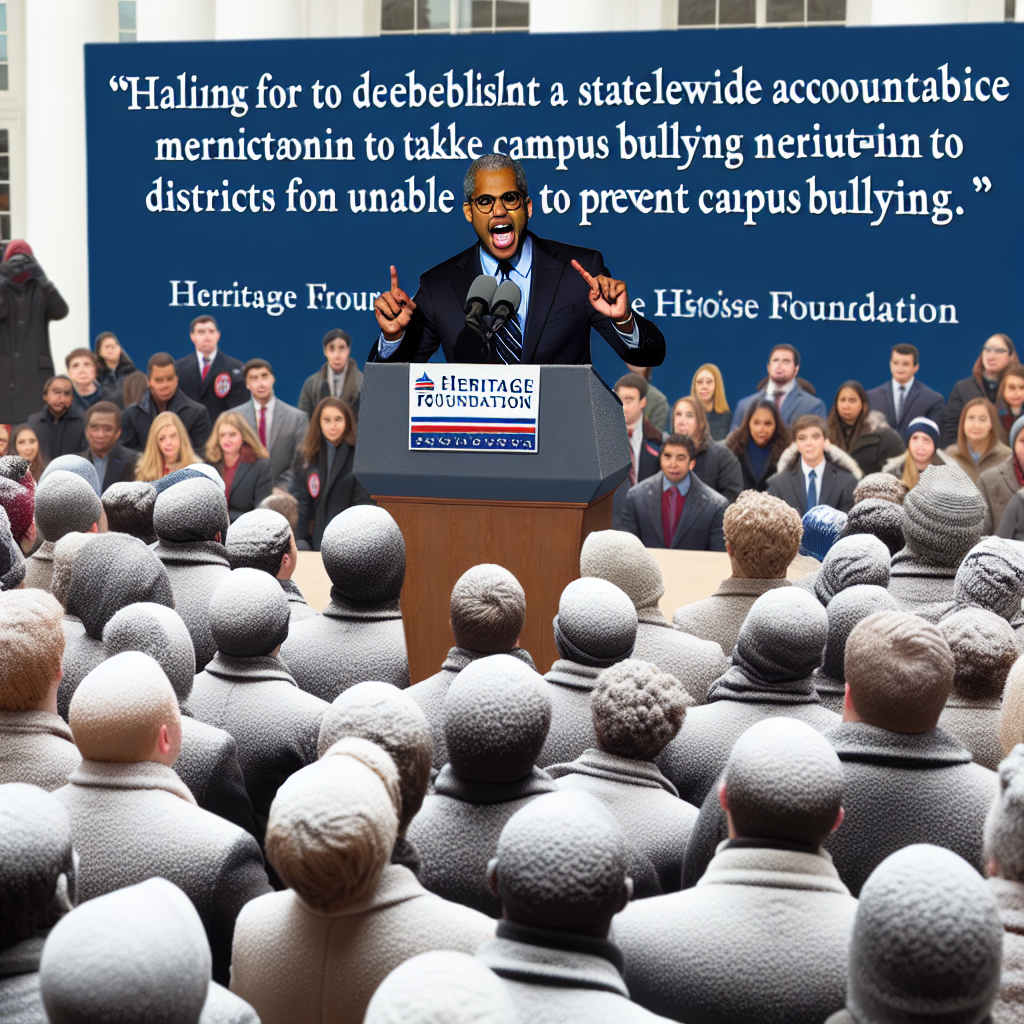
On Wednesday, February 4th, at a discussion hosted by the Heritage Foundation in Washington, D.C., Stephen Gilchrist, the Vice Chair of the Civil Rights Commission, called for the establishment of a statewide accountability mechanism for campus bullying. He also suggested that districts failing to properly address bullying incidents should face funding cuts.
Gilchrist revealed that his son, Daniel Gilchrist, was subjected to prolonged bullying by classmates during his time in middle school, to the extent that other students and even school staff referred to him as a “snitch.”
In 2024, surveillance footage from a public school in South Carolina showed another student punching Daniel in the face during a basketball class. Gilchrist mentioned that while other children turned a blind eye, teachers stood in a corner looking at their phones, completely unaware of the situation.
A week later, another student filmed Daniel sitting in a restroom stall and circulated the video to the entire school with racially derogatory text accompanying it.
Gilchrist reported both incidents to the school authorities and the police. Although arrests were made in both cases, the perpetrators continued to remain on the campus. Despite the cases being in criminal proceedings, the school did not disclose any disciplinary actions taken.
Over five terms, Gilchrist sent 180 emails to the district regarding bullying incidents, receiving minimal responses mostly consisting of teachers complaining that the victim complained about classmates too often.
School officials stated that they could not take action against bullies unless a formal complaint was filed in accordance with Title IX of the federal Education Law, which pertains to gender and sexual harassment.
Gilchrist opposed this stance, stating during the Heritage Foundation discussion on Wednesday that Daniel’s case is a microcosm of the current state of campuses across America. “Action must be taken now,” he said.
Gilchrist called for the establishment of a statewide accountability mechanism, suggesting that if district staff fail to handle bullying incidents properly, their funding should be reduced.
Furthermore, Virginia Gentles from the Defense of Freedom Institute proposed that victims of campus bullying should be eligible for vouchers to attend private schools through new federal tax incentive programs.
Both individuals stated that they will submit these proposals to members of Congress in the coming months.
Gilchrist mentioned that approximately 5,000 students in his South Carolina district are planning to transfer to charter schools, which could lead to the layoff of up to 1,400 teachers.
In May 2025, Trump issued a “Dear Colleague Letter,” reminding state and district leaders to comply with event reporting regulations.
The letter highlighted that during the 2021-2022 school year, there were 1.2 million violent incidents in K-12 public schools nationwide, yet “no schools were reported as continuously dangerous.” Once a school is identified as continuously dangerous, parents can transfer their children to other schools. Only four schools were listed as continuously dangerous in the following year, and five in the 2023-2024 school year.
The Elementary and Secondary Education Act of 1965 does not establish a disciplinary mechanism for teachers or school staff who fail to accurately document or report incidents, let alone document multiple incidents to assist state and federal governments in identifying high-risk campuses.
Gentles stated, “This system has failed on many levels.”
Gilchrist added, “We must reinforce the responsibility and duty of educators who are aware of problems occurring on campus.”
Jonathan Butcher, acting director of education policy at the Heritage Foundation, pointed out that lax discipline in many school districts across the country stems from policies during the Obama era that penalized schools with disproportionately high suspension rates for Black or Hispanic students.
Affected by this policy, districts, to avoid discrimination accusations, deliberately downplayed violations involving Black students, leading to a loss of campus discipline.
Gilchrist mentioned that his district is a case in point. Daniel, the bullies in the two incidents, and the majority of students in the area are Black.