
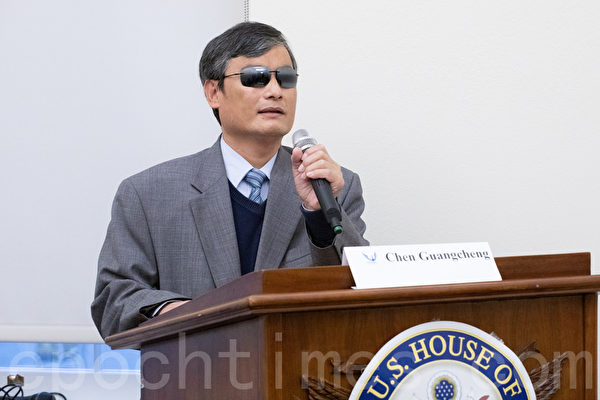
Former Chinese human rights lawyer Chen Guangcheng, who now resides in the United States, has filed a lawsuit against Chinese online media personality Wang Zhi’an, who is currently living in Japan, for spreading rumors and defamation. The case has been formally accepted by the Tokyo court and is scheduled for next Tuesday, February 10th.
In a statement released on social media platform X on Friday, Chen Guangcheng stated, “Regarding the defamation and slander conducted by Wang Zhi’an against me, I filed a lawsuit for reputational infringement damages in accordance with the law with the Tokyo District Court on December 24, 2025. I am requesting the defendant to compensate for reputational infringement damages totaling 330 million yen. The case has been officially accepted by the court and the trial is set to commence on February 10, 2026 (Tokyo time).”
This legal action is in response to Wang Zhi’an, a former CCTV media personality, who on August 18, 2025, uploaded a video on the streaming platform YouTube targeting Chen Guangcheng. In the video, Wang repeatedly claimed, “Chen Guangcheng is not blind, his eyes are perfectly fine!”
In a response video released by Chen Guangcheng on Friday, he stated, “Wang Zhi’an, through editing clips, selective quoting, changing concepts, and logical leaps, arrived at the conclusion that ‘Chen Guangcheng is not blind, his eyes are fine’ and ‘Chen Guangcheng is not blind, it is this society that is blind,’ and based on this, further negated my character, integrity, and the legitimacy of my long-standing public activities.
“The related videos continue to spread across the internet, being amplified and solidified in the comments section and on social platforms, gradually evolving into personalized accusations and sustained attacks against me.
“I chose not to defend myself in the court of public opinion, allowing time to settle the facts and for society to see clearly: perspectives can be debated, positions can differ, but Wang Zhi’an not only denies medically verifiable facts but also further extrapolates, maligning me on multiple fronts, crossing the boundary of freedom of speech.
“Now, I have filed a lawsuit for reputational infringement damages with the Tokyo District Court, and the case has been formally accepted. This action is not aimed at criticism itself, nor is it a response to political differences. It is a demand for legal accountability for spreading rumors and defamation under the guise of seeking the truth.”
According to records from Dajiyuan, the video posted by Wang Zhi’an on his YouTube channel targeting Chen Guangcheng has a duration of 53 minutes and 52 seconds, with tags such as “political asylum” and “US Embassy in China.” As of Friday, the video has been viewed by 480,000 people.
According to the host of the “Sino-U.S. Comparison” program’s exclusive report on Chen Guangcheng’s lawsuit against Wang Zhi’an, the lawsuit strategically led by Chen Guangcheng against Wang Zhi’an for defamation is very restrained and precise. The plaintiff’s lawyers did not fall into topics set by Wang Zhi’an in the video, such as political, moral, or positional arguments, but strictly confined the scope of the case to “factual false statements” in reputational infringement.
The host stated that the plaintiff’s lawyers focused on differentiating between “value judgments” and “factual assertions.” As Wang Zhi’an repeatedly and clearly asserted in the video that “Chen Guangcheng is not blind, his eyes are fine” and accused Chen of “deliberately disguising his disabled status.”
The host indicated that whether Chen Guangcheng is blind “belongs to an objectively verifiable medical fact, once this fact proves that what Wang Zhi’an said is false, it constitutes the crime of reputational infringement under Japanese criminal law and civil law, and is no longer protected by freedom of speech.”
She revealed that when explaining the reasons for the lawsuit, the plaintiff’s lawyers emphasized two points. First, the plaintiff is completely blind, which is a medically supported objective fact. Second, the content of the defendant’s video is enough to make the “general audience” understand as “the plaintiff has long deceived the international community with a false disabled status to engage in human rights activities, severely damaging his social reputation and personal legitimacy.”
The host also disclosed why Chen Guangcheng is seeking a substantial compensation of 330 million yen from Wang Zhi’an, with three considerations. First, Wang Zhi’an holds significant influence in the Chinese-speaking community, the video’s reach is extensive, consequently magnifying the aftermath of the infringement. Second, the accused content directly targets the plaintiff’s character and fundamental life facts, with the claimed level of mental harm being deemed extremely significant. Third, the high amount itself serves a clear deterrent effect to draw the line between “what constitutes a comment and what constitutes a violation of the law.”
The host predicted that the next step would be protracted legal debates in the Japanese court between the two parties.