
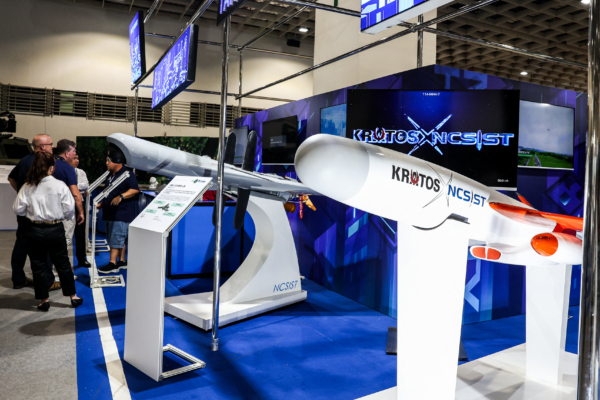
Taiwan’s National Chung-Shan Institute of Science and Technology (NCSIST) and the US defense contractor Kratos have made significant progress in the development of the “Mighty Hornet IV” long-range attack drone. The drone, a joint effort between NCSIST and Kratos, is set to undergo live-fire testing after the Chinese New Year, following which it can be produced on the island.
Kratos announced on Thursday (February 5th) that the technical teams from both sides have completed system integration and ground testing at Kratos’ facility in Oklahoma. This attack drone, powered by jet engines, is based on Kratos’ “MQM-178 Firejet” target drone but enhanced with superior features such as a top speed of 0.8 Mach, high G-force maneuverability, and components developed by NCSIST which provide a range of up to 1,000 kilometers and an operational altitude exceeding 35,000 feet.
As a government-funded research institution overseeing advanced military research, testing, and evaluation in Taiwan, NCSIST has collaborated with Kratos over several months to successfully integrate the mission systems provided by NCSIST into the drone’s design without modifications, enabling it to be combat-ready.
Following the Chinese New Year, the “Mighty Hornet IV” will undergo live ammunition flight tests. Once testing is completed successfully, the drone will enter mass production in Taiwan, bolstering the nation’s defense capabilities.
At the core of its design is the concept of achieving “Affordable Mass,” aiming to increase the enemy’s defense difficulty through a cost-effective and highly threatening fleet of drones.
The “Mighty Hornet IV” is also equipped with AI automatic target tracking and locking features, along with electro-optical/infrared (EO/IR) sensing systems, enabling it to conduct all-weather reconnaissance and precise strikes, effectively countering electronic interference.
Kratos views this test as a significant milestone that could pave the way for deeper cooperation between the company and NCSIST.
Steve Fendley, President of Kratos’ Unmanned Systems Division, remarked, “The successful testing by both organizations marks a crucial step towards flight testing.”
He added, “This achievement not only validates the feasibility of the technical solution but also underscores the value of collaborative development between the two technical institutions, laying the groundwork for potential future cooperation between Kratos and NCSIST.”
Amid escalating geopolitical threats posed by China, Taiwan’s Ministry of National Defense noted a 23% increase in the number of detected Chinese military aircraft (including fighter jets and drones) operating near Taiwan in 2025 compared to the previous year.
In response, Taiwan is planning a “high-low mix” strategy, intending to combine the low-cost “Mighty Hornet IV” long-range drone with the expensive “Hsiung Feng II E” cruise missiles. This strategy aims to saturate enemy defenses with cost-effective weaponry in potential conflicts in the Taiwan Strait.
Looking ahead, the “Mighty Hornet IV” is not only set for extensive deployment in Taiwan but also holds potential for international market penetration.
With its performance surpassing comparable weapons like Iran’s “Shahed-238” drone and the ability to operate in conjunction with manned aircraft (MUM-T), the “Mighty Hornet IV” has garnered attention from multiple countries.
As the success of the “Mighty Hornet IV” unfolds, there is keen interest in whether Taiwan and Kratos will further collaborate on the production of the more advanced “Valkyrie” stealth drone (XQ-58A Valkyrie) in the future.