
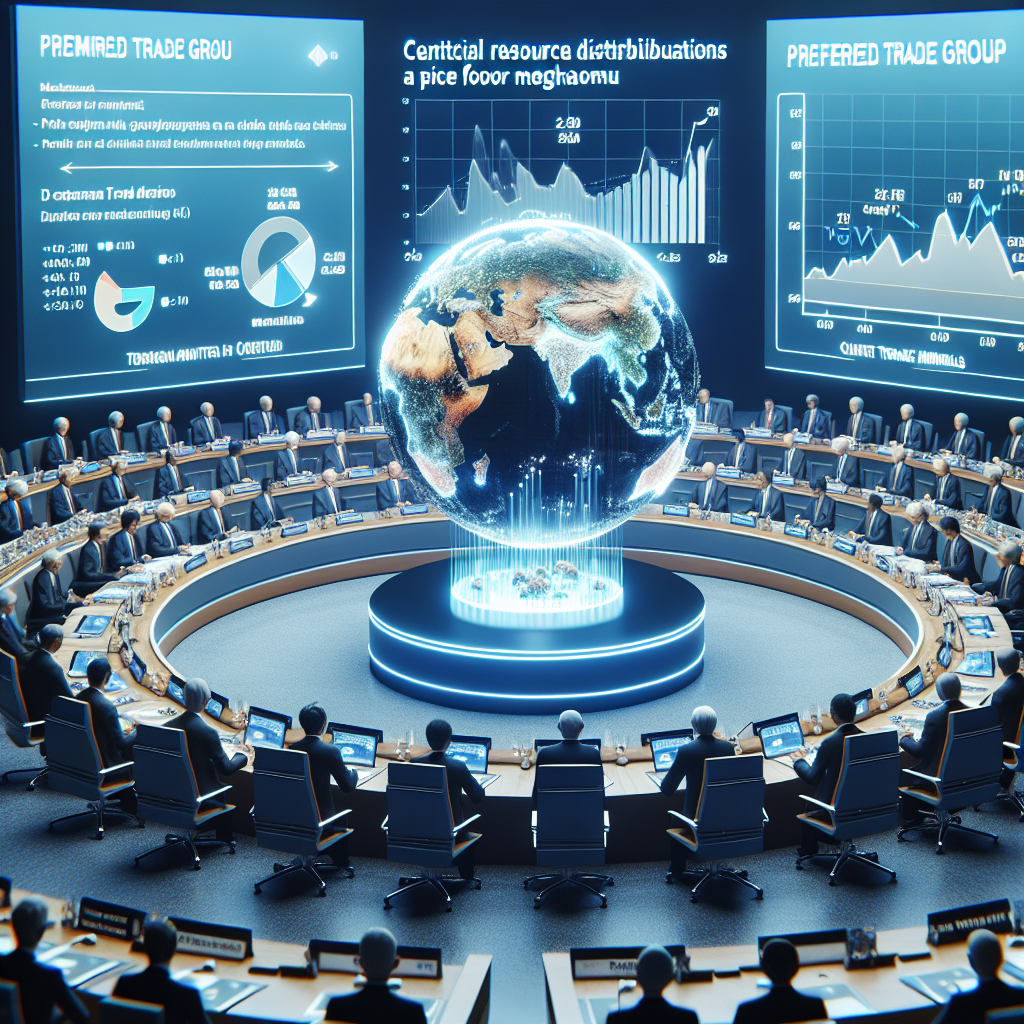
Recently, the United States convened a crucial mineral summit involving 55 countries, announcing the establishment of a “Preferred Trade Group” and setting a price floor mechanism, aiming directly at China’s dominant position in critical resources such as rare earth minerals.
Experts point out that the U.S. strategic vision goes beyond simple supply diversification, transforming critical minerals from a market issue to a governance model of a “club of allies”. Through various means, the U.S. is forming an exclusive security supply chain among its allies to structurally weaken China’s monopoly in critical minerals.
On February 4th, U.S. Vice President JD Vance hosted a ministerial-level summit on critical minerals in Washington, announcing the establishment of the Critical Mineral “Preferred Trade Group” and proposing a price floor mechanism.
Vance emphasized, “Over the past year, we have learned the hard way about the extent of our dependence on these critical minerals.” He stated that the U.S. hopes member countries can establish a trade group among allies to ensure both America’s industrial strength and the expansion of production capacity in the region.
U.S. Secretary of State Mike Pompeo revealed that 55 countries attended the summit, including mining or smelting powers such as South Korea, India, Thailand, Japan, Germany, Australia, and the Democratic Republic of the Congo.
According to Reuters, although Pompeo did not directly name China, he explicitly pointed out that critical minerals are currently “highly concentrated in the hands of a certain country”, serving as a “geopolitical pressure tool”.
U.S. Interior Secretary Doug Burgum stated on Tuesday that 11 more countries will be announced to join the Critical Mineral Trade Club this week, expanding its membership beyond the U.S., Australia, Japan, South Korea, Saudi Arabia, and Thailand, with 20 other countries showing “strong interest”.
Prior to the summit, U.S. President Trump officially launched the “Project Vault” strategic mineral reserve project on February 2nd at the White House.
Trump announced that the U.S. already has strategic oil reserves and national defense mineral reserves, and the new project aims to establish a similar mechanism for the industrial sector to avoid supply disruptions. Participating companies include General Motors, Boeing, Google, and several other major corporations.
Meanwhile, both parties in the U.S. Congress are pushing relevant legislation. The House passed the “Critical Mineral Dominance Act” on February 4th to make Trump’s related executive orders permanent. The Senate introduced the “SECURE Minerals Act” in January, proposing the establishment of an agency to manage a $2.5 billion mineral reserve.
Professor Xie Tian from the School of Economics at the University of South Carolina analyzed that the core goal of current U.S. policy is to reduce reliance on Chinese mineral resources through strategic inventory construction and multilateral cooperation.
He stated that the U.S. is integrating global mineral resources through partnership to form a resource cooperation system excluding China. Once this alliance is formed, not only can it ensure stable supply chains for critical U.S. industries, but it may also restrict China’s ability to access certain mineral resources.
Xie believes that if the resource alliance formulates a coordination mechanism, China’s past strategy of using mineral exports for political pressure may be counteracted because China also relies on imports for some critical minerals, including resources from Australia.
China currently controls about 70% of global rare earth mining and 90% of rare earth processing market. Last October, China introduced rare earth export control measures, restricting the export of rare earth products and technology, leading to production delays and shutdowns for European and American automakers.
Rep. John Moolenaar, Chair of the House China Task Force and a Republican federal representative, stated on Tuesday that China has threatened to cut off rare earth supplies, making countries aware of the risks of relying on a single source.
In a joint report released earlier with Democratic Rep. Raja Krishnamoorthi, Moolenaar pointed out that for decades, China has attempted to manipulate global critical mineral prices and has used its control as an economic weapon to expand its manufacturing industry and geopolitical influence.
Professor Sun Guoxiang from the Department of International Affairs and Business at Nanhua University in Taiwan analyzed that the U.S.’ strategic vision is no longer just about supply diversification, but upgrading critical minerals from a market issue to a governance model of a “club of allies”.
He believes that the U.S. may form an exclusive security supply chain among allies through preferential tariffs, long-term procurement contracts, joint investments, and price floor mechanisms, structurally weakening China’s monopoly in key areas such as rare earths, lithium, and graphite.
Sun thinks that the U.S. is taking this step to secure the raw material security of its national defense, semiconductor, and green energy industries, and to strengthen political and economic ties with resource-rich countries in Africa, Latin America, and the Indo-Pacific region in exchange for minerals, thereby restraining China’s global influence in the Southern Hemisphere.
However, Sun also pointed out that the U.S.-led mineral group still faces risks in implementation. If this move is seen as a strong signal against China, it may prompt Beijing to adopt export control or hoarding strategies, exacerbating global supply fluctuations in the short term.
In response to questions about the meeting, the Chinese Embassy in Washington recently informed Reuters that China has long played a constructive role in maintaining stability in the global critical mineral supply chain and is willing to continue making contributions.
Xie analyzed that if the U.S. economy and technological advantage continue to grow, and China faces structural pressures such as population decline, relevant countries may further lean towards the resource system led by the U.S., accelerating the restructuring of global supply chains.
Sun believes that the U.S., the European Union, and China could form parallel supply systems, with rules becoming fragmented. He says, “Future competition for critical minerals will be more like a long-term tug-of-war of supply resilience, cost, and political influence, rather than a situation of complete replacement in the short term.”