
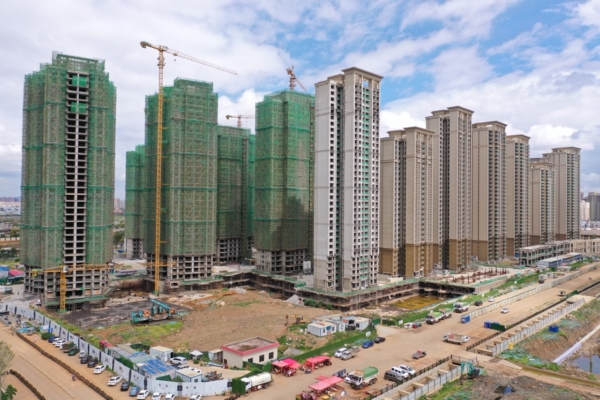
China’s economy continues to decline, impacting the construction industry, infrastructure, consumption, corporate expansion, and more. There have been noticeable changes in the high-end white liquor market, particularly with Maotai leading the pack.
Recently, data from various sources including the National Bureau of Statistics of the Chinese Communist Party showed that the number of large private and state-owned real estate developers with sales exceeding 100 billion yuan has decreased from 17 in 2023 to 10 in 2025.
A report from Citibank in the United States indicates that developers expect a 16% decline in new home sales in 2026.
The continued downturn in the real estate industry has directly affected the construction sector. A civil engineer, Zhang He, told Dajiyuan that compared to the peak period, the amount of construction work has significantly decreased.
“In the construction industry, the impact is particularly severe,” he said. “Because real estate development is everywhere, some infrastructure has not been completed, roads are being repaired, subways are being built, and high-speed rail is being repaired. At least half of the real estate has been cut now, at least two-thirds less than before.”
In this context, many professionals relying on construction projects for their livelihood are facing dual pressures of employment and income. Zhang He believes that in order to absorb excess capacity and maintain employment, authorities have been consistently promoting the Belt and Road Initiative in recent years. “The purpose of promoting the Belt and Road Initiative is to unleash domestic productivity,” he said.
Meanwhile, the slump in the real estate sector has also affected the consumption sector, impacting the white liquor industry. Fang Da, a liquor distributor, believes that this demand is mainly concentrated in traditional industries.
Fang Da told Dajiyuan that some industries related to large-scale infrastructure, including the real estate sector that uses Maotai, are particularly affected. For instance, it used to be a normal practice for the second party to give high-end Maotai as a gift to the first party, but now they are basically reluctant to do so. “This is the role Maotai plays.” High-tech industries, on the other hand, do not usually use Maotai.
Furthermore, changes in the administrative and business consumption environment have also directly impacted the white liquor market. Fang Da mentioned that the consumer groups mainly driven by official banquets and gifting have significantly diminished.
“Our traditional industries, including real estate, infrastructure-related sectors, have faced relatively difficult times in recent years. Both the first and second parties are now avoiding giving gifts,” Fang Da said.
He predicts that the white liquor market will continue to face pressure in the future amidst the ongoing downturn in the real estate and construction sectors.