
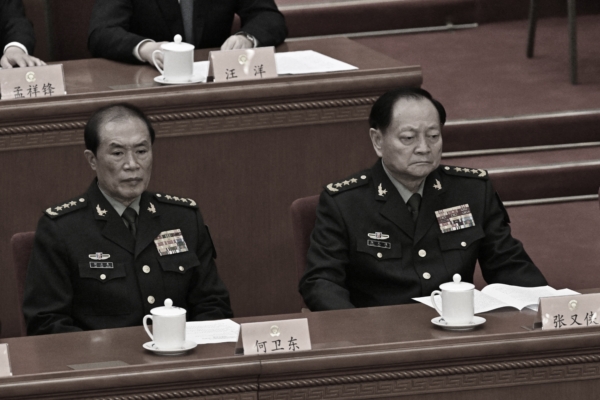
On January 24th, Zhang Youxia, Vice Chairman of China’s Central Military Commission, and Liu Zhenli were removed from their positions. The vacancy in the position of Commander of the Beijing Garrison Area, which had been empty for nearly a year, was filled in early January by Chen Yuan, the former Commander of the Shanghai People’s Armed Police Force. Chen Yuan is a compatriot of former Vice Chairman of the Central Military Commission, He Weidong. The Beijing Garrison Area holds a significant position, and some analysts speculate that this reshuffle may be related to the political maneuvering leading to the arrest of Zhang and Liu.
According to a report by Caixin Net on February 4th citing the Beijing Daily, Major General Chen Yuan attended the 9th (expanded) meeting of the Beijing Garrison Area’s Communist Party Committee on January 14th in his capacity as the leader of the Beijing Garrison Area.
Publicly available information shows that Chen Yuan, aged 53 (born in August 1972), hails from Dongtai, Yancheng, Jiangsu Province. He has had a long career in the People’s Armed Police system, serving as the Deputy Commander of the Jiangsu Provincial PAP Corps around 2018, later becoming the Principal of the PAP Officers’ School around 2019, and then being appointed as the Commander of the Guangxi PAP Corps in 2021 before being promoted to the rank of Major General the same year. By January 2023, Chen Yuan had already assumed the role of Commander of the Shanghai PAP Corps before his recent transfer to lead the Beijing Garrison Area.
While Beijing official media has not disclosed Chen Yuan’s current specific position, conventionally, he is likely to have taken up the role of Commander of the Beijing Garrison Area which had been vacant for almost a year.
The former Commander of the Beijing Garrison Area was Fu Wenhua, who had served for a long time in the 16th Group Army of the former Shenyang Military Region and was an associate of Zhang Youxia, the current Vice Chairman of the Central Military Commission. After Fu Wenhua’s relocation to a new position, the Commander of the Beijing Garrison Area remained vacant for nearly a year.
The report by the Beijing Daily also mentioned that Zhu Jun, a member of the Standing Committee of the Beijing Municipal Committee and Political Commissar of the Beijing Garrison Area, delivered remarks at the meeting, outlining the deployment of the so-called “Party-controlled Armed Forces” work across the city.
In June 2024, Major General Zhu Jun, with an Air Force background, succeeded Zhang Fandi, taking on the role of Political Commissar of the Beijing Garrison Area, and also became a member of the Standing Committee of the Beijing Municipal Committee in September of the same year.
The Beijing Garrison Area, also known as the “Imperial Guard,” bears the crucial responsibility of safeguarding the capital’s safety, protecting key areas like Zhongnanhai during peacetime, and providing cover for the evacuation of high-ranking officials in times of war. It is said that controlling the Beijing Garrison Area is akin to holding half of Beijing in one’s hands.
Since Xi Jinping took office at the 18th National Congress of the Communist Party of China, there have been frequent changes in leadership positions within the Beijing Garrison Area, with nearly ten individuals holding the positions of Commander and Political Commissar.
After the 18th National Congress of the Communist Party of China, the successive Commanders of the Beijing Garrison Area included: Zheng Chuanfu (December 2009 – December 2013), Pan Liangshi (December 2013 – July 2016), Wang Chunning (July 2016 – April 2020), Fu Wenhua (April 2020 – March 2025), and Chen Yuan (since February 2026); while the successive Political Commissars of the Beijing Garrison Area included: Gao Donglu (December 2009 – December 2014), Jiang Yong (December 2014 – December 2019), Zhang Fandi (December 2019 – October 2023), and Zhu Jun (since June 2024).
Out of the aforementioned former Commanders and Political Commissars of the Beijing Garrison Area, except for Zhu Jun with an Air Force background and Chen Yuan from the People’s Armed Police, the remaining seven individuals have a background as army officers.
Commentator Li Linyi pointed out that there was intense factional strife within the Chinese Communist Party surrounding control of the Beijing Garrison Area. The appointment of a new commander for the Beijing Garrison Area can serve as a significant indicator of the direction of the internal power struggle within the military of the Chinese Communist Party.
The recent personnel changes in the Beijing Garrison Area occurred before the downfall of Zhang Youxia and Liu Zhenli. After their absence from the ceremony of the commencement of the provincial ministerial-level seminar on January 20th, various versions of the reasons behind their removal began to circulate. The most widely circulated version suggests that on the night of January 18-19, Zhang and Liu were directly apprehended by personnel from the Central Guard Bureau, Special Operations Bureau, and the Central Commission for Discipline Inspection at the August 1st Building, the Central Party School, or the Jingxi Guesthouse in Beijing.
Su Ziyun, the Director of the Institute of Defense Strategy and Resources of the Taiwan Institute for National Defense and Security Studies, stated to Epoch Times that Chen Yuan arrived at the Beijing Garrison Area on January 14th. If connected to Xi Jinping’s capture of Zhang Youxia in late January, it would hold a deeper significance, indicating that Xi Jinping had premeditated capturing Zhang and others and had been planning to do so by bringing in people from other provinces to take up key leadership positions such as the Commander of the Beijing Garrison Area. This Commander, of course, would inevitably be someone he trusted.
Senior military commentator Mark also expressed his opinion that Chen Yuan assumed the position of Commander of the Beijing Garrison Area before the removal of Zhang Youxia and Liu Zhenli. The timing of this revelation following the removal of Zhang and Liu is indeed sensitive, indicating that Xi Jinping had arranged for a reliable individual to oversee the Beijing Garrison Area before taking action against Zhang Youxia.
Mark analyzed that at the latest by January 2023, Chen Yuan had become the Commander of the Shanghai PAP Corps. When former Chinese Premier Li Keqiang passed away suddenly in Shanghai in October 2023, there were suspicions that it was an assassination orchestrated by Chen Yuan, who was considered Xi Jinping’s henchman. Even though it cannot be verified, as at least Li Keqiang encountered trouble within the jurisdiction overseen by Chen Yuan, it must have led to pressure on him from within the Chinese Communist Party. In the end, Chen Yuan was not removed or held accountable but instead was promoted to a key position in Beijing, potentially due to Xi Jinping’s perception of Chen Yuan’s loyalty following the incident involving Li Keqiang, leading to his transfer to the Beijing Garrison Area.
Mark stated that with Xi Jinping’s apprehension of Zhang Youxia, should Zhang resist with a substantial security force, and should the resources of the Central Guard Bureau be insufficient, the Beijing Garrison Area becomes a highly significant backup force. Therefore, Chen Yuan’s arrival in Beijing essentially implies that he is meant to be the gatekeeper for Xi Jinping.
The newly appointed Commander of the Beijing Garrison Area, Chen Yuan, and the former Vice Chairman of the Central Military Commission, He Weidong, both hail from Dongtai, Jiangsu Province, and had connections in the former Nanjing Military Region. Prior analyses have indicated that there has been a long-standing discord between Zhang Youxia and Xi Jinping, with He Weidong getting involved in this internal power struggle.
Independent commentator Du Zheng wrote in a piece for Taiwanese media “Shang Bao” that He Weidong and Miao Hua provided suggestions to Xi Jinping, targeting equipment systems and the Rocket Force, aiming to remove Rocket Force Commander Li Yuchao, Political Commissar Xu Zhongbo, and then-Minister of National Defense Li Shangfu, indirectly targeting Zhang Youxia. He Weidong subsequently accused Zhang Youxia of purchasing defective equipment and falsifying training records. In response, Zhang launched a counterattack by compiling evidence of He Weidong’s corruption, especially regarding the selling of official positions by Miao Hua, pressuring Xi Jinping to agree to investigate Miao Hua, He Weidong, and members of their faction.
Researcher Shen Mingshi from the Taiwan Institute for National Defense and Security Studies analyzed that the rotation of the Commander position in the Beijing Garrison Area is indeed linked to the factional struggles within the Chinese Communist Party. Chen Yuan, who was transferred to the Beijing Garrison Area, presumably belongs to He Weidong’s faction. Previously, before the reassignment, the original Commander of the Beijing Garrison Area was considered to be Zhang Youxia’s ally, and following the removal of Wang Chunning, a figure from He Weidong’s faction within the People’s Armed Police Corps, acting Commander Cao Junzhang, who had long served in the former Chengdu Military Region, was also found to be associated with Zhang Youxia.
At the promotion ceremony for the rank of General at the end of last year, Cao Junzhang was absent, and another representative of the People’s Armed Police attended on his behalf, with rumors circulating that Cao Junzhang had been removed from his position.
In addition, according to reports by Caixin Net, aside from the changes in the Beijing Garrison Area, in mid-January, several newly appointed provincial-level military district leaders appeared at meetings of the Communist Party Committees of the Shanghai Garrison Area and the military districts of Anhui, Shanxi, Shaanxi, Hainan, Jilin, and Sichuan, including Zhang Zhanli, Commander of the Shanghai Garrison Area; Wang Jinliang, Political Commissar of the Anhui Military Region; Chen Jundong, Commander of the Shanxi Military Region; Zhang Wenzhong, Commander of the Shaanxi Military Region; Ding Jinsong, Commander of the Hainan Military Region; Wang Qingyun, Political Commissar of the Jilin Military Region; and Liu Sen, Commander of the Sichuan Military Region.
Shen Mingshi noted that following the removal of Zhang Youxia and Liu Zhenli, Xi Jinping had made significant changes by replacing those previously groomed by Zhang Youxia with individuals affiliated with He Weidong or Miao Hua. Hence, there has been an increase in cross-service and cross-service branch transfers. Given the uncertain state of morale within the Chinese Communist Party military, Xi Jinping’s plans to utilize force against Taiwan in the near future may face delays.
However, Australian scholar Yuan Hongbing previously cited an insider within the Chinese Communist Party system stating that Xi Jinping harbors a paranoia-induced mental illness. It is foreseeable that after the end of the great purge and the completion of the reconstruction and improvement of the leadership institutions within the CCP’s guard force, it will not be long before new major cases erupt once again, thereby precipitating another round of even more severe military purges.