
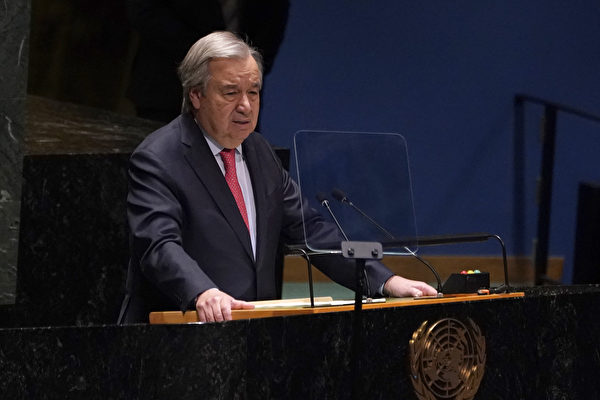
United Nations Secretary-General Antonio Guterres issued a statement on Thursday, February 5th, regarding the formal expiration of the New Strategic Arms Reduction Treaty (New START), describing the current situation as a “critical moment” for international peace and security. He called on Russia and the United States to quickly return to the negotiating table and initiate new talks on nuclear arms control frameworks.
Guterres pointed out that the treaty expired at midnight local time on Wednesday, setting binding limits on the number of strategic nuclear warheads that could be deployed by both the United States and Russia, as well as placing caps on land-based and submarine-launched missiles, and strategic bombers.
The expiration of the treaty signifies that for the first time in over half a century, there is no longer any legally binding limit on strategic nuclear weapons between the two countries that possess the vast majority of global nuclear weapons.
Reflecting on the Cold War era and subsequent decades, Guterres emphasized the critical role that nuclear arms control arrangements between the U.S. and Russia played in averting catastrophic conflicts. These agreements not only enhanced strategic stability but also, in conjunction with other security measures, effectively reduced the risk of misjudgments.
He warned that the gradual unraveling of decades-long arms control achievements is occurring at the “worst possible moment” as the risk of actual nuclear weapon use has reached its highest level in decades.
He also emphasized that this moment of uncertainty should be seen as an opportunity to restart the arms control process, stressing the need to establish a new arms control framework that can adapt to the rapidly changing international security environment.
Guterres welcomed recent statements by the presidents of the United States and Russia, noting that both sides recognize the detrimental effects of a nuclear arms race and the necessity of preventing uncontrolled nuclear proliferation.
In conclusion, Guterres urged the international community to closely monitor whether Russia and the United States can translate their political declarations into concrete actions. He called on both countries to swiftly return to the negotiating table, reach consensus on establishing a follow-up framework, reinstate verifiable modalities of restrictions, reduce nuclear risks, and collectively strengthen global security.
The New Strategic Arms Reduction Treaty was signed by the U.S. and Russia in 2010 and came into effect in 2011, representing one of the most significant bilateral nuclear arms control agreements since the end of the Cold War. The treaty was extended for an additional five years in 2021 by mutual agreement, but subsequent substantive negotiations on a successor agreement did not progress due to geopolitical tensions and deteriorating bilateral relations.