
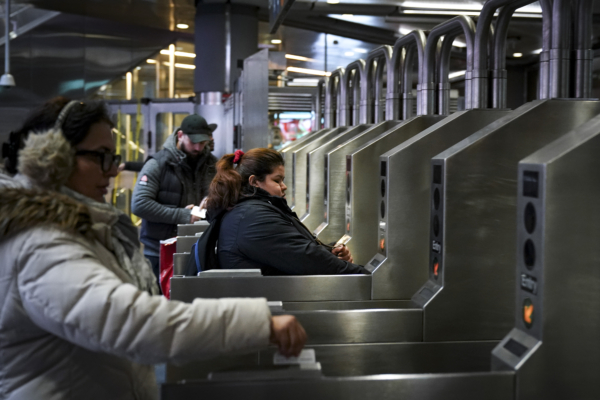
To combat the long-standing issue of fare evasion plaguing the New York City subway system, the Metropolitan Transportation Authority (MTA) is currently testing a new generation of subway fare gates that incorporate artificial intelligence (AI) technology to detect and report fare evasion. Three companies are currently competing for a contract worth up to $1.1 billion to redesign the subway gate system citywide.
Over the past two months, these three companies have installed experimental new gates at 10 subway stations. Unlike traditional waist-high turnstiles, the new designs mostly feature full-body height gates to reduce jumping over or tailgating, common fare evasion behaviors.
MTA Chairman Janno Lieber stated this Tuesday in Albany during a state budget hearing that the pilot program is set to expand to 20 subway stations in the “coming weeks.”
Currently, the new gates are being tested at several busy stations, including Atlantic Terminal, Port Authority, and Hoyt–Schermerhorn. MTA plans to install the new gates next week at the 125th Street station where the A, B, C, and D lines intersect.
MTA officials noted that at least two companies have indicated that their gate systems incorporate some form of AI functionality to track fare evaders. These gates are equipped with monitoring devices that automatically trigger an alert and record about five seconds of footage when the system detects someone entering without paying. The AI system then generates a description of the suspected fare evader’s appearance and automatically sends relevant information to MTA.
According to the plan, MTA ultimately aims to install the new entry gates at 150 out of the city’s 472 subway stations. In addition to the gates, MTA is also continuing to explore other applications of AI in the subway system. Last year, MTA had mentioned collaborating with AI companies to investigate relevant technologies capable of detecting passenger “problematic behaviors.”