
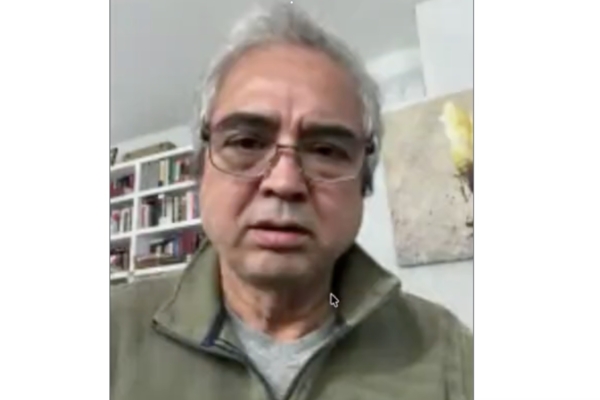
Ilshat Hassan Kokbore, who fled from Xinjiang to overseas, revealed that every contact with his family resulted in his family members being implicated, arrested, and beaten. In the United States, he faced surveillance and threats from the Chinese Communist Party (CCP). Almost every day, someone called him, Uighur youths were deployed to track him, and individuals directly warned and threatened him, suggesting the CCP might orchestrate a car accident against him.
Ilshat expressed to Epoch Times that the CCP’s transnational repression is a serious infringement and interference with American sovereignty and justice. The U.S. government should enact a series of robust retaliatory policies to arrest and punish any CCP agents; otherwise, the United States will become another battleground for the CCP’s transnational repression.
Ilshat Hassan Kokbore spent 15 years as a lecturer at a teacher training institute in Shihezi, Xinjiang, before being arrested and abused by local police on charges of attempting to achieve ethnic autonomy. He escaped China in 2003 and arrived in the United States as a UN refugee in 2006.
Having served as the President of the Uyghur American Association, Ilshat has been the spokesperson for the World Uyghur Congress since May 22, 2025. He is now a U.S. citizen residing near Washington D.C.
When asked if his relatives in Xinjiang were affected because of him, Ilshat stated that, since his last phone call with his mother in 2016, he had received no further information about her; she seemed to have vanished inexplicably.
His relationship with his older sister was particularly close. She is a single mother taking care of two children. He sent her money several times, leading to her arrest on August 15, 2014, after which she asked him to stop sending money, citing difficulties in withdrawing funds.
In a concerning incident around 2012-2013, Ilshat ordered a computer online for his niece attending college, which was delivered by a Uighur individual in Texas returning to Xinjiang. Upon exiting the Urumqi airport, the niece was taken into a car by National Security officers and detained for a week.
In 2018, Ilshat learned through The New Yorker magazine that his two sisters, along with their husbands and children, were detained in internment camps. Since then, he has been uncertain about the whereabouts and well-being of his relatives.
Regarding transnational repression in the United States, Ilshat told reporters about suspicious individuals taking photos of his house, a Uighur youth insisting on a meeting to disclose being coerced to spy on him for the CCP, and receiving threatening messages on social media platforms.
Fearing for his safety, Ilshat eventually reported these incidents to the FBI. Following a meeting between FBI personnel and the youth, the FBI took over further action on the matter.
Ilshat revealed the frequent phone calls he receives, often leading to silence on the other end. His social media accounts are frequently targeted with attacks and intimidation from Chinese individuals, likely affiliated with the CCP.
Despite not being perturbed by these events, Ilshat acknowledged the emotional toll they take each day. His daughter worries about his safety, to which he reassures her of his security within the U.S.
However, Ilshat also recounted an instance of direct threat when someone warned him at a ‘June 4th’ event held in front of the Chinese Embassy, implying potential poisoning. Reflecting on the encounter, he realized it as a veiled threat.
Speaking from his firsthand experience of transnational persecution by the CCP, Ilshat stressed the impactful consequences on the U.S. as a breach of sovereignty and justice. He urged the U.S. government to address and combat these issues to prevent the country from becoming another frontline of transnational repression by the CCP.
In advocating for effective measures to counter the CCP’s transnational repression, Ilshat emphasized the necessity for targeted policies, identifying and penalizing any CCP agents involved, including deportation and prosecution, under U.S. law.