
Beijing’s Economy Faces Struggles Despite Official Claims of Recovery
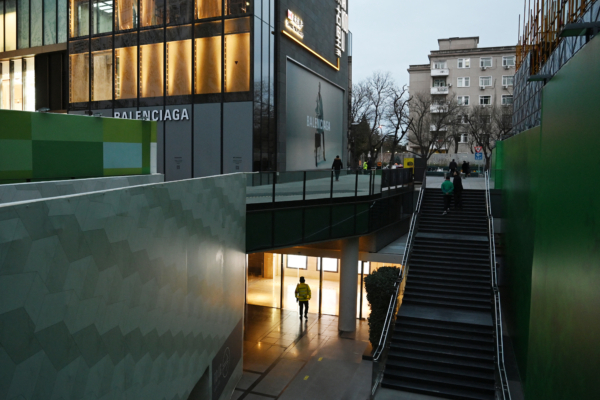
The Beijing municipal government officials recently claimed that the city’s economy continues to show signs of improvement, with the public’s sense of gain, happiness, and security constantly strengthening. However, the reality witnessed by the people is quite different. Commercial squares are deserted, storefronts are shuttered along the streets, and once bustling agricultural markets now stand empty. Homeless people lament that they can’t even find food scraps to eat, with some resorting to selling blood to make a living. Experts analyzing the core economic data announced by the authorities suggest that Beijing’s economy is on the brink of a downturn.
Just after a senior-level cleansing within the CCP military on January 26, Beijing Municipal Party Secretary Yin Li, during a meeting with a delegation of troops stationed in Beijing, mentioned that over the past year, various aspects of Beijing’s development have made steady progress, pushing the city’s total economic volume past 5 trillion yuan and enhancing the public’s sense of gain, happiness, and security.
On January 21, at the press conference on Beijing’s economic performance in 2025 held by the Beijing Municipal Government, Deputy Director Zhu Yannan of the Beijing Municipal Bureau of Statistics summarized that the city’s economy has been continuously improving in 2025.
However, individuals living in Beijing shared with the media experiences and observations that contradict the official propaganda.
Chen Hong (pseudonym), who lives in Beijing to make a living, told the media that the number of people coming to Beijing to seek employment has been declining, leading to a significant decrease in foot traffic at Beijing West Railway Station, with many trains canceled and barely any people seen at night. The commercial district surrounding the West Station, comprised of North Square and South Square, is now deserted, with shops on all levels closed. Chen Hong reflects on the past when carrying luggage used to be an easy way to earn money, but now with the lack of foot traffic, even the luggage storage locations are reduced to just a few, highlighting the desolate situation.
Jin Xiang (pseudonym), who has lived in Beijing for nearly 40 years, recalled how busy the streets used to be even during non-peak hours. Wangfujing Street and Qianmen Street were always crowded, but now they are eerily quiet, with many storefronts displaying “For Rent” signs. Several large shopping malls have closed down, such as the one at Fuxingmen, where there are hardly any customers and more staff than visitors, painting a grim picture of the city’s retail sector.
Supermarkets and agricultural markets are also not as thriving as before, with Jin Xiang specifically mentioning a visit to Pinggu Shanshuji, a historic market, which used to attract people from the city and suburbs but now sees much fewer visitors.
The situation around Beijing’s attractions is no different, according to Jin Xiang, with hotels and guesthouses near these places closing down. He describes a hotel near Jinhai Lake being overgrown with weeds and even housing sheep inside, resembling a ghost town.
Due to the economic downturn, many individuals in Beijing feel hopeless, leading to various coping strategies such as ‘lying flat’ to avoid the pressure of striving for better, or relying on family support. The detrimental effects are visible in the increased presence of homeless individuals and a rise in the number of people seeking financial assistance.
On social media platforms like Douyin, numerous videos portray the bleak economic situation in Beijing, with a surge in homelessness due to job losses. Jin Xiang noted a concerning trend of younger individuals engaging in activities like scavenging for recyclables that used to be mainly done by the elderly.
Chen Hong, who has been scavenging for recyclables to survive in Beijing for several years, highlighted the difficulties faced by educated individuals in finding jobs and the harsh realities of survival in the city. He talked about the days when scavenging offered opportunities to earn a living but lamented how even that has become almost impossible now.
Chen Hong mentioned the drastic decrease in opportunities to scavenge due to the removal of garbage bins and the reduction in discarded items like food scraps, emphasizing the challenging scenario for many struggling to survive in the city.
Reflecting on the past when scavenging used to be a viable means to make ends meet, Chen Hong reminisced about the various food items that could be found in the trash bins, including expensive fruits that people discarded without a second thought. However, these opportunities have drastically diminished now, making survival increasingly difficult for those at the bottom rung of society.
Chen Hong revealed that in recent years, many individuals resorted to selling blood at Beijing West Station as they couldn’t secure basic daily-wage jobs to sustain themselves. The disappearance of this group towards the end of last year left many wondering about their fate.
He noted that the current situation has left countless individuals without means to afford a meal, underscoring a much more severe reality than what was shared, implying a dire state of affairs that goes beyond what he described.
Typically, economic recession is reflected through the core indicators of unemployment and social retail figures.
In terms of social retail, data released by the Beijing Municipal Statistics Bureau showed that in 2025, Beijing’s total social retail amounted to 1.3677 trillion yuan, a decline of 11.7 billion yuan compared to the 2022 figure of 1.3794 trillion yuan, indicating a more severe decline in retail in 2025 compared to the strict control policies during the epidemic.
American economist Davy Jun Huang analyzed the data over the years from 2022 to 2025, pointing out the fluctuations in consumer spending in Beijing and the challenges faced. Despite efforts for a rebound post-pandemic, the economy saw setbacks, with a continuous downward trend in 2024 and 2025, indicating a structural deterioration that transcends a mere one-time crisis.
Yellow David pointed out the increasing uncertainties in employment, investment, and policies leading to a contraction in discretionary spending and internal demand shrinking, posing a more profound challenge to reverse than external shocks like the pandemic.
Unemployment figures also shed light on the economic challenges faced by Beijing, with Huang emphasizing the sensitivity of the unemployment funds’ balance sheet compared to publicly available unemployment rates. The deficits in the fund during certain years signal ongoing employment crises and economic structural issues that demand attention.
Overall, the economic outlook for Beijing appears bleak, with downward pressures intensifying, hinting at a looming recession despite the city being the political-economic hub of China. The challenges faced in Beijing’s economy may be indicative of a broader economic downturn affecting other regions as well.