
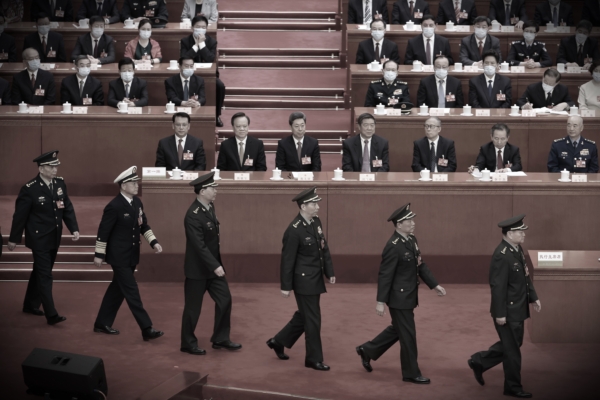
The military newspaper criticizes Zhang and Liu, moving from editorial to commentary, shifting the charges from political to corruption, facing passive resistance within the military during this critical moment, and questioning who can bear the heavy responsibility in history.
On January 24, 2026, the Chinese Ministry of National Defense announced the downfall of Vice Chairman of the Central Military Commission Zhang and member Liu, after which “The Military Newspaper” published four heavyweight articles on January 25, 31, February 1, and 2. However, an unusual phenomenon emerged with a downgrade in the articles’ status from editorials to commentary pieces, showing decreasing strength and conviction.
The editorial on January 25 was the highest in terms of status, featured as the front-page headline, with all five “serious” allegations being politically motivated, including serious trampling of and destruction of the chairman responsibility system of the Military Commission, emphasizing the need for the military to “renew itself.” However, the subsequent three articles were downgraded to commentary pieces by contributors.
The January 31 article titled “Firm Belief in the Fight Against Corruption and Building a Strong Military” shifted the focus from politics to corruption, labeling it as a “major victory” in the anti-corruption campaign, urging the entire military to achieve a “renewal.” The essence of the term “renewal” mentioned in these two articles should be understood as a significant purge within the military, a comprehensive bloodletting, rather than an insinuation referring to Xi Jinping, as some claim. The authors of “The Military Newspaper” are unlikely to pay attention to such overseas speculations.
The commentary pieces on February 1, “Continued Deepening of Political Rectification, Advancement of Anti-corruption Measures” and February 2, “Advancing Fearlessly with a Strong Sense of Mission,” though on the front page, were no longer the headlines.
Moreover, there was only a brief mention of Zhang and Liu at the beginning of the articles, with no specific details about their crimes mentioned throughout the entire text, apart from corruption, lacking even vague accusations. The prevalent themes were the need for the entire military to support China’s central leadership under Xi Jinping, indicating that the military has not openly declared its support for the cleansing of the two individuals. The other theme focused on military readiness, albeit appearing superficial, primarily emphasizing political militarization, which has resulted in weakened military strength rather than strengthening it.
These articles seem to lower the tone on the cleansing issue to avoid causing panic within the entire military.
Rumors regarding the current military and political situation in the Chinese Communist Party are widespread. In recent days, there have been numerous rumors circulating online about Liu Yuan, Hu Jintao, and Hu Chunhua working behind the scenes.
It is highly unlikely for Hu Jintao to re-emerge. Judging from his removal from the 20th National Congress, both his physical condition and mindset are not at their best. Such matters require high levels of concentration and energy, making him unfit for the task. Furthermore, as a representative of the faction, he is unlikely to depart from the faction’s characteristics. The faction is primarily focused on grooming successors who are obedient and compliant, rather than innovative or possessing leadership skills. During his ten-year rule, most of the time, he operated under the shadow of Jiang Zemin’s power. Had he possessed the courage, there were actions he could have taken. His most outstanding moment within the Party, recognized by Deng Xiaoping, was leading the front in the crackdown in Lhasa, donning a helmet.
This is a common trait of the faction, to participate in the Chinese Communist Party’s wicked political movements. Although they rarely initiate such events, they are always the most loyal executors.
As for Liu Yuan, he is considered the most orthodox princeling. However, his personal background is insufficient for him to become a pivotal figure in significant political upheavals. Coming from a political background rather than a military one, he transitioned to the military sector. Within the military, he served as a political commissar, not as a frontline combatant, resembling Zhang Shengmin, who is currently not well-regarded by the military.
Given Xi Jinping’s crackdown on the more professional command system to favor political officials, the likelihood of military support for him is slim. Additionally, having been out of the military for many years, with no representatives or anti-Xi forces within the military, diminishes his influence.
Hu Chunhua’s situation parallels that of Hu Jintao as a typical faction member, boasting achievements of hardline repression in Wukan village. He lacks a strong foothold both in the military and political spheres, falling short of the stature of Hu Jintao, merely a designated successor admired by Hu Jintao. To become the flag-bearer of the opposition, regardless of one’s motives or knowledge, an individual must have a long-standing presence in military and political circles, reaching the upper echelons — recognized and respected by most, believed to possess the courage and determination.
None of the aforementioned individuals exhibit these characteristics.
In times of significant historical change, those who emerge as prominent figures are often not seasoned politicians entrenched in the bureaucracy but individuals with a degree of detachment from politics, or even those completely oblivious but embodying strong leadership qualities. At the end of the Qin dynasty, the first uprising was not led by any Qin army generals or remnants of the aristocracy from the conquered six states but by commoners like Chen Sheng and Wu Guang.
On the eve of the Wuchang Uprising, due to a leak in information, the organizers decided to abandon the plan; however, it was a soldier, not affiliated with the revolutionary party, who fired the first shot to protect his fellow townsmen and the revolutionary party’s squad leader, inciting the uprising.
The dissolution of the Soviet Union presents a different scenario; although both involve system collapses, they were not triggered by a single event. However, they share a common feature — the old regime or system is not a personal burden for the individuals. Mikhail Gorbachev is a prime example. After withdrawing from the Communist Party, he made a successful political comeback as an outsider. While initiating reforms may have initially been an attempt to save the Soviet Union, upon realizing its irreversible decline, he did not resist the historical tide and allowed the Soviet Union to dissolve.
Those who are unable to let go of their historical burdens associated with themselves or the old system can only make incremental reforms, leading to persistent issues. Deng Xiaoping’s approach exemplifies this with two instances. Firstly, the rehabilitation of the Rightists, where Deng Xiaoping could advocate for the nationwide rehabilitation of Rightists, indicating his understanding that the anti-Rightist campaign was flawed. Yet, as the primary executor of the anti-Right campaign, he retained five major Rightists unexonerated nationwide, attempting to prove that the anti-Rightist movement was not wrong in essence but had been exaggerated.
The second instance was Deng Xiaoping’s assessment of Mao Zedong following the end of the Cultural Revolution. Despite fully denouncing the Cultural Revolution, Deng Xiaoping maintained a positive stance towards Mao Zedong by attributing his contributions as seventy percent positive and thirty percent negative. Deng Xiaoping was a part of Mao Zedong’s revolution, denying Mao Zedong equated to rejecting himself, a line he could not cross ultimately.
Due to this, Deng Xiaoping’s reform and opening-up policies were inherently flawed, plagued by future consequences that persist to the present day.
Among the senior leaders in the Chinese Communist Party’s military, few exhibit the courage and mettle needed for significant change. The individual who may potentially trigger a major event is likely someone who acts without calculation, ignorant of the consequences, or even ignorant of the situation but embodies a strong leadership quality. If they are within the system, they must be capable of breaking away from the Chinese Communist Party and its system at a fundamental level. Otherwise, they not only fail to make a significant impact but also risk their own downfall.
As the Chinese Communist Party’s military is designed to safeguard domestic political power rather than engage in external warfare, military leaders, including the Vice Chairman of the Central Military Commission, lack the authority to mobilize the military. Additionally, with ammunition and firearms kept separate during peacetime, it’s understandable that individual units find it challenging to act during significant events.
Currently, within the army, passive resistance is evident, and this lack of action or resistance may stem from a lack of consensus at the highest levels regarding the characterization of Zhang and Liu, as demonstrated in the four articles of “The Military Newspaper.”
However, during moments of historical change, the military, comprising both leaders and soldiers, have the opportunity to make choices, to stand with the people, to stand on the side of justice.
Following the Wuchang Uprising, various provincial new armies echoed the call, leading to the independence of fourteen provinces within two months, ultimately forcing the Qing dynasty to abdicate.