
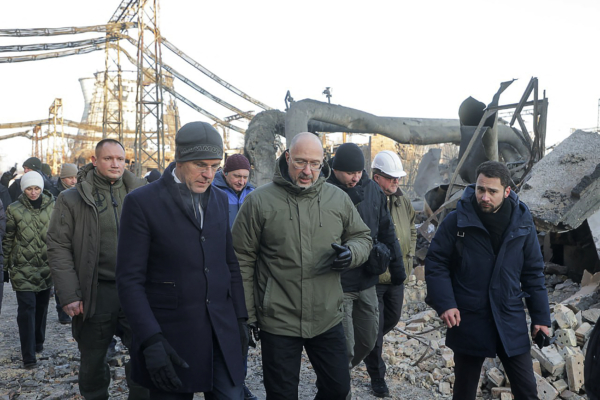
NATO Secretary-General Mark Rutte visited the Ukrainian capital, Kyiv, on Wednesday (February 4) and inspected a civilian heating facility that had been attacked by Russian missiles. He also surveyed the damage on-site with the Ukrainian Minister of Energy.
Rutte later posted on social media that the facility had no military value whatsoever, and the attacks were apparently not for military purposes, but deliberately targeted civilians to inflict suffering.
He emphasized that despite continued attacks, Ukraine has demonstrated strong resilience and resistance. NATO will continue to stand with Ukraine and provide steadfast support.
Ukrainian Energy Minister Denys Shmyhal stated on Telegram that a power heating facility in the eastern outskirts of Kyiv was severely damaged in a Russian missile attack in the early morning. The government has urgently allocated resources to prioritize restoring heating needs for thousands of residents.
Shmyhal pointed out that the damaged facility, located in the Darnytsia district, primarily served central heating functions and was purely a civilian energy infrastructure. At the time of the attack, the local temperature dropped to minus 25 degrees Celsius. The strike by Russian forces on the heating target in extreme cold conditions clearly showed deliberate intent.
Shmyhal emphasized that such attacks on civilian energy facilities should be classified as “war crimes” and those responsible must be held accountable.
Ukrainian Foreign Minister Andrii Sybiha reiterated during the meeting with Rutte the urgent need for enhancing air defense protection for heating and power facilities, including the prompt delivery of air defense systems and missile interception.
Shmyhal reported that this round of attacks affected eight regions in Ukraine, with Russian forces using ballistic missiles, cruise missiles, and drones targeting residential buildings and thermal power plants used solely for heating purposes.
In addition to Kyiv, facilities in Kharkiv, Dnipro-Petrovsk, Donetsk, Odesa, Vinnytsia, and elsewhere suffered varying degrees of damage to power generation facilities and distribution grids.
Currently, several regions have implemented emergency power reduction measures, and the energy department is urgently mobilizing mobile generators to critical areas. Shmyhal stated that comprehensive restoration will take time, with the energy department, relevant government agencies, and local authorities working together with public and private enterprises to expedite repairs.
Furthermore, Ukrainian Deputy Prime Minister Oleksiy Kuleba posted on social media on the same day that the attacks had left over 1,100 buildings in Kyiv and more than 110,000 users in Kharkiv without heating, and the authorities are mobilizing all efforts to address the situation.