
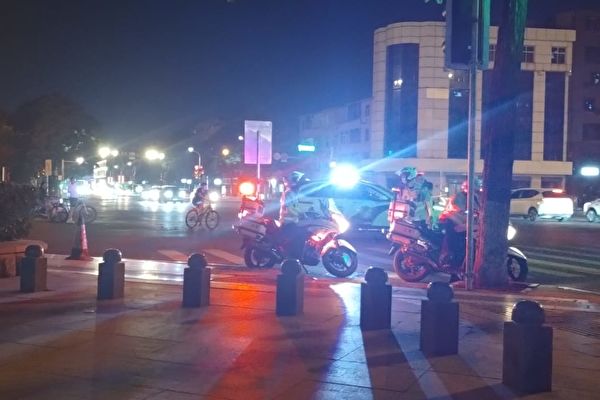
On the eve of the 35th anniversary of the “June Fourth” incident, China has launched stability maintenance measures in various regions. Informed sources indicate that the authorities are using big data for strict monitoring on social media platforms, and police officers are checking phones on public buses. Some individuals identified as key figures by the authorities have been subjected to increased surveillance or restricted from traveling.
Beijing resident Yang Sheng (pseudonym) told Epoch Times on May 28th that the authorities are closely monitoring the tracks of individuals within the country traveling abroad to participate in “June Fourth” commemorative activities, employing big data screening through national security measures.
“One university student I know from Beijing Institute of Technology had their social media account suspended, identified through big data screening, for posting inappropriate content on Xiaohongshu. Those who are now staying silent on social media are basically under surveillance, including human rights lawyer Lu Tingge; his WeChat account has been very quiet recently.”
Yang also mentioned that there has been an increase in mobile patrols on the streets of Beijing to maintain so-called public order. Authorities are checking phones inside buses, with three police officers conducting inspections on one bus.
The “Tiananmen Mothers” are a group that annually faces significant monitoring by the authorities. According to Radio Free Asia, Tiananmen Mothers spokesperson You Weijie stated that personnel have currently been stationed outside the home of one of the founders of the Tiananmen Mothers, Zhang Xianling, with no restrictions placed on the movements of other members.
You Weijie mentioned that the Tiananmen Mothers plan to issue commemorative statements prior to “June Fourth” as they have done in previous years, and will also visit the Wan’an Cemetery on the day of “June Fourth” for condolences.
In Beijing, it has been reported that various human rights activists related to the “June Fourth” incident have started to receive notifications to undergo “mandatory traveling.” Among them, well-known human rights lawyer Pu Zhiqiang has been confirmed to be taken away from Beijing.
Epoch Times attempted to contact senior Beijing media personality Gao Yu via phone, but was unable to reach her.
Qian Ming (pseudonym), a resident from Hebei Province, revealed to Epoch Times on May 27th that the current atmosphere is tense, stating, “I encountered patrol teams holding batons when I went out yesterday morning; it’s really ominous. Now, ID checks are being conducted in many places on the streets.”
Dissident artist Ji Feng has been forcibly sent on a trip. On May 25th, he posted a message accompanied by an image on X, saying, “Just watch the wind and rain, don’t discuss national affairs. The annual trip is starting today…”
Ji Feng was previously required to return to his hometown of Zunyi, Guizhou, two weeks before last year’s “June Fourth” anniversary. He mentioned to Radio Free Asia that since the 35th anniversary of “June Fourth” is a significant event, with previous commemorations stirring up global attention, this year’s commemoration is prohibited from being mentioned. Consequently, his movements are confined to the vicinity of Zunyi, without the ability to travel far. He noted that in the past, he could freely travel anywhere, even in the outskirts of Beijing. Two years ago, he even visited Pingyao Ancient City; however, the current financial situation may be tight, leading to restrictions on movement.
Dissident Mingfu (pseudonym) from Henan Province informed Epoch Times that he has not yet received any notifications. In past years, he would be invited for discussions over tea; however, there may be some interference with certain VPN services.
Shanghai writer Ma Sheng (pseudonym) informed Epoch Times that due to his critical articles on the lockdowns and “zero-COVID” policies during the three-year pandemic period, he has become a subject of stability maintenance by the authorities. However, he has not sensed any unusual activities directed towards him this year.
Shanghai human rights activist Shen Yanqiu told Radio Free Asia that tensions have escalated in Shanghai since Zhang Zhan was released and that the situation nearing “June Fourth” is different. She described the authorities as adopting a policy of internal tightness and external looseness. Although there may not be significant differences on the surface from usual days, surveillance has actually been intensified. In her case, public security officers almost come to have tea with her daily, and if she does not comply, officials may show up at her door. She believes that the local monitoring of human rights activists will be further strengthened as “June Fourth” approaches.