
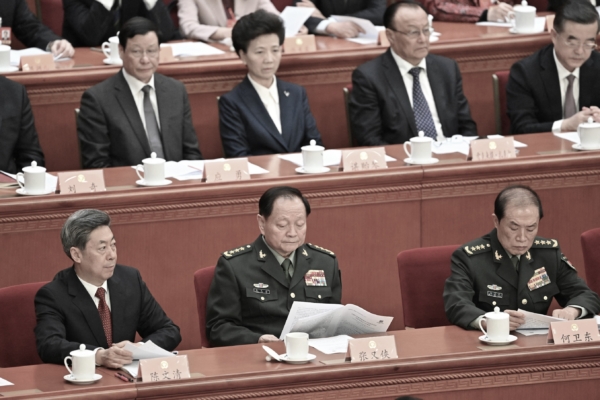
China’s “anti-corruption” efforts hit a new high in 2025, with the Communist Party taking down a record number of officials. In the first month of this year, they targeted another group of officials known as the “Ten Tigers,” including Zhang Youxia, a member of the Politburo and Vice Chairman of the Central Military Commission. However, Zhang’s investigation is believed to be primarily driven by power struggles. Experts suggest that Xi Jinping’s intensified crackdown on the political arena is aimed at securing his re-election at the 21st Party Congress.
According to the official announcement by the Chinese authorities on January 31st, Wang Xiangxi, Party Secretary and Minister of the Emergency Management Department, is under investigation. Reports indicate that since January, eight senior officials under central management have been investigated.
These “central management officials” refer to cadres whose appointments are under the jurisdiction of the Communist Party Central Committee and managed by the Organization Department of the Central Committee. High-ranking officials above deputy minister level are considered central management officials. Additionally, certain key department-level and deputy department-level officials are categorized as central management officials, excluding military personnel.
Based on official data, the eight central management officials who fell from grace in January include Wang Xiangxi, Minister of the Emergency Management Department, Li Xu, Standing Committee member and Deputy Commander of the Xinjiang Production and Construction Corps, Gu Jun, former General Manager of China National Nuclear Corporation, Sun Shaocheng, former Party Secretary of Inner Mongolia Autonomous Region, Tian Xuebin, former Deputy Minister of the Ministry of Water Resources, Zhang Jianlong, former Director of the State Forestry and Grassland Administration, Yang Hongyong, former Deputy Director of the Central Inspection Team, and Bao Hui, former Party Secretary and Director of the Chengdu Municipal People’s Congress in Sichuan Province.
Additionally, in the military, Vice Chairman of the Central Military Commission Zhang Youxia and Commission Member Liu Zhenli were both publicly ousted on January 24th. This intensive “anti-corruption” campaign mirrors the momentum of the previous year, where a total of 65 central management officials were publicized as being under investigation by the Communist Party.
Gong Xiangsheng, a researcher at the Taiwan Institute for National Defense and Security Studies, emphasized in an interview with Epoch Times that targeting even higher-ranking officials like Zhang Youxia among the Ten Tigers signals Xi’s determination to control military power. Addressing senior military officers is not solely about combating economic crimes through anti-corruption efforts, but instead, it focuses on consolidating military authority.
Veteran military commentator Mark stated to Epoch Times that Xi Jinping’s rapid pace of “anti-corruption” signifies preparation for his re-election at the 21st Party Congress. However, many young officials who have been shaped by decades of so-called reform and opening-up may have conflicting ideologies with Xi Jinping. Reverting the CCP to its original communist doctrine as Xi envisions might be unattainable.
Mark believes that Xi Jinping, viewing himself as a “second-generation red,” attempts to maintain CCP dominance. Nonetheless, many officials may view Xi’s approach as regressive and even foolish, leading to significant economic repercussions in China.
Su Ziyun, Director of the Institute of National Defense Strategy and Resources at the Taiwan Institute for National Defense and Security Studies, stated to Epoch Times that Xi Jinping utilizes the “anti-corruption” campaign to legitimize his continued grip on power at the 21st Congress.
Su highlighted that corruption has long plagued the Communist Party as a systemic issue. Xi’s ongoing purges risk uprooting the Party’s foundation itself. The absence of independent judiciary and media in the CCP further underscores that the so-called anti-corruption efforts are primarily political purges, evident from allegations levied against figures like Zhang Youxia and Liu Zhenli.
At 75 years old, Zhang Youxia is one of the few senior military leaders in the CCP with combat experience. Like Xi Jinping, he belongs to the “second-generation red” and has been perceived as a close ally of Xi within the military circles.
The Financial Times published an article on January 30th by Dennis Wilder, a China analyst from the former U.S. Central Intelligence Agency, analyzing the reasons behind Xi Jinping’s targeting of Zhang Youxia.
Wilder speculates that Xi may be pondering whether he could be Zhang’s next target or if Zhang might try to impede his fourth term as chair. As a member of the Politburo and a top military officer, Zhang is likely to collaborate with other Politburo members and retired party elders over the next year to take such actions. Additionally, Zhang Youxia might have previously opposed Xi’s directives regarding preparing for a possible conflict in the Taiwan Strait by 2027.
Following the arrests of Zhang Youxia and Liu Zhenli, the number of active generals falling after the 20th National Congress has reached 18. In addition, 20 other generals are currently in a state of “disappearance.”
Su Ziyun expressed that Xi’s crackdown within the military surpasses mere corruption and signals a drastic move of cutting off the leadership’s heads. This has led to numerous vacancies in key military positions, resulting in a “leadership vacuum.”
Moreover, Su highlighted that with a multitude of generals under investigation or missing, the crackdown may extend to the level of lieutenant generals, leading to a visible leadership gap within the military. This situation could undermine military morale, sowing seeds of discontent within the ranks.
However, Su noted that by decapitating his command structure, Xi risks standing alone, potentially jeopardizing Taiwan at any given moment.
Mark suggested that although clearing out high-ranking military officials poses no current security threat to Xi’s regime, the lack of loyalty among officials in China’s political system signifies a vulnerability. In times of need, these officials, motivated by personal gains, may betray each other.
After the public announcement of the ousting of Zhang Youxia and Liu Zhenli on January 24th, the official Communist Party military newspaper issued a call-to-action over three consecutive days from January 31st, urging military personnel to support the decisions of the “Party Central,” recognize the overall situation, and not lose focus.
Shen Mingshi, a researcher at the Taiwan Institute for National Defense and Security Studies, highlighted the CCP’s tendency to emphasize or demand based on current needs. The military newspaper’s articles reflect unstable military sentiments.
Political commentator Li Linyi mentioned that the military’s call-to-action seeks to align all forces with strengthening the army, affirming the fact that the unrest following Zhang and Liu’s investigations has disrupted military training and possibly triggered internal resistance or dissent against central decisions.
Kou Jianwen, a professor at the Department of Political Science and the Institute of East Asian Studies at Taiwan’s National Chengchi University, remarked at a recent forum discussing Chinese political dynamics that Xi Jinping’s military purges have left military morale unstable, adrift, and insecure. Dissatisfaction may arise within the military and among high-ranking CCP leaders, potentially isolating Xi further in the future.