
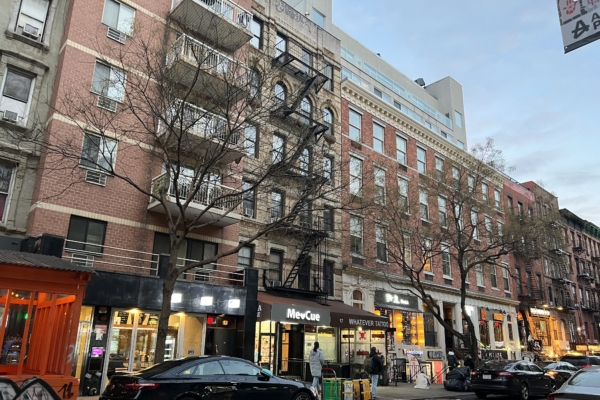
After nightfall, the East Village is illuminated with lights that almost never go out. Restaurants, bars, and music venues line the streets, with the sound of conversations in different languages echoing from street corners. The night crowd flows through the narrow streets, making this area feel like a city that never sleeps. For today’s New Yorkers, the East Village is synonymous with nightlife, a place where gatherings, dining, and cultural consumption are concentrated. However, behind this seemingly bustling and immediate prosperity lies a city history that has accumulated over a long period of time.
Before becoming the “city that never sleeps,” the East Village was once a swamp, a middle-class residential area, and a space where different generations of immigrants settled, lived, and created. Germans, Jews, Puerto Ricans, and Eastern European immigrants have left their marks in terms of language, beliefs, theaters, dining tables, and public life. The lively street scenes in the neighborhood today did not appear out of thin air but were built upon the foundation of multicultural integration, coexistence, and transformation over more than two centuries. Looking back at the still operating buildings, venues, and daily life, the night in the East Village is not just an extension of entertainment but also a continuously evolving urban cultural history.
Walking through the East Village today, cafes, bars, and stylish storefronts stand side by side. The street is filled with a mix of languages, creating a fast-paced rhythm. It is hard to imagine that this seemingly mature and trendy neighborhood was originally a low-lying, damp swamp. In the 17th century, when Manhattan had not yet taken shape, this area still belonged to the city’s periphery.
The land where St. Mark’s Church in-the-Bowery stands today originally belonged to the “Bowery Farm” during the Dutch colonial period and was the family farm of Peter Stuyvesant, the last governor of New Amsterdam. After his death in 1672, he was buried here, and he still rests in the underground crypt of St. Mark’s Church, built in 1799.
St. Mark’s Church is one of the oldest churches still in use in New York. Unlike the towering, elaborate, and authoritative cathedrals in European cities, St. Mark’s Church’s architecture is restrained and introverted. The main structure is predominantly red brick, with modest proportions, simple lines, close to the scale of the street, and not intentionally distanced from the surrounding community. The late 19th-century renovations and additions incorporated Gothic Revival elements such as pointed arch windows and detailed ornaments, maintaining a sense of dignity in simplicity without being grandiose.
In the mid-19th century, the East Village saw the first wave of large-scale immigration. Following the failed German Revolution of 1848, many intellectuals, craftsmen, and middle-class families chose to leave Europe and seek a new beginning in the United States. They established a community known as “Little Germany” (Klein Deutschland), with a population once exceeding 250,000.
During the heyday of Little Germany, the East Village was almost self-sufficient. There were German-language newspapers, schools, churches, singing societies (Gesangverein), gymnastic clubs (Turnverein), and various associations and clubs. German was spoken on the streets, shop signs were written in Gothic fonts, and beer gardens and cafes became important places for socializing and public discussions. Even today, if you look up and examine the facades of some buildings on St. Mark’s Square, you can still see historical traces inscribed in German.
McSorley’s Old Ale House, a tavern opened in 1854, bears witness to the history of Little Germany. Founded by John McSorley, an Irish immigrant, the tavern brought the European tavern tradition to America: standing while drinking, sharing long tables, and emphasizing conversation over the menu. The German community’s emphasis on beer quality and daily consumption also deeply influenced tavern culture. To this day, they only serve two types of ale, Light Ale and Dark Ale, without offering cocktails, wine, or other liquor options. The walls are adorned with memorabilia and uniforms of veterans from different eras who were regular customers or donors.
However, the fate of Little Germany took a sharp turn for the worse in the early 20th century. In June 1904, the city was shocked by the sinking of the General Slocum passenger ship. On that day, a steamboat carrying German church women and children from the East Village for their annual outing caught fire and sank in the East River, resulting in the deaths of over a thousand people. This disaster not only became one of the most severe civilian accidents in New York’s history but also inflicted irreparable psychological and demographic trauma on the German community.
After the accident, the previously tight-knit German community rapidly disintegrated. Many surviving families chose to move away from this area, filled with memories of grief, and resettled in Yorkville or other parts of Brooklyn. In just over a decade, Little Germany transformed from a vibrant immigrant hub into a neighborhood experiencing rapid population loss, with its cultural influence gradually replaced by subsequent Jewish and other immigrant communities.
New York’s early 19th-century urban planning reshaped the East Village’s appearance. In 1811, the Manhattan grid street system was established, laying out streets and avenues rationally. In 1825, the Erie Canal opened for navigation, propelling New York to become America’s most important shipping and trade hub. The city rapidly expanded northward, and the previously desolate East Village began to develop into residential neighborhoods for the middle class, officially becoming part of urban life.
The Hamilton-Holly House at 4 St. Mark’s Place represents the rise of the urban middle class. This Federal-style row house was completed in 1831, belonging to a relatively spacious and decent type of urban housing at that time. In 1833, it was purchased by the son of founding father Alexander Hamilton and subsequently became the late-life residence of (his widow) Eliza Hamilton, with their daughter Eliza Hamilton Holly also living here. These row houses are important because they embody the ideal of family life in 19th-century New York—emphasizing private space, street order, and stable communities, laying the foundation for immigrant and middle-class lifestyle patterns.
If the Hamilton-Holly House represents the rise of the urban middle class, then the Merchant’s House Museum, completed in 1845, fully preserves the daily life of an upper-class family in the 19th century. This residence is not a memorial building but an almost unchanged “real home” that was once the living space of the Tredwell family. From the living room and bedroom to the servant spaces, it finely presents the lifestyle details of that time. This only interior with its original layout and family heirlooms not only epitomizes the development of American urban housing but also bears witness to several generations living, rising and falling, and dispersing here. However, this old house is in need of rescue as a threat looms from a developer planning to build nearby.
In the early 20th century, a large number of Jewish immigrants from Eastern Europe arrived in New York, settling not only in the Lower East Side but gradually extending north to the present-day East Village. As the population increased and the community stabilized, Second Avenue quickly became the epicenter of Jewish culture. Theaters sprang up one after another, Yiddish-language plays, music, and comedies flourished, forming a cultural corridor known as the “Yiddish Rialto.”
The East Village also became a landing spot for Ukrainian immigrants, who formed “Ukrainian Village” around Second Avenue and East 6th Street. The Ukrainian Museum in the area showcases the art and folklore of Eastern European immigrants. The St. George Ukrainian Catholic Church on East 7th Street, providing religious services and serving as a community center, not only offers language, celebrations, and communal assistance but also houses the popular restaurant Veselka, founded in 1954. Open 24 hours a day, Veselka is one of the most representative Ukrainian diners in the East Village, serving traditional Ukrainian dishes such as varenyky, borscht, and home-style cuisine, becoming a city table shared by Ukrainian immigrant families, artists, and night owls.
After World War II, with the outsourcing of manufacturing and the transformation of the city’s economic structure, New York experienced a period of decline, and the social landscape of the East Village changed once again. Puerto Rican immigrants settled here, bringing new languages, rhythms, and lifestyles. Poetry, music, and street culture gradually became important forms of community expression. As an important center of Puerto Rican and Latin American culture, the Nuyorican Poets Cafe is famous for its spoken word poetry and improvisational performances, allowing language and creativity to flow continuously in the neighborhood, making the East Village one of the few urban spaces capable of carrying memories of different immigrant cultures simultaneously.
At different times, Tompkins Square Park has served as a “public living room” for various ethnic groups, embodying radically different social roles. At the end of the 19th century, it was a space for immigrant families to rest and celebrate; in the early 20th century, as the surrounding population grew denser, the park became an important venue for labor gatherings and public discussions; and after World War II, as the city’s economy transformed and wealth disparities widened, it also became a place where social tensions were most likely to surface.
One of the most representative events took place in 1988. That year, a large-scale confrontation erupted in Tompkins Square Park regarding security and the right to use public space, becoming a highly symbolic moment in the East Village’s urban transformation process. This conflict not only reflected policing and governance issues but also highlighted conflicts between longtime residents, new arrivals, and different social strata, making the park a magnifying glass for urban change.
Today, the East Village has undoubtedly become one of the most expensive and highly regarded neighborhoods in New York. Beneath its constantly updated appearance, the East Village still retains layers of history. Its story is not a linear development but rather a city history with repeated writing—from a swamp to a middle-class community, from immigrant settlement to a cultural experimentation ground, and to today’s high-priced district. It is this accumulation and succession that make the East Village one of the most genuine and thought-provoking neighborhoods in New York.