
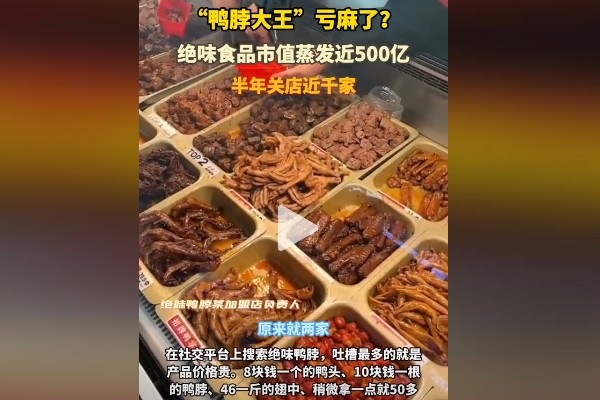
Juewei Food, known for its duck neck products that were once wildly popular across China, is now facing an unprecedented crisis. According to the company’s recent performance forecast, Juewei Food is expected to incur losses of 160 to 220 million yuan in 2025. This marks the first annual loss since the company went public and signifies a substantial decline in its performance.
Juewei Food, officially known as Juewei Food Co., Ltd., is a well-known Chinese retail giant in the braised food industry. As a publicly listed company, it has long been at the forefront in terms of store numbers and market value, being referred to as one of the “Big Three” in the braised food industry alongside Zhouheiya and Huangshanghuang.
A report by Jiemian News mentioned that attempts to reach Juewei Food’s office for comments on January 30 were unsuccessful, with no response received by the time of publication.
Last year, Juewei Food attracted attention due to financial issues, including the omission of “700 million yuan in franchise store renovation costs” from accounting records, leading regulatory authorities to issue a “risk alert” and prefix the company’s stock symbol with “ST,” indicating abnormal business or financial operations.
Following the “ST” designation, Juewei Food’s daily stock price fluctuations were limited to 5%, causing many institutional investors to liquidate their positions. The combination of financial turmoil and performance losses has severely damaged the company’s reputation in the capital market.
In its financial forecast, Juewei Food attributed its poor performance to industry pressures, underutilized production capacity, various factors, and investment failures.
However, looking at its core business of braised food retail, the market widely believes that Juewei Food’s deeper challenge lies in its extensive franchise expansion model facing backlash, while its operational capabilities have yet to effectively adapt. This has led the company to be the first of the “Big Three” to experience a decline in performance.
With its rapid expansion through franchising in earlier years, Juewei became the brand with the most store locations among the “Big Three.”
According to information from Juewei Franchise Center, the expected investment for its three types of stores ranges from 60,000 to 80,000 yuan, 80,000 to 150,000 yuan, and 150,000 to 250,000 yuan, respectively.
Since the mid-2024 report, Juewei no longer discloses store numbers in its financial reports, signaling to outsiders a contraction in store presence. Narrow-door data shows that Juewei currently has approximately 10,713 stores nationwide, over 4,000 fewer than revealed in the mid-2024 report released a year and a half ago. Juewei did not provide further explanations for the closed stores in its financial reports.
The period from 2024 to 2025 proved to be a critical test for the braised food industry, as both Zhouheiya and Huangshanghuang continued to close stores during these years.
By mid-2025, Zhouheiya’s store count plummeted to 2,864, with nearly 600 store closures in the first half of 2025. However, according to Zhouheiya’s financial report, these closures mainly involved inefficient stores, optimizing the store structure. Huangshanghuang closed over 700 stores in the first half of 2025, primarily concentrated in non-core markets.
The dense distribution of Juewei stores resulted in a continual decrease in profitability per store.
A franchisee in Jiangsu province revealed that amidst intensified competition in takeout and weak consumer spending, their store generates around 3,000 yuan in daily revenue with a 30% gross profit margin, yielding an annual net profit of less than 70,000 yuan. The declining profitability of individual stores was also a contributing factor to the closures of Zhouheiya and Huangshanghuang outlets.
During the industry’s rapid growth phase, headquarters encouraged franchisees to expand and maintain confidence. However, with the rapid increase in alternative braised food options such as Ziranbaiwei Chicken, Jiujuya, and numerous community-based braised food stores and instant packaged products, the competitive environment has significantly deteriorated.
Compared to tea brands like Xicha and Bawang Chaji, which have made significant strides in digital marketing, collaboration products, and supply chain management, Juewei’s management mindset remains focused on basic aspects like slogans and inventory checks.
Juewei’s new product launches in recent years have failed to resonate with consumers, and efforts in online and offline traffic acquisition and channel expansion have not shown notable improvement.
Alongside declining performance is the growing criticism on social media regarding the pricing of Juewei’s signature duck neck product, which has exceeded 60 yuan per catty, while similar offerings like Ziranbaiwei Chicken or community-based braised food shops remain within the 35-45 yuan range. In today’s more rational consumption climate, high prices and a lack of innovation are causing Juewei to gradually lose its cost-effectiveness advantage on the dining table.