
In the year of 2026, about 2 million Chinese Communist military troops had entered North Korea for battle. After suffering heavy losses, they only dared to claim to have fought on par with 300,000 American and UN troops externally, while proclaiming victory internally. From the initial arrogant surprise attacks to being pinned down at the 38th parallel, repeatedly stunned, the battles of the Korean War continue to hold significance today.
The Chinese Communist army’s human wave tactics struggled to break the deadlock in the Korean War—how they were left dumbfounded on the Korean battlefield (Part Nineteen).
The new UN Supreme Commander Clark was more cautious than his predecessor Ridgway, rejecting the large-scale attack plan of the US 8th Army repeatedly.
In September 1952, the Panmunjom negotiations faced serious disagreements over prisoner repatriation. In late September, the Chinese Communist forces planned an attack on White Horse Mountain but failed in their October operation. On October 8th, the truce negotiations were halted. Clark approved the “Operation Showdown” plan.
The UN’s objective was a ridge north of Kŭmhwa, forming a V-shape when viewed from the air or map. Hill 598 was situated at the tip of the V-shape, with Pike’s Peak extending northwest from Hill 598; the ridge extending northeast from Hill 598 linked two peaks, one being Jane Russell and the other Sandy Ridge, across from which was Sniper Ridge. The battle was named the Triangle Hill Battle by the US according to the terrain features, while the Chinese Communists later called it the Battle of Shangganling but now acknowledge that the battlefield was not actually located at Shangganling.
On October 5th, a staff officer of the 1st Division of the South Korean Army defected, providing the Chinese Communist forces with the detailed operational plan of “Operation Showdown”, which was not taken seriously.
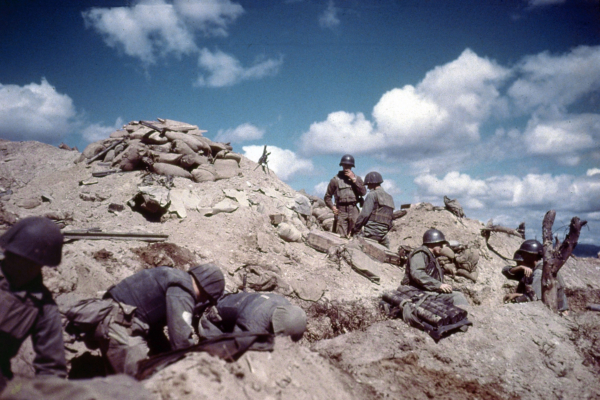
On the morning of October 14th, after two days of air strikes, the UN forces’ artillery launched a fierce bombardment on the 30-kilometer defensive area of the Chinese Communist forces, clearing the vegetation on the mountain, destroying most defense works, and disrupting the communication lines of the Chinese Communist forces.
The 31st Infantry Regiment of the US Army first donned bulletproof vests, but the 1st and 3rd battalions still suffered heavy casualties in the initial attack, with 96 killed and 337 wounded, making it the deadliest day. Under the superior firepower of the UN forces, the Chinese Communist forces’ defenses began to crumble, with the US making partial progress by evening.
In the afternoon of that day, the 2nd Battalion of the 32nd Infantry Regiment of the South Korean forces occupied Sniper Ridge, leaving only 20 Chinese Communist troops retreating to a tunnel.
In the darkness of night, the Chinese Communist forces launched a fierce counterattack, charging up the mountain despite the UN forces’ artillery blockade; flares illuminated the sky as both sides engaged in close-quarters combat. Running out of ammunition, the UN forces were forced to abandon the captured positions.
On October 15th, American and South Korean forces regrouped for another attack. The US’s two battalions met with minimal resistance and took Hill 598 and Sandy Ridge, but faced obstructions when advancing towards Pike’s Peak and Russell Mountain. The South Korean forces retook Sniper Ridge in the afternoon but were compelled to retreat under Chinese Communist counterattacks.
On October 16th, the US forces seized Russell Mountain, repelling the Chinese Communist counterattack. The South Korean forces took control of Sniper Ridge for the third time and held their ground.
Initially, the Chinese 15th Army Commander Qin Jiwei failed to react promptly to the UN forces’ offensive. Under the heavy UN firepower, the Chinese Communist forces suffered significant casualties.
At dawn on October 20th, the Chinese Communist counterattacks all failed, and the remaining forces were forced to retreat to the tunnel, with the 45th division suffering extensive losses. On the night of October 23rd, the Chinese Communist forces once again failed to retake Hill 598.
The UN forces firmly controlled most of the Triangle Hill area, trapping the remaining Chinese Communist forces in the tunnel. The American artillery bombarded the tunnel entrance, using flamethrowers, bulldozers to seal the tunnel, and artillery to block the Chinese Communist supply routes. On October 26th, the South Korean forces blew up parts of the Chinese Communist tunnel. Forced to operate at night under enemy fire, the Chinese Communist forces struggled to smuggle in limited troops and supplies.
After 10 days of battles, the Chinese Communist forces suffered over 4,000 casualties. The Chinese Communist headquarters ordered that they must seize Triangle Hill at all costs. After Peng Dehuai returned to China in June 1952, Deng Hua assumed the position of acting commander of the Chinese Communist forces in Korea. Deng Hua’s orders seemed implausible to normal individuals, but he saw this as an excellent opportunity to engage in a war of attrition with the UN forces. His orders meant that the Chinese Communist forces were willing to suffer several times the casualties of the enemy to achieve partial enemy losses.
Deng Hua aimed to incur as many casualties as possible among US troops to elevate his status, enhance propaganda, with little concern for more casualties on their side. Even 70 years later, the lives of soldiers and civilians remain insignificant to the top Chinese Communist leadership and officers.
On October 25th, the 31st Regiment of the South Korean 2nd Infantry Division took over the US positions in the Triangle Hill area, and the 17th Regiment continued to defend Sniper Ridge. This disrupted the Chinese Communist forces’ aspiration to engage in a war of attrition with the US.
The Chinese command ordered the 12th Army to be transferred to the 15th Army, all under Qin Jiwei’s command. The focus of the counterattack was centered on Triangle Hill previously occupied by the US forces, with the South Korean capture of Sniper Ridge designated as a secondary objective. However, by October 29th, the South Korean forces had been holding their ground at Triangle Hill, and the Chinese Communist forces suffered heavy losses.
At noon on October 30th, the Chinese Communist forces concentrated more artillery fire on Triangle Hill, marking their largest artillery barrage during the Korean War. At midnight, ten Chinese infantry companies implemented human wave tactics, rushing up the hilltop, causing three South Korean companies to retreat.
On November 1st, the Chinese Communist forces launched another attack on Russell Mountain, resulting in the South Korean positions being overrun. Over the next five days, the South Korean forces continued to counterattack but in vain. The Chinese Communist forces sustained severe casualties and kept reinforcing. The UN forces ordered a halt to the attack on Triangle Hill to prevent further loss of life.
On November 11th, the Chinese Communist forces fiercely attacked Sniper Ridge, forcing the 1st Battalion of the South Korean 32nd Regiment to retreat. At dawn on November 12th, the South Korean forces launched a counteroffensive, reclaiming two-thirds of Sniper Ridge with significant casualties inflicted on the Chinese Communist forces. The following battles turned into a stalemate until November 25th, gradually calming down the fighting on Sniper Ridge.
To avoid further casualties, UN Commander Clark ordered a cessation of operations on November 28th, ending the Triangle Hill battle. On December 2nd, the Chinese Communist forces once again attacked Sniper Ridge, engaging in a protracted conflict with the South Korean forces, but no changes occurred in the frontlines.
The Triangle Hill battle was the largest and deadliest battle of the Korean War in 1952.
After 42 days of intense fighting, 365 US soldiers were killed, 1,174 wounded, and 1 captured; the South Korean forces lost 1,906 soldiers, had 3,496 wounded, and 97 missing.
The UN estimated about 19,000 casualties among the Chinese Communist forces, while the latter claimed 3,838 dead and 6,691 wounded.
The Chinese Communist forces claimed that the UN forces suffered 25,498 casualties, exaggerating their figures to match or exceed the actual number of UN troops engaged in combat.
Though the Chinese Communist forces concentrated the largest number of artillery, it was only half of the US forces’ artillery. The US also held air superiority, with over 2,200 aircraft sorties launched, causing significantly more losses for the Chinese Communist forces in the war of attrition.
Despite the US soldiers wearing bulletproof vests for the first time in this battle, the Chinese Communist forces were not equipped with helmets. Helmets had been widely used since World War I. The Chinese Communists once falsely claimed that manufacturing helmets was difficult when the actual reason was their disregard for the soldiers’ lives. In the 1979 Sino-Vietnamese War, the Chinese Communist soldiers still did not wear helmets.
After the US forces captured Triangle Hill, the South Korean forces took over the defense, while the Chinese Communist forces were willing to sacrifice multiple casualties to only cause partial losses to the South Korean forces.
UN Commander Clark avoided entangling the South Korean forces in a war of attrition, ordering a halt to the attack, unwilling to sacrifice soldiers’ lives needlessly for the sake of capturing a certain hill. With US assistance in training, the South Korean forces’ combat capability significantly improved, independently completing the fight for Sniper Ridge, garnering more confidence, yet the US advisors remained dissatisfied.
Despite the heavy losses suffered by the Chinese Communist forces, they were indifferent to utilizing disproportionate attrition warfare to combat the UN forces, acknowledging their weak combat strength and the inferior tactical skills of their commanders.
Despite massive losses, the Chinese 15th Army Commander Qin Jiwei continued to rise through the ranks and eventually became the Minister of National Defense of the Chinese Communist regime.
In 1956, the Chinese Communist propaganda film “Shangganling” was released, which misled a large number of people. In 2024, the Chinese Communist regime produced a TV series “Shangganling,” continuing to deceive another generation of Chinese people.
The Chinese Communists fabricated stories like Huang Jiguang using his body to block enemy bunkers’ firing holes, which contradicted basic common sense, and Qiu Shaoyun’s false account of immolating himself with an incendiary bomb while in hiding, preferring to be burned alive; these deceptions have since been exposed one by one. The Chinese Communist forces continue to employ similar methods to fabricate propaganda, such as vigorously concealing the truth about the 2020 Galwan Valley clash between China and India.
On June 17, 2019, the Chinese Ministry of National Defense website posted an article titled “Why is the Battle of Shangganling so Famous?” admitting that the location of the Battle of Shangganling was not at Shangganling but mentioned that a nearby small village destroyed a year earlier was called Shangganling, where a party committee expanded meeting was held to discuss the fifth battle. This implies the Chinese Communists tacitly acknowledged the UN forces’ speculation, conflating the 1951 Battles of Heartbreak Ridge and the 1952 Battle of Triangle Hill, concocting the Battle of Shangganling to cover up the truth.
The article stated that the Chinese Communist forces 15th and 12th armies, consisting of over 4,000 troops, with casualties reaching 11,529, a casualty rate over 20%; simultaneously, falsely claiming that the total force of the UN forces was over 60,000 troops, with a casualty rate over 40%.
These figures lack logical consistency, and the Chinese Ministry of National Defense continues to brazenly lie. However, the text describes, “the tunnels were blasted, constantly crumbling… medical supplies were scarce and many wounded could not be treated, festering and ulcerating, even sacrificing themselves in the tunnel”; yet it affirms that the Battle of Shangganling showcased “military command artistry.”
On September 9, 2019, the “Communist Party of China News” published an article titled “The Battle of Shangganling: Defeat the Enemy Before the Negotiation Table.” The text describes the tunnel’s “harsh environment with a lack of medicine and medical care, causing many wounded soldiers’ wounds to fester and ulcerate, even sacrifices in the tunnel”; yet it claims “our mood is always pleasant.” The Chinese soldiers were callously left to fend for themselves within the tunnels, but the Chinese Communists depicted it as a “pleasant” atmosphere, underlining their lack of humanity.
On October 29, 2020, the “Communist Party of China News” released an article entitled “The Unknown Battle of Shangganling.” The text describes, “Qin Jiwei’s guard company reinforced the first tunnel, over 120 individuals, passed through two layers of fixed artillery blockades, leaving only a lieutenant and 25 soldiers”; yet the article hailed the Chinese “Fifteenth Army’s fame within one battle.”
This is how the original 15th Army Commander of the Chinese Communists “rose to fame.” The text also illustrates a conversation between the 45th Division Commander Cui Jiangong and Qin Jiwei, where Cui Jiangong remarks, “General, my unit is nearly depleted, some companies only have a few soldiers left. How can we fight without troops?” Qin Jiwei falls silent for a moment before replying, “Old Cui, if the positions are lost, it’s not good to see me when you return.” Stunned, Cui Jiangong holds the phone, replying, “That’s true.”
This exchange vividly reflects the lack of military professionalism among senior Chinese Communist military leaders, who recklessly risk soldiers’ lives, primarily concerned with their own promotions. Today, the Chinese Communist armed forces’ command structure remains the same, rife with corruption and officers unwilling to engage in combat despite their fierce rhetoric.
(To be continued)