
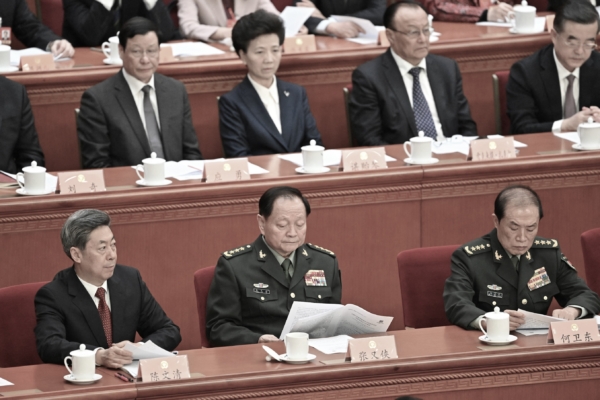
In recent developments in the Chinese Communist Party (CCP), Vice Chairman of the Central Military Commission Zhang Youxia and Commission Member Liu Zhenli were officially removed from their positions. In response, the CCP Central Political Bureau convened a meeting on January 30th, emphasizing the importance of “upholding the centralized and unified leadership of the party central committee.” Interestingly, this meeting saw the unusual absence of military representatives, raising concerns among experts in Taiwan about the ramifications of the CCP’s high-level crackdown and its impact on the situation in the Taiwan Strait.
According to Xinhua News Agency, on January 30th, CCP leader Xi Jinping presided over a Central Political Bureau meeting to review reports on the work of various party organs, including the Standing Committee of the National People’s Congress, the State Council, the Chinese People’s Political Consultative Conference, the Supreme People’s Court, the Supreme People’s Procuratorate party group, and the central secretariat for the year 2025, reiterating the importance of “upholding the centralized and unified leadership of the Party.”
During the broadcast of the Central Political Bureau meeting on CCTV’s evening news, no footage from the meeting was disclosed, with only the news anchor reading from a script.
On January 24th, the Chinese Ministry of National Defense announced that CCP Central Political Bureau member and Vice Chairman of the Central Military Commission Zhang Youxia was under investigation. Together with the previous announcement of the removal from office of Political Bureau member and Vice Chairman of the Military Commission He Weidong last year, the absence of both military representatives from the 20th Political Bureau at the recent meeting raised eyebrows.
Furthermore, currently serving Political Bureau member and former Xinjiang Secretary Ma Xingrui has been noticeably absent from major events recently, with rumors suggesting he may have also faced troubles and consequently skipped the Political Bureau meeting.
Commenting on the situation, Lee Lin, a current affairs commentator, pointed out that although Xi Jinping holds the position of Chairman of the Military Commission, he is essentially a civilian without a military rank. The absence of all military representatives from the Political Bureau meeting signals a significant disruption within the CCP, potentially leading to biased decision-making in the future, particularly concerning military-related matters.
When the Chinese Ministry of National Defense spokesperson announced the investigations into Zhang Youxia and Liu Zhenli on January 24th, no specific charges or allegations were disclosed. However, a subsequent editorial in a CCP military newspaper accused the two of “seriously undermining the principle of the chairman’s responsibility system of the Military Commission” and “seriously compromising the party’s absolute leadership over the military and threatening the party’s governance foundation due to political and corruption issues.”
Alessandro Arduino, a Chinese security expert at the UK think tank the Royal United Services Institute (RUSI), remarked that Zhang Youxia, previously seen as an untouchable figure, being ousted indicates that “political loyalty is valued more highly than military readiness.” For Xi Jinping, “political disloyalty is a major offense within the CCP.”
In light of these developments, the Institute of International Relations at Taiwan Political University hosted a seminar on “Shocks in the Higher CCP Military Echelons and the Impact on Cross-Strait Relations” where experts and scholars analyzed the implications of the recent military leadership shake-up in China and its implications for Taiwan.
Kou Jianwen, a professor at the Political Science Department and the Institute of East Asian Studies at the Political University, opined that the ongoing purge within the CCP’s military hierarchy has created vacancies in positions of senior generals, likely to be filled by younger officers, some born in the late 1960s or even the 1970s. This cleansing has led to instability, uncertainty, and confusion within the military ranks, raising concerns among aspiring officers about quick promotions and potential sudden demotions, instilling fear and perplexity across the armed forces.
He further speculated that the upheaval at the top echelons would breed discontent within both the military and the CCP leadership, potentially undermining Xi Jinping’s authority. By eliminating long-standing allies, Xi risks alienating himself and growing isolated, akin to an ancient emperor secluded in his palace, detached from the daily struggles of the populace.
Kou Jianwen suggested that the upcoming 21st CCP Congress might usher in a weaker leadership, prompting Xi Jinping to preemptively remove highly respected figures from the military, reminiscent of Ming dynasty Emperor Zhu Yuanzhang’s purges to secure his successor’s succession smoothly.
Ding Shufan, a retired professor at the Institute of East Asian Studies at Political University, emphasized that after Xi Jinping’s crackdown on senior military officials, managing relationships with high-ranking officers would pose a challenge. Establishing trust with them and implementing the chairman’s responsibility system within the Military Commission would be problematic. The anti-corruption campaign has fostered a culture of mutual denunciations, fostering suspicion and critique when proposing new ideas or actions, leading many officials to opt for a passive stance for self-preservation.
Ma Zhenkun, a professor at the Institute of Military Affairs at the National Defense University, believed that Xi Jinping’s atypical handling of the removal of Zhang Youxia signals a deep awareness of the potential backlash. Xi’s political motivation for cleaning house may stem from viewing Zhang Youxia’s senior military and “Red Second Generation” status as a challenge to his bid for reelection at the upcoming 21st CCP Congress.
Regarding the impact of Zhang Youxia’s fall on the situation in the Taiwan Strait, Ma Zhenkun highlighted that after Zhang’s removal, Beijing’s military intentions towards Taiwan have entered a period of uncertainty. While Xi makes the final decisions, he still relies on credible military advisers for suggestions. With uncertainties in appointees, Beijing’s military stance vis-a-vis Taiwan has become unpredictable, posing dangers to Taiwan’s security as it enters a precarious phase.
Kou Jianwen further analyzed that Xi Jinping’s recent extensive purges of senior military officials in the past two to three years might temporarily reduce the likelihood of the CCP engaging in a major war. The delayed appointments to the Central Military Commission and the need for additional personnel in the Joint Operations Command Center are contributing factors.
In a different perspective, Jie Zhong, an adjunct assistant professor at the Institute of International Affairs and Strategic Studies at Tamkang University, believed that the likelihood of Chinese military aggression towards Taiwan in 2027 is not significantly higher. Beijing still prioritizes peaceful reunification, with no set timeline for unification by force. Decision-making primarily rests with the CCP’s Taiwan Work Leadership Group, making Zhang Youxia’s removal less directly impactful in this regard.
Jie Zhong stressed the importance of guarding against unintended crisis escalation in cross-strait relations due to political developments or military incidents. With the recent sweep of top CCP military leadership, officers may hesitate to speak their minds honestly, increasing the risk of miscalculation in Beijing; this might push Beijing into making more provocative moves to satisfy national sentiment, complicating crisis management efforts significantly.