
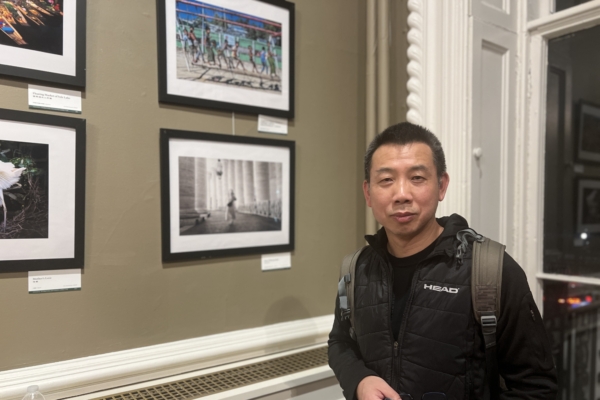
Artworks are said to reflect the inner world of their creators. Two years ago in Vatican City, Chinese-American photographer Wang Tongsheng from Philadelphia was struck by the contrast between the magnificent grandeur of the cathedral and the tiny humans walking amidst it. He patiently waited until a nun kicked up her skirts and gracefully walked into the play of light and shadow cast by the towering columns, feeling that the moment was right.
This black and white photograph titled “Walking in the Light” was thus born. It captures the beauty of the architecture’s symmetry, the devoutness of people before God, and the hope brought by faith. Wang Tongsheng’s work was selected for the fifth New Tang Dynasty International Photography Contest finalists exhibition.
“The building was particularly grand and exquisite, with a strong sense of rhythm that deeply moved me,” recalls Wang Tongsheng. “Then I saw the nun and her expression. I like this photo because the lighting is well-balanced, not overexposed or overly dark. Later, I converted it to black and white and adjusted the brightness and contrast.”
Although Wang Tongsheng works in IT, he has had a passion for photography since childhood. With age and a deeper understanding of life, he has realized that what truly touches people in photography is “humanity.”
“I used to love landscape photos, but now I believe that nature without humans is meaningless,” he says, so he strongly agrees with the traditional aesthetic values advocated by the New Tang Dynasty contest.
The New Tang Dynasty Photography Contest emphasizes traditional beauty that showcases brightness, kindness, positivity, and naturalness. Wang Tongsheng believes that “the level of work in this contest is very high.”
“I am pleased to see several pieces that are very good, making people pause to look slowly, with the authors having their own thoughts and emotions, leaving it to the viewers to ponder,” he says. “Some works are flawless in terms of technique, perspective, and lighting.”
Wang Tongsheng believes that the beauty of humanity and the expression of human nature are things that modern artificial intelligence (AI) cannot replace.
“Human beings always have the desire and need to record beautiful moments—phones are always at hand, whether capturing moments worth remembering, moments of joy, or heartbreak, they all document human emotions,” he says. “In these aspects, I think AI cannot completely replace humans. It can create impeccable photos, but human photos are not always perfect. Look at the photos of those photography masters, each has imperfections…but they are the master’s works, representing many crucial historical moments that AI simply cannot replace.”
For example, Wang Tongsheng says that his work “Walking in the Light” embodies feelings of light, beauty, and faith, aspects that AI cannot portray.