
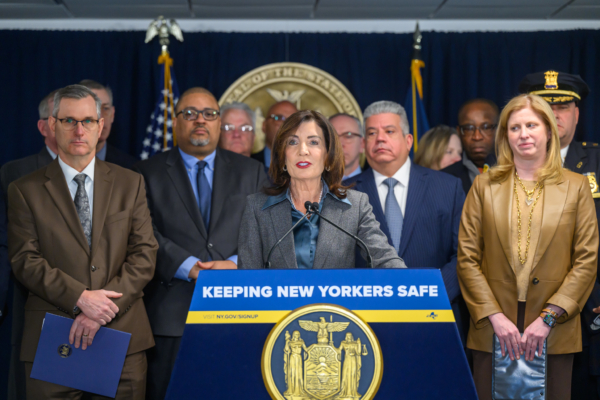
On January 31, 2026, New York Governor Ho Chu announced a legislative proposal to ban local law enforcement agencies from collaborating with the U.S. Immigration and Customs Enforcement (ICE) in civil immigration enforcement. The proposal aims to abolish the federal 287(g) agreements, prohibit the use of local police forces, detention facilities, and resources for large-scale immigration sweeps, and require judicial warrants for federal agents to enter sensitive locations such as homes, schools, and hospitals. The legislation still permits local police to assist federal law enforcement in combating serious crimes.
Governor Ho Chu, speaking at a press conference attended by several local prosecutors and police chiefs, emphasized the core principle of the legislative proposal as “local police focusing on local crimes.” She highlighted that local law enforcement officers should not be utilized to carry out federal civil immigration tasks to avoid undermining community trust in the police, which could impact public safety.
Ho Chu pointed out that current federal laws allow ICE to enter into cooperation agreements with local governments to use local police forces, detention facilities, and resources for immigration enforcement. She argued that such agreements have been abused in some areas, leading to local police being tasked with immigration detention and enforcement duties unrelated to their primary responsibilities.
The governor stressed that the proposal would not alter New York State’s stance on cooperating with the federal government in criminal cases. She stated that individuals who illegally entered the country and are involved in violence or other serious crimes will still be apprehended, prosecuted, and deported in collaboration with federal agencies after serving their sentences. Since taking office, New York has transferred approximately 1,400 convicted felons to ICE upon completion of their prison terms.
Additionally, Ho Chu announced that schools, childcare centers, religious institutions, and hospitals would be designated as off-limits to ICE civil immigration enforcement activities unless there is a judicial warrant. In light of recent incidents where federal agents entered private residences without warrants, private homes will also be included in the protection list by the state government.
Furthermore, the state government plans to restrict ICE’s use of local detention facilities and county jails to prevent these institutions from being utilized in large-scale immigration detention operations. Ho Chu highlighted that local jails should prioritize serving state and local justice systems rather than becoming infrastructure for federal immigration enforcement.
New York City Police Commissioner Jessica Tisch affirmed that the NYPD has not entered into cooperation agreements with ICE and has long abstained from civil immigration enforcement. She noted that crime rates in New York City have continued to decline in recent years, including decreases in shootings and serious crimes reaching historic lows.
Brendan Cox, the Police Chief of Ossining, warned that mistaking local police for immigration enforcement units might diminish residents’ willingness to report crimes, weakening law enforcement’s crime investigation capabilities.
The legislative proposal announced by Governor Ho Chu on Friday sets the stage for potential conflicts between the state government and counties currently engaged in 287(g) cooperation agreements with the federal government, notably Nassau County Executive and Republican gubernatorial candidate Bruce Blakeman.
Blakeman criticized Ho Chu’s position in a statement, accusing her of showing indifference towards community safety and crime victims. He vowed to veto related legislation if elected as governor of New York.
In response to questions about potential electoral considerations, Ho Chu denied such claims, stating that the legislative intent is not directed at specific local officials or political parties since the majority of New York’s 62 counties have not signed cooperation agreements with ICE.
When asked about her stance on dismantling ICE, Ho Chu expressed her lack of support for such a measure. She emphasized the need for effective border and immigration management mechanisms within the federal government, but stressed that ICE urgently requires reforms in its enforcement methods, training, and accountability.
Ho Chu also explained that the timing of the legislation was prompted by her recent understanding of the practical implications of immigration enforcement agreements for some local police forces and controversial incidents in other states, leading her to believe immediate action was necessary.
If the bill is approved by the state legislature, all local governments will be required to comply with the regulations outlined in the proposal, and violators may face legal action brought by the state Attorney General.