
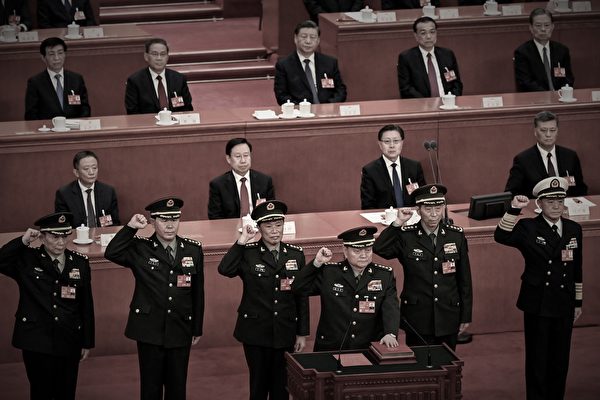
According to senior reporter Katsuji Nakazawa of Nikkei Asia, there was a widespread network of private relationships between Zhang Yuxia and several retired high-ranking Communist Party elders, which led Xi Jinping to see Zhang Yuxia as a key ally in consolidating his control over the military. However, this also became the reason for Zhang Yuxia’s eventual arrest.
Around January 20th, rumors started circulating about a potential investigation into Zhang Yuxia. On the 24th, the Chinese Ministry of Defense hastily issued a brief statement, stating that Zhang Yuxia, a member of the Central Political Bureau and Vice Chairman of the Central Military Commission, was “suspected of serious violations of discipline and law” and was under investigation. Zhang Yuxia was one of the most powerful military figures ever purged in Communist Party history.
Xi Jinping and Zhang Yuxia both belong to the “second-generation reds” and have been acquaintances for a long time. Zhang Yuxia is three years older than Xi Jinping.
Both Zhang Yuxia’s father and Xi Jinping’s father were born in Shaanxi Province and were allies. In their youth, they were comrades in the Central Northwest Bureau of the Communist Party.
“Having been a bridge of communication and a political balancer between Xi Jinping and the Party elders, Zhang Yuxia eventually found himself in a dilemma,” said Nakazawa. “He may never have imagined that he would face a fate similar to that of former Vice Chairman of the Central Military Commission, Lin Biao.”
Lin Biao, a military leader and politician who was considered Mao Zedong’s successor, died in a plane crash in Mongolia in 1971. Prior to that, he was suddenly labeled a “traitor” by Mao Zedong.
In November 2012, shortly before assuming the position of General Secretary of the Communist Party, Xi Jinping suddenly disappeared from public view and spent two weeks in the hospital.
At that time, Xi’s power base was not yet secure, and during this period, he met with the “Crown Prince Party” and other “second-generation reds,” including Zhang Yuxia. Xi Jinping sought their support for his tough anti-corruption campaign.
Nakazawa said that during his tenure as the highest-ranking military officer, Zhang Yuxia also played an important role as a bridge of communication between Xi and the Party elders. He had considerable influence within the Chinese military and was also willing to offer constructive criticism to Xi.
At the 20th National Congress of the Communist Party in October 2022, the 72-year-old Zhang Yuxia was reappointed.
According to insiders of the Communist Party, while Xi Jinping ultimately made the decision to retain Zhang Yuxia, Zhang had strong support from the Party elders and was seen as a result of a compromise between Xi and the Party elders, as well as the underlying reason behind this unusual personnel decision.
At the 20th National Congress, the Deputy Prime Minister of the Communist Party, Hu Chunhua, who was hailed as the “star of tomorrow,” was demoted from a member of the Political Bureau to an ordinary Central Committee member. At the same time, the former Party leader and General Secretary of the Communist Party, Hu Jintao, was forcefully escorted out of the venue amid much media attention.
“The Party elders are in a weak position in their struggle with Xi, and they have no choice but to tolerate these actions,” wrote Nakazawa. “However, they firmly advocate for Zhang Yuxia to act as a bridge and a political balancer between the two sides to prevent Xi from acting with complete impunity.”
In the summer and autumn of 2023, cracks began to appear in the relationship between Xi Jinping and Zhang Yuxia. At that time, Defense Minister of the Communist Party, Li Shangfu, suddenly disappeared from public view and was later removed from office.
Li Shangfu was recommended by Zhang Yuxia to be the Defense Minister and was ousted after only a few months. Shortly before Li Shangfu’s removal, two top leaders of the Rocket Force of the Communist Party, including Commander Li Yuchao, were also investigated.
At that time, some speculated that as part of Xi’s restructuring of the military, it was only a matter of time before he would fall out with Zhang Yuxia.
The Rocket Force was established in 2015 as the successor to the Second Artillery Corps, responsible for the Communist Party’s nuclear weapons and missile arsenal.
In 2024, there were signs that Zhang Yuxia could turn the tide.
Starting in November of that year, Xi’s closest aides in the military – core members of the Fujian gang – were successively purged for various reasons, and even some political forces not closely associated with Xi Jinping exposed the misconduct of these military members.
Almost simultaneously, a seemingly unfavorable 16-character political slogan began circulating within the military: “Collective leadership, democratic centralism, individual deliberation, decision by meeting.”
This slogan implies that under the system of collective leadership, democratic centralism must be implemented, important issues must be discussed individually, and decisions must be made at meetings.
The Central Military Commission mouthpiece, the “People’s Liberation Army Daily,” also published related editorial articles. Although these four principles have been enshrined in the Communist Party charter since Xi’s era began in 2012, they have seldom been mentioned over the years.
Xi Jinping and his inner circle became increasingly concerned about the unsettling actions General Zhang Yuxia might take with the support of the Party elders. Meanwhile, the covert investigation surrounding the Rocket Force scandal entered its third year.
Following this, Xi suddenly launched an investigation into Zhang Yuxia.
In the latest editorial of the “People’s Liberation Army Daily,” it was stated that Zhang Yuxia and others “seriously betrayed the trust of the Party Central Committee and the Central Military Commission, seriously trampling and undermining the Chairman’s responsibility system of the Military Commission.”
Nakazawa said, “No one knows how the fierce power struggle within the Communist Party will unfold. Now that the crucial communication channel between Xi and the Party elders has been severed, the internal dynamics of the Party and the military are far from stable.”